
San Diego’s Economy
From life sciences to military and defense, explore the interactive dashboard below and learn more about the makeup of San Diego’s economy. For additional information regarding the dashboard, please see the Traded Clusters Technical Note. Interested in more industry-specific info? Visit our Industry Profiles.
1.6M
REGIONAL JOBS (2024)
$266.9B
GROSS REGIONAL PRODUCT (2024)
$109K
MEDIAN HOUSEHOLD INCOME (2024)
3.2M+
POPULATION (2024)
Quarterly Snapshot

Every quarter, San Diego Regional EDC analyzes key economic indicators to help you understand the dynamics and outlook of the region’s economy. In this issue covering Q2 2026, EDC examines the changing employment landscape alongside shifts in the region’s built environment, culminating in economic pressures facing businesses and households.
Get San Diego’s Quarterly Economic Snapshot
delivered to your inbox →
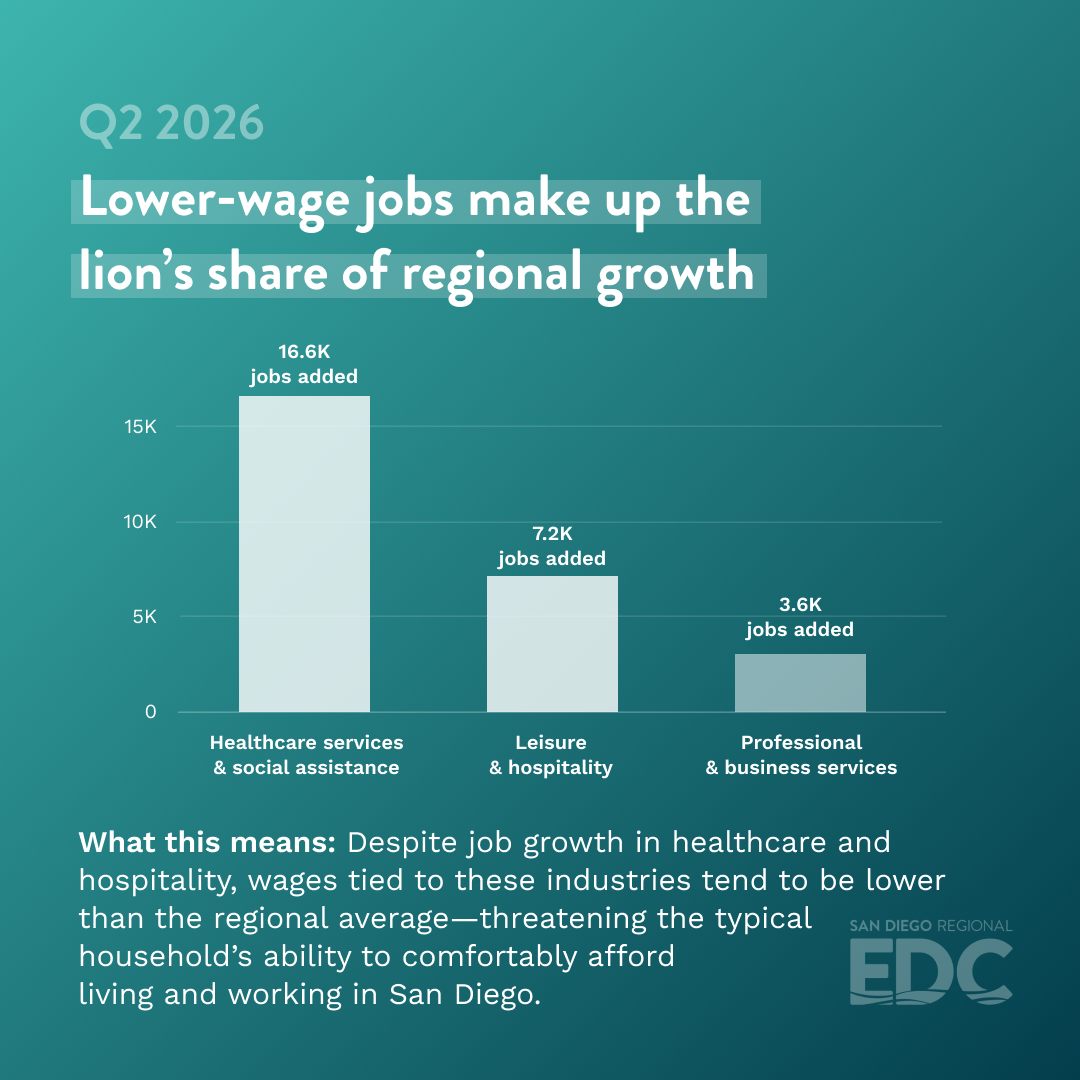
A continued pattern of uneven growth in Q2 2026 underscored the persistent tension between economic activity and how San Diegans actually work and live.
San Diego continued to add jobs in Q2 2026, but that growth remained uneven. Total non-farm employment was up 16,200 jobs from June 2025 to June 2026. However, the majority of this year-over-year growth was concentrated in healthcare and social assistance, which added 16,600 jobs, as well as leisure and hospitality which added 7,200 jobs. Though critical parts of our economy, wages tied to these jobs tend to be lower than the regional average—significantly lower for occupations in the leisure and hospitality sector, which make an estimated average of $7,000 per year below EDC’s quality wage threshold. Here, we see this limited economic growth has not yet translated to felt growth.
There were, however, signs of potential momentum in the innovation industries. After three consecutive years of decline, professional and business services added 3,600 jobs between June 2025 and June 2026. In parallel, San Diego saw continued VC movement as startups attracted roughly $1.6 billion across 30 deals in Q2 2026, spanning consumer, life sciences, and technology companies. Despite this funding influx, professional and business services employment remained 20,500 jobs below the sector’s October 2022 peak.
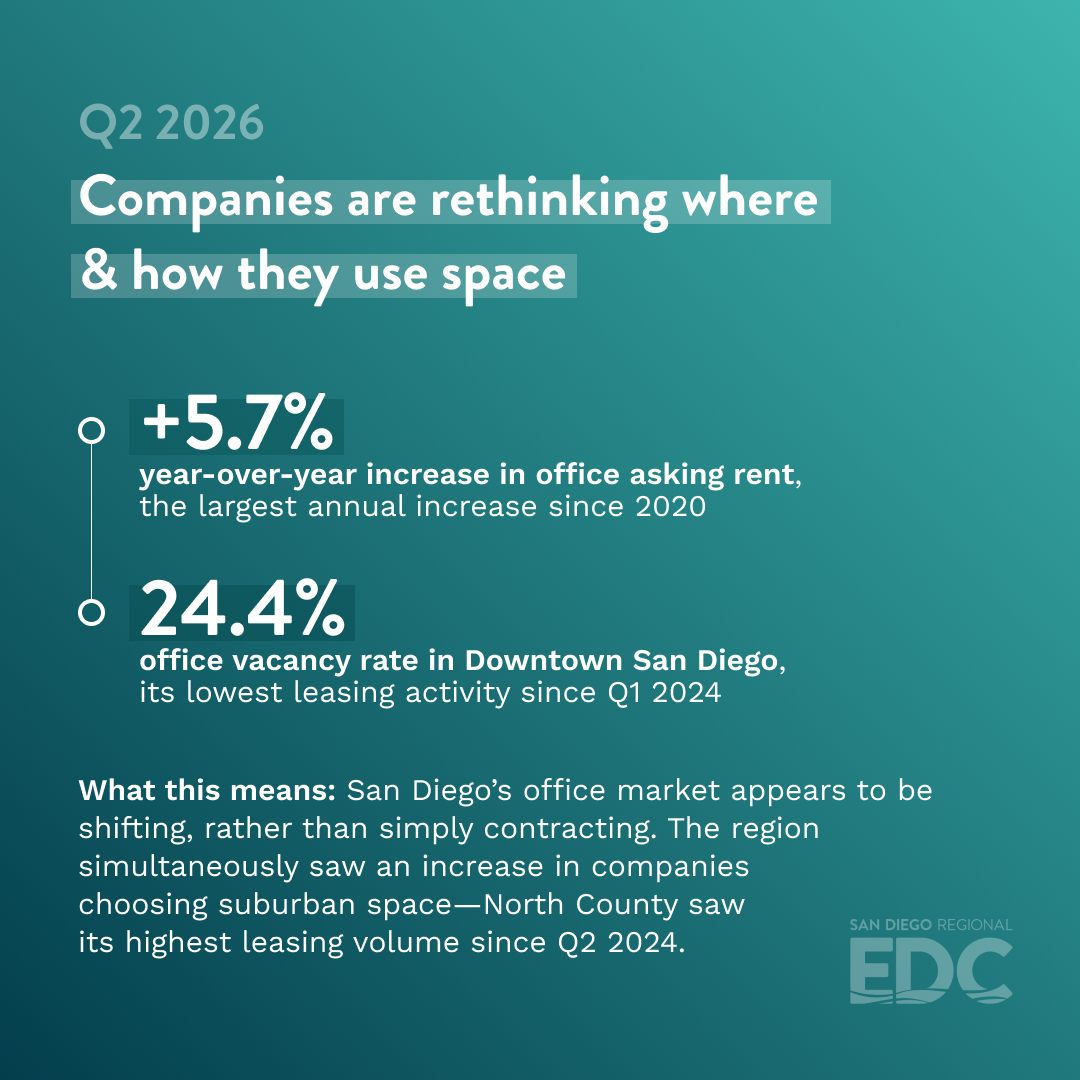
San Diego’s real estate market offered another view of this uneven economic landscape. On the commercial side, the region continued to experience negative net absorption of office space for the sixth straight quarter, meaning more space was vacated than newly occupied. Yet, notable new leases such as Industrious (26,000 square feet in Downtown), Bosch Building Technologies (25,000 square feet in Scripps Ranch), and San Diego Lighting Associates (17,000 square feet in Kearny Mesa), suggested that there were pockets of continued demand for office space. At the same time, office asking rents increased 5.7% year-over-year in Q2 2026, the largest annual increase since 2020.
Together, these trends suggest that the office market is not simply contracting but reflecting a shift in where and how businesses use space. Downtown San Diego, for instance, had its lowest leasing activity since Q1 2024 and the highest vacancy in the region, at 24.4%, driving the region to use space creatively with some high-rises being prepared for conversion to residential use. San Diego simultaneously saw an increase in companies choosing suburban space elsewhere in the region—North County saw its highest leasing volume since Q2 2024.
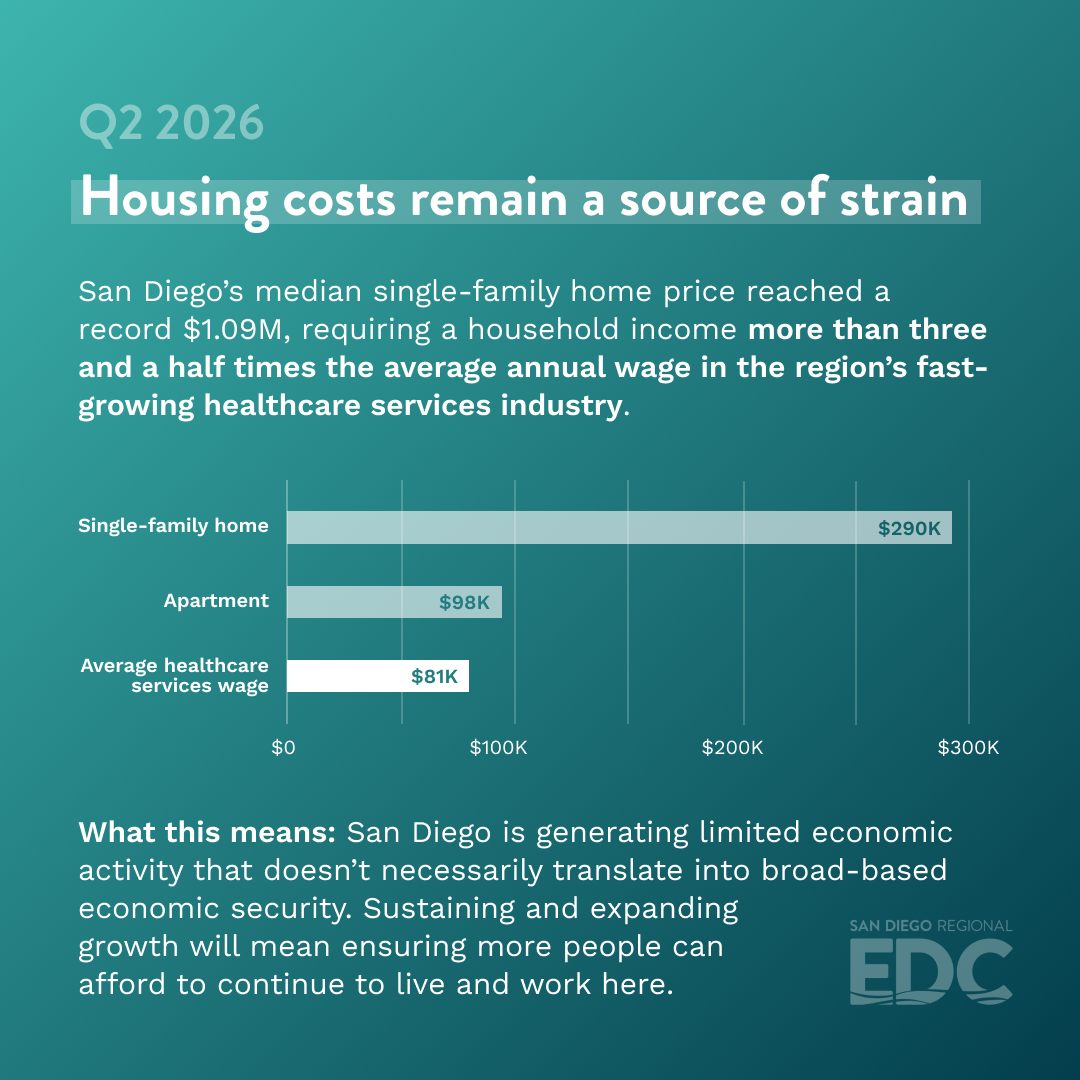
On the residential real estate side, San Diegans’ ability to afford housing remained a source of strain. In Q2, the average annual wage within the region’s growing healthcare services industry was approximately $81,003—above the region’s quality wage threshold of $24.48 per hour, but still far below the income needed for a typical household to comfortably afford a median-priced home or sustain the average apartment rent.
June 2026 saw San Diego’s median single-family home price reached a record high at $1.09 million. For San Diegan households, Zillow estimated a monthly all-in mortgage payment for a single-family home would be roughly $7,200 per month, which would require a household income of approximately $290,000 per year to keep costs at 30% of earnings. That is more than three and a half times the average annual wage for healthcare services roles.
For many San Diegans, renting remained the more accessible option. Average apartment rent across unit types was approximately $2,453 per month in Q2 2026, requiring an annual household income of roughly $98,000 to remain within the conventional 30% housing-cost threshold. While considerably more attainable than homeownership, this cost still consumes a substantial share of household income.
As businesses change where and how they use space and housing costs remain high relative to wages in higher-growth sectors, a more pressing picture has begun to emerge: San Diego is generating limited economic activity that doesn’t necessarily translate into broad-based economic security. Sustaining and expanding growth will mean ensuring more people can afford to continue to live and work here.
What we’re watching in Q3 2026:
In the first half of 2026, San Diego saw investment growth driven largely by innovation technologies tied to the defense industry. A $2.3 billion deal with drone maker Shield AI dominated Q1, followed by drone maker Aevex’s $320 million IPO in Q2, both the largest deals of their respective quarters. As investment continues to be concentrated in defense-related technologies, the question will be whether this capital investment translates to durable economic momentum and quality jobs, or if it is a short-term concentration of capital around a moment of heightened focus in the defense industry.
EXPLORE THE DATA:
Click through our interactive Economic Snapshot dashboard below to see how San Diego’s economy stacks up relative to the rest of the U.S.
Key Industries
With breakthrough technology companies and research organizations, the largest military concentration in the world, and a strong tourism industry, the San Diego region has one of the most dynamic economies in the country. Deep dive into the industries that make San Diego the global innovation hub it is, with data on employment, businesses, wages, and more.
-
Aerospace
-
Cleantech
-
Cybersecurity
-
Defense
-
Life Sciences
-
Manufacturing
-
Software
-
Tech
-
Tourism
Aerospace
Aerospace has a long history in San Diego, dating back to the early 1900s when Ryan Airlines built the Spirit of St. Louis and Reuben Fleet brought Consolidated Aircraft Corporation to Lindbergh Field. Since then, San Diego’s aerospace industry has been an integral part of the region’s—and the world’s—economy. See the Industry Profile.
Cleantech
The San Diego cleantech industry is a collaboration between public, private, and academic organizations working together to deploy IoT technologies and advance urban connectivity to reduce greenhouse gas emissions, increase water and energy efficiency, and drive economic growth in the San Diego region. See the Industry Profile.
Cybersecurity
San Diego has emerged as a leader for the development of cybersecurity technology and the delivery of cyber-related services. The region’s innovation ecosystem, including its strong military presence, world-class academic institutions, incubators, and partnerships between industry associations and governments, has positioned San Diego as a hub for cyber operations. Today, there are nearly 1,000 firms in the San Diego region focused exclusively on cyber, with nearly 26,000 total impacted jobs. See the Industry Profile.
Defense
San Diego’s defense cluster is critical for the region’s innovation and military economies, and ultimately, to the United States’ national security priorities. San Diego is home to the largest concentration of military assets in the world and the largest federal military workforce in the country. When considering the overall ripple effects of the defense cluster in San Diego, about 20 percent of San Diego’s gross regional product (GRP) is the result of defense-related spending. Jobs supported as a result of defense spending include uniformed military, federal government employees, and defense contractors, as well as employees in healthcare, engineering, construction, hospitality, and tourism. See the Industry Profile.
Life Sciences
The life sciences cluster has a deep history in San Diego’s innovation economy, contributing to global advances in pharmacology, genomics, and medical device manufacturing for more than half a century. Seeded by globally-renowned research institutions and fueled by private and public investment, San Diego continues to rank among the top three life sciences markets in the world. See the Industry Profile.
Manufacturing
The San Diego region is home to a vibrant manufacturing cluster that spans many industries, including defense, aerospace, shipbuilding and repair, medical devices, craft brewing, and sports and active lifestyle. With a highly-skilled workforce, robust training programs, and close proximity to Mexico, San Diego is a hub for advanced manufacturing companies, with more than 4,429 manufacturing establishments currently supporting more than 121,027 jobs. See the Industry Profile.
Software
With more than 3,100 software establishments and more than 100 research institutions in the region, the technology industry is a major driver of the innovation economy in San Diego. The research institutes—along with UC San Diego, San Diego State University, and other major universities—provide the sector with breakthrough technologies that fuel company growth and product development. These unique assets, combined with one of the most skilled labor forces in the world, make San Diego one of the most innovative markets in the U.S. See the Industry Profile.
Tech
A world leader in wireless technologies, San Diego companies are driving local and global innovation that keep us all connected. Founded in San Diego in 1985, Qualcomm invented technologies at the heart of 3G and 4G wireless and the first smartphone, and continues to pioneer new technologies ranging from 5G to artificial intelligence. See the Industry Profile.
Tourism
With more than 70 miles of coastline, state of the art hotel and convention spaces, and an array of entertainment options, San Diego is one of the top visitor and convention destinations in the world. Dubbed by Fodor’s as a “vacationer’s paradise” and by the U.S. Weather Bureau as “the closest thing to perfect weather in America,” San Diego’s world-class waterfront and award-winning international airport make it accessible from destinations across the globe. See the Industry Profile.
Why San Diego?
Situated next to the busiest land port of entry in the Western hemisphere, San Diego is home to more than 3.3 million people and offers incomparable opportunities for business of all sizes to thrive. From sequencing the human genome to inventing the next wave of 5G technology, San Diego has the talent and expertise to change the world—and the numbers to back it up.
EDC Research
EDC provides research and data to local companies, site selectors, and civic leaders to help them make well-informed decisions about our economy. For companies outside of the region considering San Diego for expansion or relocation, EDC provides a variety of assistance, including responding with formal proposals (RFPs) to professional site selectors.
EDC Deep Dives
-
![Artificial Intelligence]()
Artificial Intelligence
-
![Life Sciences]()
Life Sciences
-
![Technology]()
Technology



Maps & dashboards
EDC provides data-driven, Geographic Information System (GIS) mapping tools like the San Diego Investment Map, District Insights Map, and Community Explorer to support strategic decision-making for local officials, businesses, and constituents. These maps offer insights on income distribution, worker concentrations, housing, childcare, and site selection, helping drive inclusive economic development aligned with EDC’s 2030 goals.
Explore the tools below:
-
San Diego Investment Map
-
District Insights
-
Community Explorer
San Diego Investment Map
The San Diego Investment Map is a tool designed to support the Thriving Households goal in EDC’s 2030 Inclusive Growth framework, informing strategic decision-making related to childcare, housing, and site-selection. Explore brief reports, maps, and a dashboard to see how data-driven decisions can boost San Diego’s inclusive economic development. See the San Diego Investment Map.
District Insights
The District Insights Map is a dashboard that generates specific insights for the nine City Council districts in the City of San Diego. The tool is embedded with data related to income distribution, worker concentrations, housing permit activity and development, and more. This dashboard allows users to select and export data, as well as compare data between districts. Explore the District Insights Map.
Community Explorer
Contact EDC to access the Community Explorer, a tool designed to generate data insights on specific geographies, especially related to corporate site selection. This EDC service can help you leverage a range of aggregated data surrounding communities of interest, pin-point addresses, selected regions, or specified drive-times or walk-times from a desired location. Demo below:
A note about our research
EDC currently does not endorse specific ballot measures or candidates. From time to time, we provide objective research on the economic impact of specific measures or proposals to better inform the public and policymakers on a project’s potential economic impact. If you are interested in working with EDC on customizable research, contact us.
Questions? Contact:

Eduardo Velasquez
Vice President, Economic Development & Research