Study: San Diego’s $4.3B cyber cluster expands amid tech contraction

EDC, CCOE study quantifies impact of region’s cybersecurity cluster

Together with the Cyber Center of Excellence (CCOE), EDC released “For San Diego, By San Diego: 2025 Cybersecurity Industry Economic Impact and Workforce Study.” The sixth update since 2014, the biennial report examines the economic impact of San Diego’s $4.3 billion cybersecurity cluster and explores the firms, technology, and talent working to help detect and contain cyber threats across San Diego and beyond.

In today’s hyperconnected, internet-first economy, cybersecurity is no longer optional. Whether in manufacturing, finance, healthcare, energy, or government, a single breach can inflict cascading operational, reputational, and financial consequences—reaching an average cost of $10.2 million in the U.S., according to IBM.

San Diego continues to be a leading cyber region, with more than 1,300 firms, the Naval Information Warfare Systems Command (NAVWAR), and the highest growth of cyber certificate obtainment among our peer metros. As organizations driving innovation and strategic national priorities face increasingly costly cyberattacks, our collaborative region is developing new technologies, defenses, and cyber warriors to combat these systemic threats,” said Lisa Easterly, President and CEO, CCOE—commissioning organization of the report.

KEY report FINDINGS

  • San Diego’s cybersecurity cluster continues to expand, adding jobs, firms, and economic impact, even as the broader technology industry contracts. There are 14,875 jobs across 1,350 establishments within the cybersecurity cluster in San Diego, up 11 percent and 33 percent over the last two years, respectively. Together, this amounts to $4.3 billion regional economic impact and 29,040 jobs impacted.
  • The cybersecurity talent pool continues to grow but has been slowing down since 2022. Despite the increased need for cybersecurity professionals, the pace the talent pool grows every year is declining. This trend parallels a similar slowdown in advertised demand, as job postings for cybersecurity workers have declined and remain 60 percent lower than pre-pandemic levels.
  • San Diego continues to expand cyber skills, particularly in certificate obtainment, which outpaces all of San Diego’s peer metros. Overall degree and certificate obtainment in San Diego continues to grow, expanding 51 percent since 2019. Certificates, which are obtained both in and outside of traditional degree programs, have grown 78 percent from 2019 to 2023.
  • Business sentiment has softened. Survey results show that perceptions of San Diego’s business environment have declined relative to 2023, including access to talent, vendors, customers, and capital. Only research and development remained at the same level compared to 2023.

Amid broader technology industry declines and a shifting policy landscape, cybersecurity remains a key, growing driver of San Diego’s economy. The region’s cybersecurity cluster supports 29,000 local jobs, most concentrated at NAVWAR, the preeminent provider of information warfare capabilities for the U.S. Navy. In all, the economic impact of San Diego’s cyber cluster is equivalent to 26 Comic-Cons.

“San Diego’s cyber cluster remains a bright spot for our region, during a period of continued economic uncertainty. However, we must not take it for granted. We can continue to support its growth by connecting cybersecurity companies to new customers, more suppliers, and diverse talent that is necessary to thrive,” said Eduardo Velasquez, Senior Director of Research and Economic Development, San Diego Regional EDC.

As cyber threats grow in frequency around the world, protecting integrated infrastructure and sensitive information across critical industries, from healthcare to defense to finance, is more important than ever,said Rob Johnson, Vice President of Cybersecurity Sales, Thales.

Finding opportunities to navigate economic uncertainty, adapting curriculum to prepare talent for the rapidly-evolving cluster, and helping equip small business vendors to sustain cybersecurity compliance are all strategies that will help San Diego maintain its leadership in cybersecurity and innovation across the region and globe.

In partnership with CCOE, the report was sponsored by Thales, Deloitte, ESET, LevitZacks, and NDIA’s San Diego chapter, and unveiled November 12 at an industry event hosted at Qualcomm.

SEE THE FULL REPORT HERE

LEARN more about cyber IN SAN DIEGO

About Cyber Center of Excellence (CCOE)
CCOE is a San Diego-based nonprofit that mobilizes industry, academia and government to grow the regional cyber economy and create a more secure digital community for all.

Study: San Diego’s cyber talent grows by 10% across 1K firms

EDC, CCOE study quantifies impact of region’s cybersecurity cluster

Together with the Cyber Center of Excellence (CCOE), EDC released “Cybersecurity is Everyone’s Business: San Diego’s Cyber Cluster.” The fifth update since 2014, the report quantifies the economic impact of the region’s cybersecurity cluster and explores the firms, technology, and talent working to help thwart cyber risk across San Diego and beyond.

As cyberattacks and ransomware threats extend beyond technology and begin to impact even our built environment, the importance of cybersecurity cannot be overstated. Not only are the consequences costly—reaching an average of $9.44 million in the U.S. per IBM—but they have profound impacts on human health and safety.

San Diego is leading the charge with more than 1,000 cyber firms, top-ranked education and research institutes, and the Naval Information Warfare Systems Command (NAVWAR). This collaborative ‘Ecosystem in Action,’ as highlighted by the White House, is developing new technologies, solutions, and diverse cyber talent to create a more secure digital community for all,said Lisa Easterly, President & CEO, CCOE—commissioning organization of the report.

Marking the 10-year anniversary of CCOE, the biennial report includes a deep dive into San Diego’s $4 billion cyber cluster, a metro-by-metro comparison, a roster of local resources and assets, and business sentiments of local firms.

KEY report FINDINGS

  • Cybersecurity is everyone’s business. With increasing cyber threats to physical infrastructure, the security of data and communication is of critical importance, leading to a sharp rise in global demand for cybersecurity talent across industries. In San Diego, 59 percent of private sector cybersecurity jobs are in industries outside of technology, such as manufacturing, architecture, and engineering.
  • San Diego’s cybersecurity cluster is expanding its footprint and impact on the regional economy. There are 13,383 jobs and 1,016 establishments tied to the cybersecurity cluster in San Diego, up eight percent and 17 percent respectively in the last two years. Altogether, this amounts to a $4 billion regional economic impact.
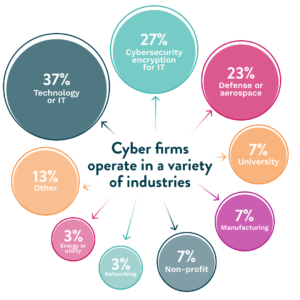
  • Local cybersecurity firms remain deeply linked to the Federal government, including the Department of Defense. A majority (65 percent) of San Diego cyber firms work directly or indirectly with the government. Nearly one-fifth indicate government-related work as their primary focus, explaining why 23 percent of local cybersecurity firms are in the defense and aerospace industry.
  • Fast growth and resilience define San Diego’s cybersecurity talent. The region’s talent pool has grown by nearly 10 percent since 2018, five times faster than all other occupations combined. The cybersecurity talent base experienced significantly smaller job losses during the pandemic and recovered both more strongly and more quickly than other occupations. 
  • Demand for cyber talent far exceeds local supply. Three out of four cybersecurity firms in San Diego report having difficulty finding entry- to mid-level as well as experienced applicants. Increasing compensation and diversity can help address San Diego’s talent shortage.

Cyber is an important and rapidly growing piece of the San Diego regional economy. The cluster supports 26,000 local jobs, most concentrated at NAVWAR, the preeminent provider of information warfare capabilities for the U.S. Navy. In all, the economic impact of San Diego’s cyber cluster is about the same as 24 Comic-Cons.

Firms in every industry face cybersecurity risks. This is driving up the demand for cybersecurity talent and solutions. To keep pace and remain competitive, San Diego must leverage its unique assets, such as the military, as well as its incredibly diverse pool of talent,said Eduardo Velasquez, Senior Director of Research and Economic Development, EDC.

We have a national shortage of cyber workers—to the tune of 663,000 in the U.S. per Cyberseek. Opening the aperture with accessible and skills-based training helps seed and diversify the talent pipeline, which is critical to advancing our country’s homeland security,said Joseph Oregon, Chief of Cybersecurity, Region 9, Cybersecurity and Infrastructure Security Agency (CISA).

More competitive compensation, increased diversity in recruitment, and thoughtful consideration of degree requirements are all strategies that can help San Diego lead in cybersecurity innovation across the region and globe.

In partnership with CCOE, the report was sponsored by Booz Allen Hamilton, CyberCatch, ESET, Haiku, RiskRecon, and San Diego State University, and was unveiled today at an industry event hosted at Qualcomm.

SEE THE FULL REPORT HERE

LEARN more about cyber IN SAN DIEGO

About Cyber Center of Excellence (CCOE)
CCOE is a San Diego-based nonprofit that mobilizes industry, academia, and government to grow the regional cyber economy and create a more secure digital community for all. sdccoe.org

Why Ireland is looking to San Diego for cybersecurity talent solutions

People sitting around a table in a board room

According to the Center for Strategic and International Studies (CSIS), the global cybersecurity workforce shortage is projected to reach 1.8 million unfilled positions by 2022. As a hub for cybersecurity companies and research, San Diego has been piloting programs to address talent shortages that are plaguing this ubiquitous industry.

San Diego’s collaborative efforts, combined with its unique concentration of academic, private sector, government, and non-profit industry, have attracted the attention of global technology markets.

In late February,  WTC San Diego – EDC’s international economic development arm –  and the Cyber Center of Excellence (CCOE) hosted 15 delegates from Ireland-based government and academic intuitions. The delegation was touring San Diego to learn about the region’s cybersecurity industry and efforts to support its ongoing growth.

The global ‘cyber’ talent crisis

San Diego companies that attended the roundtable discussed technologies they were developing and strategies for addressing talent shortfalls.

San Diego’s cybersecurity industry, anchored by the presence of NAVWAR, has become a hub for cybersecurity companies. Based on research conducted by San Diego Regional EDC and the CCOE, San Diego’s cyber industry generated $2.2 billion in economic impact in 2018, with more than 8,450 employees working directly for cybersecurity firms.

San Diego companies in attendance also had a lot to learn. Following Brexit, Ireland is the only English speaking country left in the EU. The Ireland delegation used this point, among others, to make their case for why San Diego companies should consider expanding in Ireland.

Understanding WTC’s role

World Trade Center San Diego (WTC) works with partner organizations and global stakeholders to identify strategic global markets and help connect them to San Diego businesses and institutions to increase exports and drive foreign direct investment.

By facilitating strategic meetings, WTC seeks to help elevate San Diego’s profile with key global markets to increase opportunities for inward investment and support local companies as they evaluate expanding into global markets.

Are you interested in getting connected to high profile delegations? We’re here to help.

Get in touch

Related EDC articles and research: