San Diego’s Good News of the Week – March 27, 2026

Every week, ‘Good News of the Week’ features a curation of positive headlines from San Diego, delivered straight to your inbox. A blend of aggregated stories from San Diego’s most trusted news sources and original EDC-created content, GNOTW provides a comprehensive recap of the region’s best stories from the past week. GNOTW is sponsored by Manpower.

Get Good News of the Week in your inbox every Friday. → Sign up

For the week of March 27, 2026, here’s what we’re reading:

…and here are some events and opportunities:

From our partners:

Inclusive Growth Spotlight: Cajon Valley Union School District

As part of a larger effort to celebrate local organizations advancing inclusion, EDC’s latest Inclusive Growth Spotlight highlights Cajon Valley Union School District (CVUSD) for its innovative approach to career-connected learning. CVUSD’s nationally recognized “World of Work” framework integrates career exploration, strengths assessments, and real-world learning experiences throughout its K–8 curriculum.

Learn More, Join the Movement


Business information and resources page

Be in the know – sign up below to receive future editions of GNOTW.

Want to submit your event or news update to our weekly newsletter? Contact us for more information.

sign up for gnotw

Enya Castañeda
Enya Castañeda

Coordinator, Investor Relations & Marketing Communications

EDC analysis: Petco Park generates $913M in annual economic impact

Petco Park remains one of San Diego’s most valuable public assets. A new analysis commissioned by the San Diego Padres and produced by San Diego Regional EDC quantifies the economic benefits generated by Petco Park based on 183 events held at the ballpark in 2024—including 85 home games, major concerts, community events and national sporting competitions—in addition to the value provided by the Gallagher Square renovation project.

In 2024, Petco Park activity resulted in about $913 million in economic impact for the San Diego region, which is equivalent to more than five Comic-Cons. These events supported nearly 15,000 jobs and generated about $1.48 billion in economic sales across San Diego County.

“The Padres take great pride as stewards of a public trust and committed civic partners, and our efforts extend well beyond the field,” said Padres CEO Erik Greupner. “Petco Park will continue to serve as a dynamic gathering place, both a ballpark and a community anchor, delivering benefits that extend far beyond the Ballpark District.”

“The San Diego Padres are more than a ballclub—they’re a cornerstone of San Diego’s identity and a powerful engine for our economy,” said EDC President and CEO Mark Cafferty. “The franchise’s impact extends far beyond Petco Park, supporting thousands of jobs and millions in economic impact, and elevating our binational identity around the globe. EDC’s report quantifies what San Diegans have long felt: the Padres inspire hometown pride, connection, and momentum year over year.”

The EDC analysis also revealed other economic impacts to San Diego, including:

  • Padres baseball remains the single largest driver of year-round economic activity at Petco Park, producing $9.3 million in economic impact per game due to the 40,000 fans that pack the ballpark every game.
  • Within the City of San Diego, Petco Park activity delivered more than $16.4 million to the General Fund and $10.5-12.4 million in annual hotel tax revenue.
  • The recent Gallagher Square renovation generated about $33.7 million in value added and supported 270 jobs.
  • Concerts and special events at Petco Park generated $123 million in regional economic impact across the county in 2024, which is expected to increase with the significant rise in non-baseball events each year.

READ THE EDC ANALYSIS

EXPLORE MORE SAN DIEGO DATA

The EDC assessment was commissioned by the San Diego Padres in Summer 2025. EDC currently does not endorse specific ballot measures or candidates. From time to time, we provide objective research on the economic impact of specific measures or proposals such as this to better inform the public and policymakers on a project’s potential economic impact. If you are interested in working with EDC on customizable research, contact us.

San Diego’s Good News of the Week – March 20, 2026

Every week, ‘Good News of the Week’ features a curation of positive headlines from San Diego, delivered straight to your inbox. A blend of aggregated stories from San Diego’s most trusted news sources and original EDC-created content, GNOTW provides a comprehensive recap of the region’s best stories from the past week. GNOTW is sponsored by Manpower.

Get Good News of the Week in your inbox every Friday. → Sign up

For the week of March 20, 2026, here’s what we’re reading:

…and here are some events and opportunities:

From our partners:

EDC is hiring—Research Director

Do you love San Diego? Are you looking for a role where you can lead a team and research to drive our region’s growth and competitiveness? We’re hiring a Research Director to set and execute a forward-looking research agenda that positions EDC as the region’s most trusted source of economic intelligence. Join us to connect data to decision-making for a more inclusive San Diego.

Share or apply by Apr. 3


Business information and resources page

Be in the know – sign up below to receive future editions of GNOTW.

Want to submit your event or news update to our weekly newsletter? Contact us for more information.

sign up for gnotw

Enya Castañeda
Enya Castañeda

Coordinator, Investor Relations & Marketing Communications

Inclusive Growth Spotlight: Cajon Valley Union School District

EDC’s Inclusive Growth blog series highlights and celebrates local companies and organizations helping drive economic growth and progress toward San Diego’s 2030 Inclusive Growth goals.

Launched in 2018 and informed by a partnership with the Brookings Institution, the Inclusive Growth initiative sets 2030 goals for San Diego related to increasing: 1) the supply of talent, 2) quality small business jobs, and 3) newly thriving households. The goals inform San Diego’s economic priorities and make the business case for economic inclusion.

Regional talent demand remains high

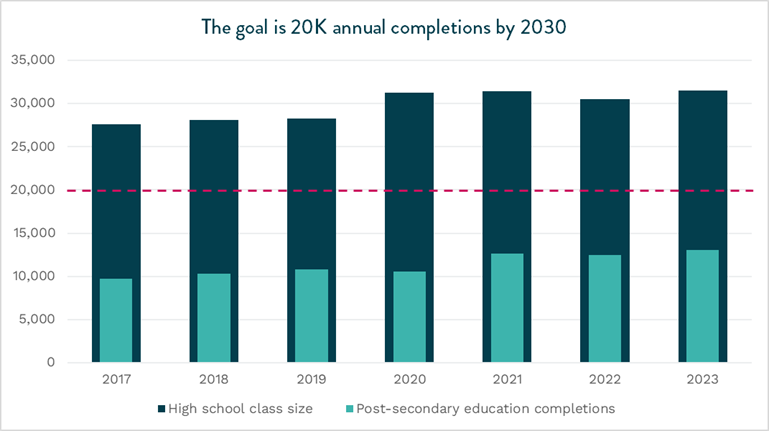
To maintain economic competitiveness, the region needs 20,000 students per year completing post-secondary education within six years of graduating high school.

While progress toward the goal has increased incrementally since 2017, talent scarcity has become the new normal as hiring demand exceeds the supply of talent across industries. Compounding this challenge, student success is demographically uneven as Hispanics and Latinos only account for 17 percent of residents over 25 years old with at least a bachelor’s degree. Employer-led talent pipeline development efforts are critical to the future of San Diego’s economy, and Cajon Valley Union School District is among those working toward a solution.

Meet CVUSD

The Cajon Valley Union School District (CVUSD) serves approximately 18,000 students across 28 schools spanning more than 60-square-miles in East San Diego County. Located in one of the most culturally and linguistically diverse regions of San Diego, the district has earned national recognition for its innovative approach to education, its commitment to whole child development, and its focus on preparing students for meaningful futures. At the center of the district’s work is a mission that guides every aspect of its approach to education: Happy Kids, Healthy Relationships, on a Path to Gainful Employment.

This mission reflects a belief that schools must do more than deliver academic content. Schools must help young people understand who they are, what they care about, and how their strengths can translate into meaningful contributions in the world.

An opportunity to re-define career preparedness

CVUSD serves one of the most diverse student populations in San Diego County. Many students are multilingual learners, newcomers to the United States, or the first in their families to navigate American education systems and postsecondary opportunities.

At the same time, San Diego faces a significant workforce development challenge, requiring education systems to rethink how they prepare students for the future. Historically, K–12 education and workforce development systems were not designed to respond dynamically to labor market changes, emerging industries, or employer needs. CVUSD has addressed this challenge by intentionally redesigning the student experience around identity, relevance, and future readiness.

An innovative approach to career-connected learning

Over the past decade, CVUSD has become nationally recognized for its World of Work framework—an innovative system that integrates career awareness, strengths discovery, and real-world learning experiences throughout the K–8 educational journey. Using the Realistic, Investigative, Artistic, Social, Enterprising, and Conventional career development assessment and model, students research professions aligned with their interests and strengths, interview professionals about their work, and present their findings through projects that connect classroom learning to real professions and pathways.

Career literacy is embedded throughout the curriculum. Students encounter real-world applications within reading and writing assignments, research projects, collaborative problem-solving challenges, and presentations that strengthen both academic and professional communication skills. Equally important, students regularly interact with professionals across San Diego’s major industry sectors.

This approach helps students see purpose in their education. In a recent district survey, 73% of students in fourth through eighth grade agreed with the statement, “The things I’m learning in school are important to my future.” This data reflects a powerful shift in how students experience learning, understanding that what they are studying today connects directly to the opportunities they may pursue tomorrow.

To expand these opportunities even further, CVUSD recently launched the World of Work Foundation, a nonprofit initiative designed to connect schools, employers, and community organizations around a shared vision for workforce development, and therefore expanding mentorship networks, employer partnerships, youth apprenticeship opportunities, and work-based learning experiences for students throughout the region.

In a region working to close opportunity gaps and build a stronger talent pipeline, CVUSD is preparing young people not only to graduate but to thrive.

Join the movement

Progress on EDC’s 2030 Inclusive Growth goals is only achievable with and through the region’s employers scaling innovative and intentional solutions. Anchor institutions like SDG&E are helping to collectively pave the way toward a more inclusive regional economy. Join us:

To learn more and get involved in EDC’s work, contact:

Bree Burris
Bree Burris

Sr. Director, Communications & Community Engagement

San Diego’s Good News of the Week – March 13, 2026

Every week, ‘Good News of the Week’ features a curation of positive headlines from San Diego, delivered straight to your inbox. A blend of aggregated stories from San Diego’s most trusted news sources and original EDC-created content, GNOTW provides a comprehensive recap of the region’s best stories from the past week. GNOTW is sponsored by Manpower.

Get Good News of the Week in your inbox every Friday. → Sign up

For the week of March 13, 2026, here’s what we’re reading:

…and here are some events and opportunities:

From our partners:

A note from Lucas: Trade and San Diego in 2026

As the global economy is being rewired and San Diego’s innovation drivers are beginning to show signs of strain, uncertainty—more than any single policy—is the primary concern of 2026. Regions that prepare early and act deliberately will outperform those that wait for certainty to return.

Read the Full Note


Business information and resources page

Be in the know – sign up below to receive future editions of GNOTW.

Want to submit your event or news update to our weekly newsletter? Contact us for more information.

sign up for gnotw

Enya Castañeda
Enya Castañeda

Coordinator, Investor Relations & Marketing Communications

A note from Lucas: Trade and San Diego in 2026

Playing offense in an uncertain 2026

Dear EDC investors and partners,

For those who joined us at board meeting in January to hear EDC VP Eduardo Velasquez present, one message was clear: Our regional economy is entering a period not simply of slowdown or acceleration—but of structural change.

The global economy is being rewired in real time. Trade relationships are being reassessed. Supply chains are shifting. Capital is flowing more selectively. And uncertainty—particularly around tariffs, court proceedings, and the upcoming 2026 U.S.-Mexico-Canada Agreement (USMCA) joint review—has become a defining feature of the landscape.

Here at home, the innovation drivers powering San Diego’s growth for more than a decade are beginning to show signs of strain. This is unfolding amid a more protectionist national posture, higher costs of capital, heightened geopolitical tension and wartime, and rapid advances in artificial intelligence that could reshape industries almost overnight.

Just last month, the Supreme Court struck down the use of the International Emergency Economic Powers Act (IEEPA) as justification for broad-based tariffs imposed over the past year. The ruling reaffirmed that sweeping tariff authority rests with Congress, not the executive branch. While tariffs are not eliminated outright, the decision introduces further uncertainty around their continuation and potential reimbursement of duties already paid. For companies on the ground, the message is clear: Trade policy remains fluid.

Time and again, we hear from businesses like yours that uncertainty—more than any single policy—is the primary concern of 2026.

The proof is in the data

Periods of trade volatility are not new. In 2018, amid similar tensions, EDC and WTCSD commissioned our North American Trade & Competitiveness Study to better understand the cross-border economy defining the Cali Baja region and to equip leaders with credible data.

Last November, we refreshed that work with the release of our Binational Trade & Competitiveness Report—a comprehensive assessment of the economic engine powering our region.

The findings are clear. Nearly 95,000 regional jobs are supported by binational trade. Since the USMCA took effect in 2020, trade with North American partners has grown by nearly one-third and continues moving up the value chain into sectors such as medical devices, aerospace, and semiconductors. Ninety-seven percent of San Diego’s goods exports go to Mexico alone, underscoring the deeply integrated nature of our intermediate goods trade. Meanwhile, services exports have risen 54 percent in recent years.

Trade is not a side story—it is the bloodstream of our innovation ecosystem.

Building on this foundation, we are now refreshing our Go Global: Trade & Investment Plan, the framework that launched WTCSD more than a decade ago. In partnership with Boston Consulting Group and regional stakeholders, we will conduct new analysis and executive engagement to ensure our roadmap through 2030 reflects today’s global realities. We invite you to join this initiative and consider sponsoring the upcoming report.

MetroConnect: Building resilience where it matters

While we focus on long-term positioning, we remain committed to near-term resilience. Our small and mid-sized businesses must be ready.

Last month, we welcomed 15 companies into MetroConnect VIII, our flagship international sales accelerator. Replicated across North America and recognized with a Presidential “E” Award in 2023, the program provides structured export training and more than 200 hours of no-cost expert consulting support per company through our role as the region’s official Export SBDC.

Competitiveness is built not in calm moments, but through preparation and deliberate action.

Japan 2026: Playing offense

As we take on 2026, we intend to play offense.

Asia now accounts for roughly half of global foreign direct investment flows. Within that trend, Japan stands out as the largest foreign investor in the U.S. and, over the past decade, the top foreign investor in San Diego County. Prime Minister Sanae Takaichi has pledged $550 billion in new U.S.-bound investment in the coming years, emphasizing defense, energy, and security—sectors where San Diego holds distinct strengths.

This fall, WTCSD will lead a delegation of approximately 35 business leaders to Tokyo, Yokohama, and Osaka. These trade missions are not symbolic; they are strategic.

We annually position San Diego as a premier landing zone for investment, engage senior government and corporate leaders, and align our region with the next wave of trusted global capital flows. In a world where reliability increasingly defines opportunity, Japan is a natural partner—and San Diego is a natural platform.

Looking ahead

We are entering 2026 with clear priorities: Strengthen our competitive advantages, deepen trusted global partnerships, and convert regional strengths into global relevance. The next era of globalization will be more selective, and more strategic. Regions that prepare early and act deliberately will outperform those that wait for certainty to return.

We invite you to engage—whether by supporting MetroConnect companies, joining us for an upcoming Global Competitiveness Council meeting, maximizing opportunity for our Japan trade mission, or contributing to our refreshed global strategy. Together, we can ensure that San Diego not only weathers the storms ahead, but emerges stronger, more globally connected, and more competitive than ever.

Lucas Coleman
Lucas Coleman

Director, World Trade Center San Diego

More from WTCSD

San Diego’s Good News of the Week – March 6, 2026

Every week, ‘Good News of the Week’ features a curation of positive headlines from San Diego, delivered straight to your inbox. A blend of aggregated stories from San Diego’s most trusted news sources and original EDC-created content, GNOTW provides a comprehensive recap of the region’s best stories from the past week. GNOTW is sponsored by Manpower.

Get Good News of the Week in your inbox every Friday. → Sign up

For the week of March 6, 2026, here’s what we’re reading:

…and here are some events and opportunities:

From our partners:

2025 Thriving Households update: Affordability pressures persisted

As of 2024, San Diego has added 38,157 newly thriving households since Inclusive Growth tracking began—a decrease from 2023 levels. The decline reflects eroding household purchasing power amid continued price pressures on essential goods including housing, groceries, and energy.

See the Update


Business information and resources page

Be in the know – sign up below to receive future editions of GNOTW.

Want to submit your event or news update to our weekly newsletter? Contact us for more information.

sign up for gnotw

Enya Castañeda
Enya Castañeda

Coordinator, Investor Relations & Marketing Communications

2025 Thriving Households update: Affordability pressures persisted

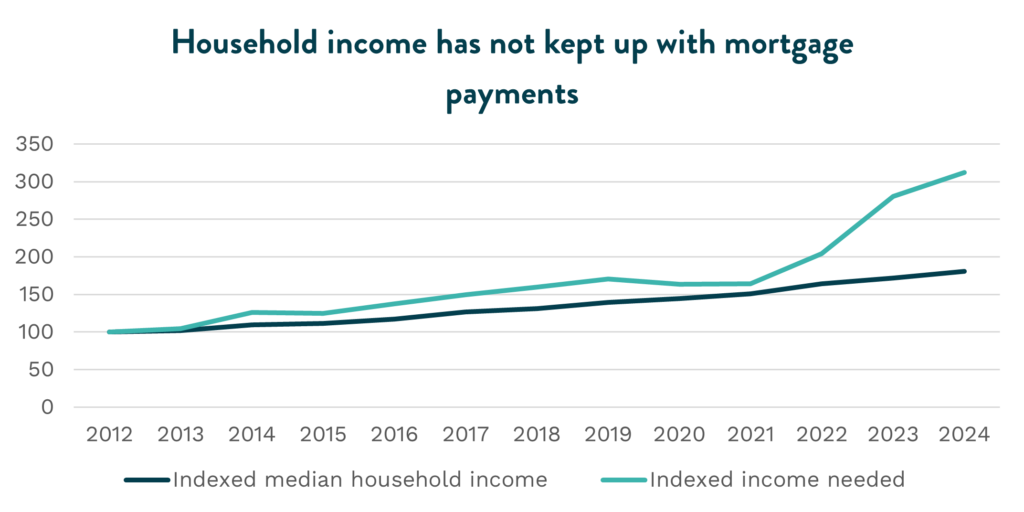
San Diego has continued to show progress in reaching our Inclusive Growth goals with 2024 median household income experiencing a 29 percent increase since 2019. Despite promising recent growth in annual earnings across the county, San Diego remains one of the most expensive metros in the U.S. By the end of 2024, households needed an income exceeding $235,000 to afford the median-priced home, a threshold that, combined with elevated interest rates, places homeownership further out of reach for most San Diegans.

On average, homeowners faced housing costs of $4,748 per month in 2024, 55.5 percent higher than 2019 costs. Because household income growth has failed to keep pace with the cost of living, the gap between local housing costs and incomes continues to widen despite home prices stabilizing.

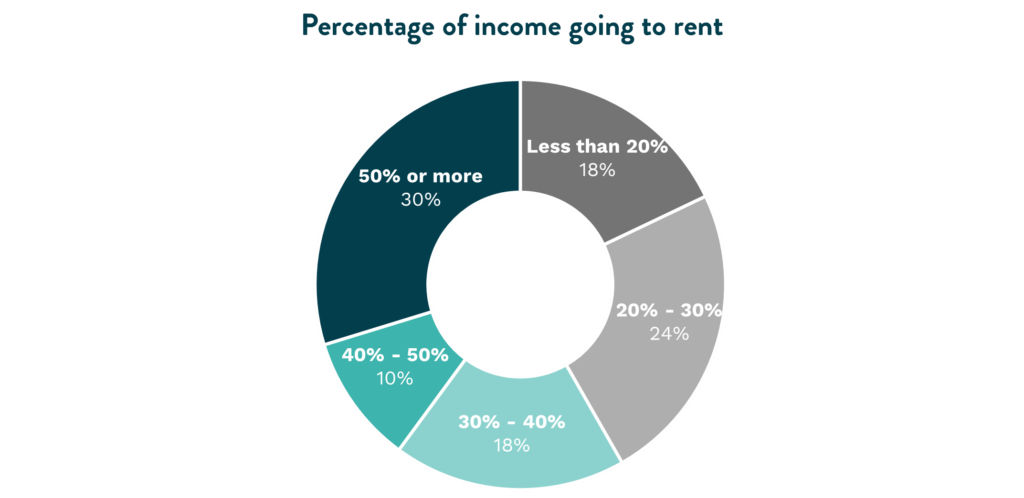
Renters face similar pressures. Average rent prices reached $4,039 in 2024, increasing by 8.3 percent over a year and 38 percent over five years. As household income struggles to catch up to increasing prices, 58 percent of renters remain cost-burdened, spending more than 30 percent of their income on rent.

Progress toward the goal

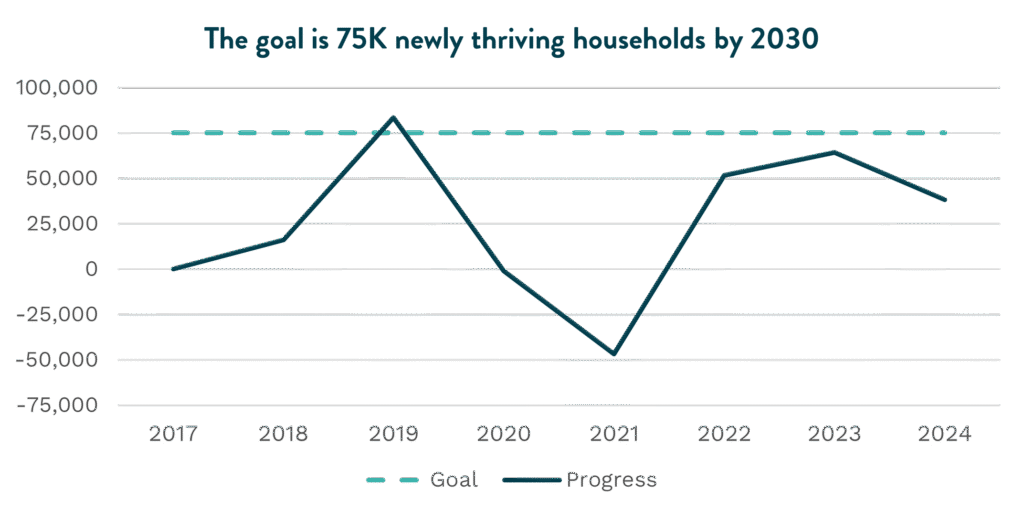
By the end of the decade, EDC estimated the region would need to add 75,000 newly thriving households. To be considered ‘thriving’ in 2024, a renter-occupied household needs at least $84,816 in household income per year, while a homeowner-occupied household needs $139,872 per year.

As of 2024, San Diego has added 38,157 newly thriving households since tracking began—a decrease from 2023 levels. The decline reflects eroding household purchasing power amid continued price pressures on essential goods including housing, groceries, and energy.

Addressing the supply challenge

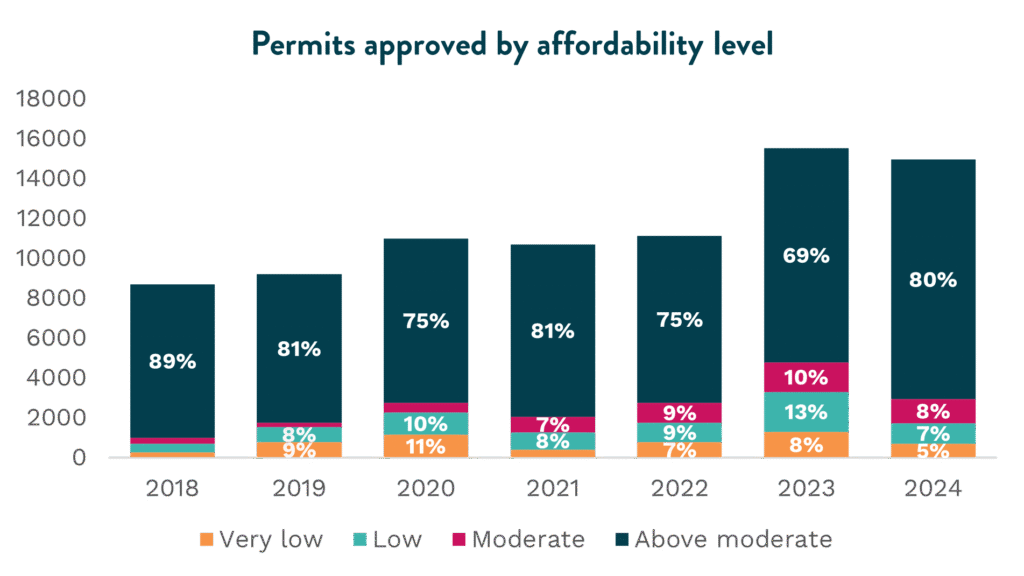
To increase housing supply, local jurisdictions have made notable progress in streamlining permitting processes. Nearly 15,000 housing permits were approved in 2024, demonstrating continued momentum despite a slight decrease from 2023. However, the number of permits for moderate income housing dropped by 18.8 percent, highlighting the persistent challenge of the “missing middle” and insufficient affordable housing production. Furthermore, permits for low and very low income households dropped 47.4 percent compared to 2023.

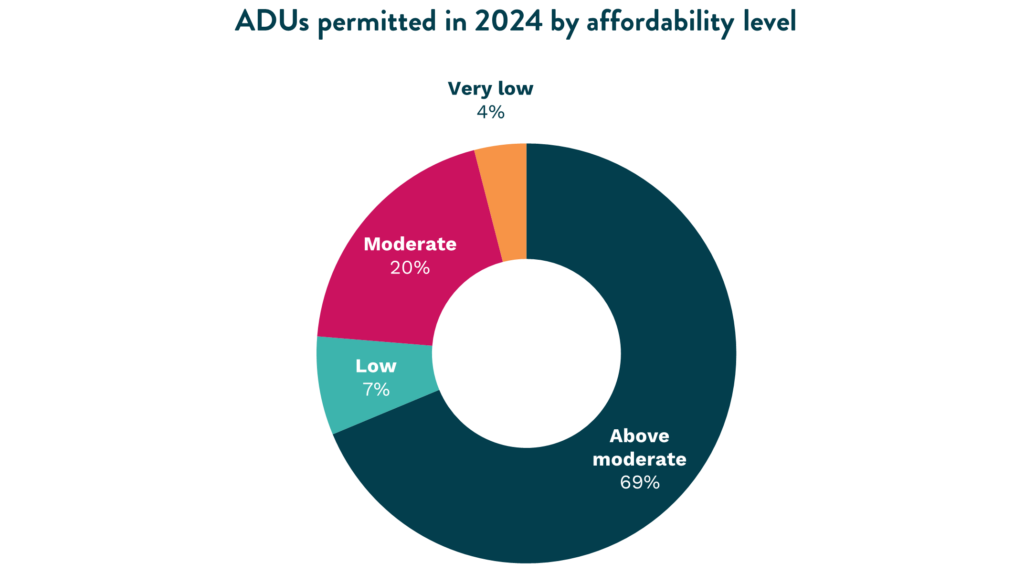
Accessory Dwelling Units (ADUs) represented nearly 27 percent of all permits approved in 2024—up from 22 percent in 2023—and 66 percent of all permits approved at moderate level pricing. However, those priced above moderate continue to make up most of ADU permits. While ADUs offer an opportunity to increase housing stock in existing single-family home lots, they’re unlikely to solve the region’s housing crises alone.

Developers cite several obstacles hampering housing production. The multifamily development market has become oversaturated, reducing incentives for new entrants. Current policies favor small units that do little to address the scale of San Diego’s housing needs. Rising construction costs, coupled with high insurance premiums and litigation risks, have the power to prevent projects from ever breaking ground.

At a broader level, California continues to experience a decline in construction employment, with a 1.9 percent annual decrease in 2024. This could be a potential contributing factor to slowed construction in coming years. This is especially relevant in states like California where the construction workforce is particularly reliant on immigrant workers. In fact, 40 percent of the construction workforce is comprised of foreign-born labor, potentially affecting construction-related labor under the current immigration enforcement landscape.

Extended timelines from permitting to groundbreaking further diminish project viability. Addressing these barriers will require better incentives for risk-taking and access to more flexible financing options.

Creative solutions for persistent challenges

Recent announcements signal significant office space vacancies in downtown San Diego. Major real estate firms including the Irvine Co. have been divesting San Diego office towers since 2024, reflecting broader shifts in the commercial real estate market. This challenge presents an opportunity.

Converting vacant office space into housing could revitalize areas where commercial properties no longer contribute meaningfully to the local economy. However, conversion costs can be prohibitively high. In many cases, demolishing outdated office buildings to construct multifamily housing may prove more economically feasible.

Similarly, conversions of single-family home lots into multiple single-family lots could have significant impact on housing affordability. According to LISC’s single family lot size reduction analysis, allowing multiple townhomes on one single family lot could lower home prices by 42 percent. Additionally, if 1.4 percent of the City of San Diego’s current single family lots were allowed to build multiple townhomes on one single family lot, the amount of new property taxes generated would be approximately $450 million each year, just for the County of San Diego. These innovative efforts require streamlined permitting, supportive re-zoning, and infrastructure assessment from local governments.

Identifying which vacant office properties are suited for conversion—or demolition and redevelopment—should be the first step. Addressing San Diego’s supply-constrained market will require strong public-private collaboration and regional strategies to explore innovative solutions at the scale needed to meet the region’s housing demands.

In February 2026, EDC’s Thriving Households Roundtable provided an opportunity to discuss employer-led solutions to these pressing challenges and to hear about innovative initiatives from local leaders such as LISC, cREate Development, and Center for Housing Policy and Design.

Join the movement. Endorse our Inclusive Growth goals.

Bree Burris
Bree Burris

Sr. Director, Communications & Community Engagement

San Diego’s Good News of the Week – February 27, 2026

Every week, ‘Good News of the Week’ features a curation of positive headlines from San Diego, delivered straight to your inbox. A blend of aggregated stories from San Diego’s most trusted news sources and original EDC-created content, GNOTW provides a comprehensive recap of the region’s best stories from the past week. GNOTW is sponsored by Manpower.

Get Good News of the Week in your inbox every Friday. → Sign up

For the week of February 27, 2026, here’s what we’re reading:

…and here are some events and opportunities:

From our partners:

EDC’s Q4 2025 Economic Snapshot

In Q4 2025, San Diego saw a 1.4 percent year over year increase in job growth. On the flipside, this growth masked declines in innovation jobs and VC and research investment amid a year of heightened economic uncertainty.

Dive into the Data


Business information and resources page

Be in the know – sign up below to receive future editions of GNOTW.

Want to submit your event or news update to our weekly newsletter? Contact us for more information.

sign up for gnotw

Enya Castañeda
Enya Castañeda

Coordinator, Investor Relations & Marketing Communications

San Diego’s Good News of the Week – February 20, 2026

Every week, ‘Good News of the Week’ features a curation of positive headlines from San Diego, delivered straight to your inbox. A blend of aggregated stories from San Diego’s most trusted news sources and original EDC-created content, GNOTW provides a comprehensive recap of the region’s best stories from the past week. GNOTW is sponsored by Manpower.

Get Good News of the Week in your inbox every Friday. → Sign up

For the week of February 20, 2026, here’s what we’re reading:

…and here are some events and opportunities:

From our partners:

From statewide leadership to regional execution: San Diego’s role in fusion’s next chapter

With North America’s largest tokamak reactor in Poway, key contributions to international fusion project ITER, and top-tier technical talent, San Diego’s opportunity for successful fusion commercialization is undeniable. With statewide momentum and investment potential, our region has a chance to double down and capture the full economic benefit of fusion’s next chapter.

Learn More


Business information and resources page

Be in the know – sign up below to receive future editions of GNOTW.

Want to submit your event or news update to our weekly newsletter? Contact us for more information.

sign up for gnotw

Enya Castañeda
Enya Castañeda

Coordinator, Investor Relations & Marketing Communications