A note from Eduardo: Looking into the 2026 crystal ball

An inflection point

As another year begins, I sit with my crystal ball once again to see what we can glean from the data we’ve received this past year and what implications it may have for our region’s economic growth in the year ahead.

The past year told a complex story, driven by uncertainty. On the surface, the U.S. economy performed remarkably well, achieving 4.3 percent real GDP growth in Q3 2025, representing an acceleration from a year ago. But this growth has been buoyed by unprecedented investment in AI led by a handful of companies, potentially masking deeper structural shifts beneath the surface.

The U.S. achieved this growth while creating just 584,000 jobs—roughly one-third the rate seen in the past decade. And while San Diego gained its fair share, adding 5,800 jobs through November 2025, all our job growth was principally concentrated in higher education, healthcare, and local government.

In 2026, San Diego stands at an inflection point—one where technological transformation collides with traditional economic challenges in ways we haven’t seen before.

Innovation industries are losing steam

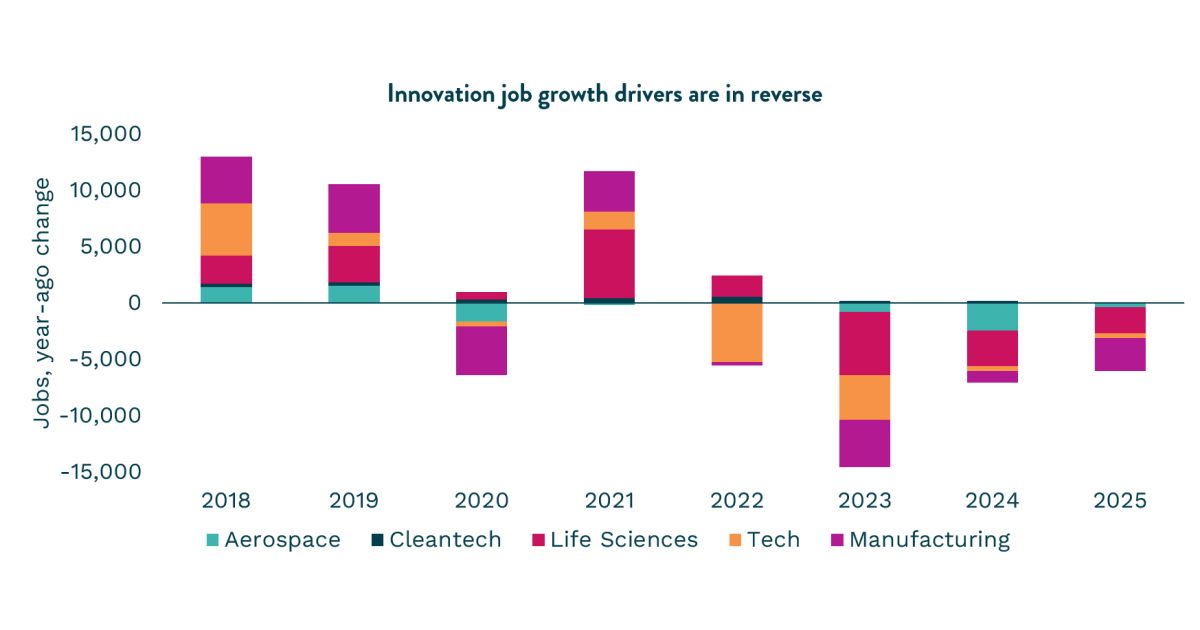
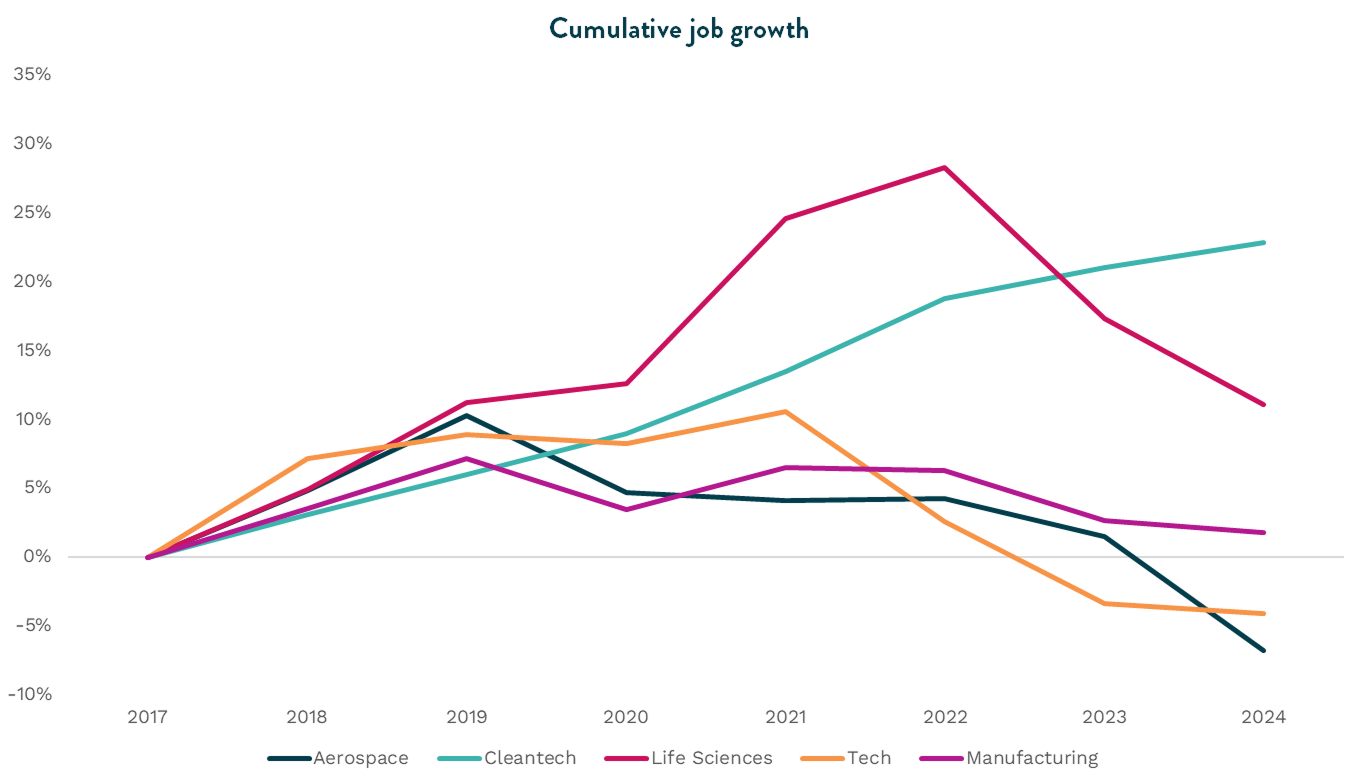
Our region’s innovation engines—the traded clusters that have long defined San Diego’s competitive advantage—are sputtering. Cumulative job growth across aerospace, life sciences, tech, and manufacturing has plateaued or declined from pandemic-era peaks. Cleantech continues to add jobs, though it represents a smaller sliver and is also growing at a slower pace than in previous years. More concerning, it’s not just leaner firms we’re seeing, but fewer firms altogether. Firm growth across these key industries has stagnated, with only defense tech startups providing a bright spot in an otherwise sobering picture.


This matters because innovation industry jobs have an outsized impact on our economy, with each added job supporting another two jobs elsewhere in the economy. When these jobs contract, the ripple effects are significant.

So what’s going on? In part, it’s a tale of structural transformation. Professional, scientific, and technical service jobs, which our innovation cluster relies on, declined 3.3 percent through November 2025. Meanwhile, an additional 550,000 square feet of office space were vacated during the year, bringing total vacant space to 11.3 million square feet in a year with zero new construction. 2025 showed our region’s economy is increasingly dependent on fewer knowledge workers and thus less office space to host those workers.

Yet, investment is happening. Nationwide, construction spending toward data centers is set to eclipse that of traditional office buildings—a trend that accelerated dramatically after ChatGPT’s release. Infrastructure investments are building for servers, not people.

AI is picking up the slack, for now

Amid this disruption comes a silver lining—AI may be delivering what all new technologies promise: Productivity. Looking at inflation-adjusted average wages as a proxy for productivity growth, San Diego’s innovation industries have recovered from the pandemic. AI may be responsible for this recovery, enabling workers to do more with less. This could help explain the decline in local job postings, which fell six percent in 2025.

The question is whether this productivity boost translates into broader prosperity or simply allows companies to operate with smaller teams.

San Diego’s talent landscape reflects this uncertainty. While the value of a degree has been questioned more than perhaps any time in history, it still brings higher income and greater job security in our region. In the past decade, more than twice as many local jobs have been added that require a bachelor’s degree or higher than those requiring associate’s degrees or less. This trend accelerated in 2025, with jobs requiring bachelor’s degrees or higher outnumbering others by a factor of six.

Yet, new graduates are struggling in a job market that increasingly favors experience alongside credentials. The national unemployment rate for young college graduates stands at 4.8 percent, up more than a percentage point compared to before the pandemic.

The market signal is clear: Disruption continues to favor those with degrees and experience, even as the nature of work itself transforms.

Affordability is not a hoax; it’s an enigma

Incomes are up and people are spending their money, but they’re not happy about it. That’s because the essentials like housing, childcare, energy, and transportation continue to get more expensive—local energy prices, for instance, are up nine percent year-over-year as of November 2025.

Housing affordability remains the single biggest threat to regional prosperity. While San Diego’s median household income has increased 25 percent since 2020—a welcome development—the cost of homeownership has far outpaced these gains. The median-priced home fell slightly to $990,000 in Q3 2025, requiring a household income of $263,000 to afford the monthly mortgage payment. Even those looking to rent are facing an average monthly outlay of $2,900, which makes San Diego one of the most expensive counties to rent in the nation.

There’s a glimmer of hope: San Diego home sales increased 14 percent year-over-year in September 2025, suggesting some movement in a frozen market.

Yet meaningful housing market recovery will remain elusive until mortgage rates drop substantially enough to free homeowners locked into historically low rates or make room for significant new supply.

The year ahead

These trends—the pace and composition of job growth, AI’s impact in the demand for talent, and housing affordability—will define San Diego’s 2026.

Can we leverage regional strengths to capture new growth opportunities, particularly in defense tech where startups show momentum? Will hiring priorities shift to tap new pools of talent as employers rethink what it means to be a skilled worker? How do we make room for more housing in a region where working families are increasingly priced out, while the office is increasingly empty?

The answers aren’t in my crystal ball.

They require deliberate action through an intentional, inclusive economic development agenda. We must make sure our region—and our state—is a place that not only cultivates great ideas but also enables the realization of those ideas into solutions, products, and jobs. We must make it easier for builders to build infrastructure and easier for businesses to do business.

In 2026, EDC will work to position San Diego as the destination for defense tech investment, build pipelines to better address employers’ evolving talent needs, and identify opportunities to replace unused office with much needed housing and infrastructure for working families.

But we can only do this with and through you—our partners across industry and academia, local and state government.

Now more than ever, our goal remains constant: To maximize San Diego’s economic prosperity and global competitiveness through meaningful partnerships with our 150+ investors and regional stakeholders. We know where we are and where we need to go. Getting there in 2026 will require resolve, creativity, and bold action—together.

LGSD!

Eduardo Velasquez
Eduardo Velasquez

Vice President, Economic Development & Research
 

Explore economic trends from prior years:

More FROM EDC’s research bureau

More on inclusive growth

A note from Mark on Giving Tuesday

Dear EDC board members, investors, and friends,

“Giving Tuesday” officially began in 2012 as a fundraising campaign associated with the 92nd Street YMCA in New York City. Today, it has grown to become a “global generosity movement, unleashing the power of people and organizations to transform their communities and the world.” In just 13 years, the effort has gone from raising a few million dollars to support a single cause/campaign to raising billions of dollars for organizations and causes across the globe.

With the Thanksgiving holiday behind us and the year-end holidays just weeks away, we encourage everyone to continue to practice and promote the generosity and kindness that has had such a strong impact in our community over the last few months and throughout this past year. Our own local ‘generosity movement’ has meant the world to individuals, families, and valued institutions during a very difficult time.

Among the list of important and valuable causes, initiatives, and organizations within our region, one effort that remains near and dear to my heart—and one that our work at EDC has become fully aligned with—is that of youth employment and internship programs. As many of you know, I started my career working in school-to-work and school-to-career programs in Boston’s high schools and community colleges. Decades later, I have seen how those very programs changed and improved lives while strengthening and supporting the city’s economic growth and prosperity. We have started to see the same results here in the San Diego region through our Advancing San Diego program, partners, and the Border Region K-16 Collaborative.

As we head into 2026, Advancing San Diego’s post-secondary internship program that has been so generously supported by JPMorganChase and the state of California over the last few years is seeking new and sustained funding and support. Recognizing it as both a critical and important talent recruitment strategy for employers and an impactful work and learning experience for our local first-generation college students, we are hoping that far more San Diego-based employers will lean in to support the program in 2026. For more information on hosting an intern at your business this coming summer, please contact Taylor Dunne. Just hosting and supporting one more intern makes a world of difference.

And for those who cannot host an intern but still wish to support these efforts financially, we encourage you to make a donation to our 501(c)3 to ensure we can maximize the number of young people we place this summer at small and growing businesses. A $7,500 donation will fully cover the wages for an intern for the entire summer at a San Diego small business. A $500 donation will support the transportation, professional clothing, and any other support services needed by most students (especially those who are from more under-resourced backgrounds). And any donation will help support, grow, and advance this important cause.

We know that there are so many important initiatives and organizations that need support right now, but we also know that this is one way where your donation can help individuals and families within our region while also strengthening our economic outlook for the future.

As always, we cannot thank you enough for your leadership and support over the past year, and we look forward to working by your sides to make the year ahead as strong and stable as possible for our region’s businesses, workers, and households.

May all of your days ahead be merry and bright.

With gratitude and respect,

Mark Cafferty
Mark Cafferty

President & CEO

Support the internship program

Inclusive Growth Spotlight: San Diego State University

EDC’s Inclusive Growth blog series highlights and celebrates San Diego companies and organizations helping drive economic growth and progress toward San Diego’s 2030 Inclusive Growth goals, launched in 2018 and informed by a partnership with the Brookings Institution.

Thriving households in San Diego

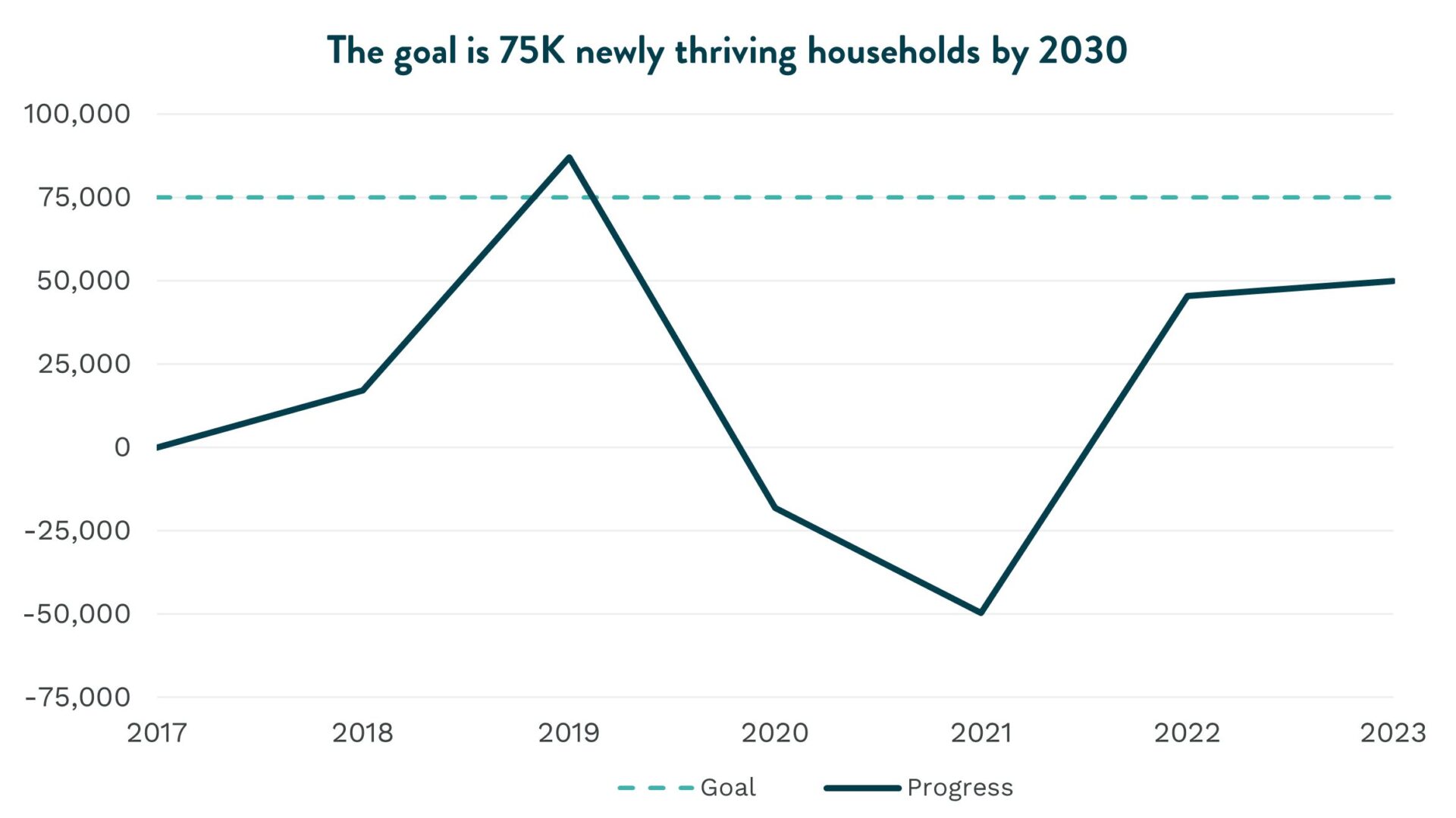
Decreasing affordability in San Diego threatens progress toward all the goals and disproportionately impacts communities of color. Household incomes have not kept pace with the cost-of-living reflected in basic household needs such as transportation, grocery expenditures, and childcare, leaving only one in 10 households able to afford the median-priced home in the region. As of 2023, San Diego has added 49,916 newly thriving households (chart below) bringing the total number of San Diego’s thriving households in the region to 610,983—51.7 percent of total households.

Read the latest Update


Meet SDSU’s Mission Valley Innovation District

San Diego State University (SDSU) is a top-tier public R1 institution that provides transformative educational experiences for more than 43,000 students in person and online, ranking among California’s leading public research universities. Building on this foundation, the SDSU Mission Valley Innovation District extends the university’s mission by fostering collaboration between academia and industry. The 1.6 million square-foot hub for office, technology, and research space creates new career pathways for students, drives regional economic growth, and advances innovative solutions to pressing societal challenges.

Promoting thriving student and faculty households

A significant challenge that SDSU faces in supporting thriving households is the rising home prices and rental costs which far outpace income growth—making it increasingly difficult for students, faculty, and staff to live near campus. For students, housing insecurity can affect academic success and well-being; for employees, it can hinder recruitment and retention, particularly among early-career professionals and those with families.

As SDSU expands through projects like SDSU Mission Valley, the university continues to explore partnerships, policy solutions, and innovative models that increase access to attainable housing while maintaining the quality and sustainability of the surrounding community. Maintaining affordability is a central focus so that students and employees can live and thrive where they learn and work—all essential to advancing SDSU’s mission of opportunity, equity, and regional impact.

Addressing affordability on multiple fronts

SDSU’s Mission Valley Innovation District is designed to advance economic opportunity and improve regional affordability through intentional planning and partnerships. Recognizing housing costs as a primary barrier to thriving households, SDSU Mission Valley will include more than 4,600 residential units, with 10 percent designated as affordable housing. The project’s transit-oriented design connects directly to the trolley, reducing transportation costs and improving access to employment and education. In addition, SDSU continues to explore partnerships that expand childcare options and support working families within the Innovation District.

Hear from SDSU:

SDSU and EDC have a shared commitment to advancing economic growth, regional talent development, and innovation. SDSU continues to invest in EDC, because EDC serves as a vital convener of regional stakeholders, bringing together leaders from government, education, and the private sector who also share common priorities and challenges. Through EDC’s programs, roundtables, and trade delegations, SDSU gains valuable connections and insights that strengthen collaboration across sectors. EDC’s data-informed approach supports evidence-based decision-making, helping partners align strategies to address regional needs in workforce development, housing, and economic growth. This collective effort directly advances SDSU’s mission of driving opportunity and innovation across the region.”

Join the movement

Progress on EDC’s 2030 Inclusive Growth goals is only achievable with and through the region’s employers scaling innovative and intentional solutions. Anchor institutions like SDG&E are helping to collectively pave the way toward a more inclusive regional economy. Join us:

To learn more and get involved in EDC’s work, contact:

Lauree Sahba
Lauree Sahba

Chief Operating Officer

A note from Mark

Our collective power in a time of need

“I am grateful for what I am and have. My thanksgiving is perpetual.”

— Henry David Thoreau

Dear EDC board-members, investors, and friends,

I hope this message finds you well as we head into the final months of the year. It is almost impossible for me to believe that 2026 is right around the corner.

Ensuring San Diego is an attractive and affordable place for talent and businesses remains more important than ever to our region’s resilience and competitiveness. As we all know and understand, the shutdown of our federal government and additional challenges coming from Washington, D.C. are creating undue stresses, strains, and hardship for families, workers, and businesses across our region—at a time when nearly half of all local households are already struggling. Just 51.7 percent of San Diego household incomes have kept pace with the region’s cost of living, meaning that many San Diegans sacrifice quality of life to pay for basic household needs such as transportation, grocery expenditures, and childcare—pressures that disproportionately impact communities of color.

I offer no political observations or critique other than to say that our charity for our neighbors and fellow citizens should never be needed because our government refuses to do its job. Yet in this season of thanksgiving, it is our charity for our neighbors and fellow citizens that is needed most.

With all that said, I could not feel more pride and gratitude for our EDC investors and partners who have been organizing efforts to help those most in need. I am grateful for:

…and many, many more that are a constant resource to families, such as Lifeline Community Services, Neighborhood House Association, YMCA of San Diego County, and local educational institutions and government partners. I see the very best of who we are as a region reflected in the actions, intentions, and service of these partners and leaders. For all of them, my thanksgiving is perpetual.

It is never lost on me that when I write these messages I am writing to our region’s most influential and important leaders. Collectively, you have the power to move mountains. As we head into a holiday season and new year that may continue to add undue stresses, strains, and hardship to the lives of so many around us, let’s not forget the power we have to make people’s days (and lives) better and brighter. Please consider donating to, aligning with, and supporting the work of the organizations listed above, or other organizations in the community whose missions and values best align with yours.

Forever grateful for what I am and have. Forever grateful for all of you.

All my best,

Mark Cafferty
Mark Cafferty

President & CEO

Read EDC’s monthly report

A note from Mark in September: From classrooms to careers

“Summer has come and passed
The innocent can never last
Wake me up when September ends.”
—Green Day

EDC investors, board members, and partners,

It’s that time of year again. If you happen to be a parent or grandparent of a certain age, live near a college or university, or work with or adjacent to higher education in any way, you know that more than 200,000 students have just made their way back to campuses, classrooms, dorm rooms, and lecture halls across our region. All ages and backgrounds. Residents and commuters. Adult learners and recent high school graduates. Hopeful. Motivated. Excited. All the things a region could and should hope for as it looks to grow and sustain a world-class economy and a world-class workforce.

To know and understand anything about the history of San Diego and our economy is to know and understand the value, strength, and importance of higher education. The critical role that our universities, community colleges, and learning communities have played over the last several decades cannot be overstated. As an economic development community, we must never forget what an important role they have played in growing and diversifying our region.

Yet as classes begin this year, unprecedented challenges continue to mount for San Diego and for our nation’s higher education institutions. Federal funding cuts; legal battles for individual universities, systems, and student populations; escalating costs, and constant threats and heated rhetoric coming from Washington, D.C. are all creating strains, burdens, and pressures that will test the system like never before. Even more so within the State of California. But as we look toward an uncertain future, let us continue to draw inspiration, strength, and resolve from the certainty of the past.

The story of higher education in the San Diego region continues to be one of inspirational growth and resilience against the backdrop of near constant challenge. Over the last century, our colleges and universities have grown from educating a few hundred students a year to hundreds of thousands of students a year. Through world wars, depressions and recessions, the rise and fall of industries, near unthinkable technological and scientific advancement, and an almost unimaginable public health pandemic, they have not only endured—they have thrived. As millions of learners have walked across stages to earn their diplomas, they have walked out into our community to start careers, grow businesses, and power industries. The San Diego economy has grown around them and because of them. And it still does.

A new chapter of history surrounds us. The stakes are certainly high for the education community and for the growth and sustainability of our economy. How we react and respond to this moment will tell future generations a great deal about who we were. And someday, if I should appear anywhere in those historical stories and records, you will most certainly find me standing side by side with our leaders and partners in higher education—right where I hope to find all of you as well.

Wishing you well this September,

Mark

P.s., EDC and Junior Achievement are surveying businesses to understand the benefits of hosting interns. If your San Diego company has recently hosted an intern, please share your insight.

Mark Cafferty
Mark Cafferty

President & CEO

STAY ENGAGED WITH EDC

A note from Mark: Summer in San Diego

Another special San Diego summer

EDC investors, board members, and partners,

No matter what may be happening in the world around us, almost any day of the summer months in San Diego might lead you to believe that everything is perfect. And while we all know that perfection is largely unattainable, what is undeniable is that it (once again) feels like a very special summer in San Diego.

From the moment Pride flags are raised throughout our neighborhoods, and the San Diego Convention Center begins its heroic transformation into host, setting, and backdrop for Comic-Con International, the city’s streets truly come to life in July. Over the last 55 years, Comic-Con has grown to become a beloved international brand within the entertainment industry while remaining an anchor event for San Diego’s tourism engine. Meanwhile, San Diego’s Pride Parade/Week continues to attract more than 300,000 attendees and remains the largest annual civic event in the City of San Diego.

As August begins, we have seen San Diego nonprofit Curebound once again raise millions of dollars in its effort to “end cancer in our lifetimes” through its (growing) Curebound Cancer Challenge. Originally known as Padres Pedal the Cause, the event moved from its exciting venue at Petco Park to its new home on the scenic Torrey Pines Mesa. This past weekend, EDC team members joined tens of thousands of cyclists, walkers, and fundraisers as they made their way past the campuses of the very institutions responsible for the scientific research and breakthroughs that are keeping San Diego at the forefront of this global fight.

And whether the remainder of the summer sees you tuning in to the Padres pennant race, attending a concert with the San Diego Symphony at the Rady Shell, or enjoying time on San Diego’s 70+ miles of beaches and coastline, we hope that the warm days and nights ahead remain (near) perfect and special for you, your business, your friends, and your family.

We hope to see you soon at our:

  • Summer Bash on August 14 for a night of networking with more than 300 innovators, live music, delicious bites and drinks, and a short keynote from Kate Therapeutics’ Kevin Forrest, in conversation with LYZZ Capital’s Court Turner.
  • Inclusive Growth Roundtable on August 20 for a progress update on our region’s Quality Jobs Goal, and a roundtable discussion on equipping small businesses to compete.

With respect and admiration,
Mark

Mark Cafferty
Mark Cafferty

President & CEO

STAY ENGAGED WITH EDC

A note from Eduardo: San Diego’s 2025 mid-year check-in

At the top of each year, we try to look ahead to which trends are most worth tracking for the potential impact each can have on our local economy. We began 2025 watching AI and affordability, as well as whether massive investments from both corporations and the federal government would translate into job growth.

We also began 2025 flagging that there would be many wild cards in the year ahead that could knock us off course. As we enter the second half of the year, we want to pause to take stock of what has been a very tumultuous six months, with both immediate impacts and long-term implications.

Affordability and AI

The housing affordability picture looks mostly the same as it did in January: dire. Mortgage rates have bounced around a narrow range while staying above six percent, and the median home price remains just above $1 million, translating to a monthly mortgage payment of about $5,300. This means the annual household income needed to qualify for a conventional loan is more than $260,000, which roughly 12 percent of all households in the region can afford.

AI adoption remains one of the most profound questions in workforce development. San Diego has once again been identified as a ‘star hub’ for AI capacity and adoption, predominantly as a region with high rates of firm readiness and job exposure to generative AI. Tech giants continue to race for AI dominance, which has led to eye-watering compensation packages, record valuations for chipmakers, and $70 billion announced in new federal investments for data centers and power grid upgrades.

What the cut?

Speaking of federal funding, the impact of federal investments on local job growth is more immediate. That’s because all the money that the federal government lined up to invest in re-shoring manufacturing, capacity building for semiconductors, and sustainable energy projects in the last few years has been cut off, significantly scaled back, or temporarily tied up. Oh, and don’t forget state and local public funding cuts.

It is worth noting that much of this remains to be settled as the courts figure out what the Trump administration can legally defund. Yet, much of it is already impacting San Diego’s economy.

New jobs data shows that through the first half of 2025, the region lost 4,900 jobs. This is not as bad as the first six months of 2024 but still trending in the wrong direction. June’s unemployment rate jumped to 4.9 percent (from 4.0 percent in May) as the number of people unemployed rose 14,200—the largest month-over-month increase since the pandemic lockdowns of April 2020.

Private sector job losses are even deeper, down 8,400 year-to-date. Every major sector in San Diego has shed jobs through mid-2025, with the exceptions of Healthcare and Social Services, Leisure and Hospitality, and State and Local Government.

Way too many wild cards in this deck

The pace of new policy directives from D.C. has been overwhelming. The lack of clarity as to whether these policy proposals will be implemented, or are legally enforceable, has been paralyzing. Whether it’s consumers, homebuilders, or manufacturers, the sentiment remains weak.

In San Diego, it’s not just bad vibes. The impacts are real.

The newly-created Department of Government Efficiency (DOGE)’s contract cancellations have started chipping away at our federal workforce, including DoD which spent $20 billion here last year. Proposals to reduce indirect costs associated with federal research grants have led to hiring freezes and layoffs in higher education and could evaporate nearly $448 million from the regional economy. The proposed cuts to NIH and NSF funding would nearly cut in half the region’s $1.1 billion that fuels the research that has led to 99 percent of drugs approved a decade ago. Congress’ latest tax law is set to increase the population of uninsured patients by 1.7 million across California and is already manifesting in workforce reductions at local hospitals, which hasn’t yet showed up in the data.

The up and down tariff threats are the top concern of local businesses that sell in global markets. As one company executive put it, retaliation from countries like China has “completely changed the growth strategy.” These impacts are felt locally in jobs losses to industries like Transportation and Warehousing (down 10 percent, year-to-date) and Retail (down almost five percent). These impacts are also felt by $1 billion less in venture capital, $500 million less in export sales, and 770 fewer employers looking to hire than a year ago in San Diego.

“If you want to go far, go together.”

There are many famous quotes about navigating uncertainty and how resilience drives success. At EDC, we often quote an African proverb: “If you want to go fast, go alone. If you want to go far, go together.”

Collaboration has often defined success in this region; it’s what makes us different.

Whether the winds change and we need to adjust our sails, or whether we fall seven times but pick ourselves up eight, let’s do it together.

As I look into my crystal ball again, I see the next six months will continue to be riddled with uncertainty and unexpected challenges. I also still see a region that is a top three Life Sciences market, a top three market for startups, has the largest concentration of military assets in the world, and the busiest land port in the Western hemisphere. So, we have a lot to build on. As your business works to navigate changing rules, reach new markets, or find talent, don’t go it alone. EDC is here to help.

Onward and upward,

Eduardo Velasquez
Eduardo Velasquez

Vice President, Economic Development & Research
More FROM EDC’s research bureau

More on inclusive growth

Investor Spotlight: Excelerate

As a nonprofit, San Diego Regional EDC is supported by the investment of more than 150 public agencies, companies, and organizations like Excelerate, LLC.

With these investments, EDC provides direct support, aligned with regional Inclusive Growth goals, to companies of all sizes to drive San Diego’s economic prosperity and global competitiveness. EDC sat down with Excelerate, which shared more on its efforts in supporting San Diego’s workforce and business development and exciting collaboration with San Diego’s New Children’s Museum.

Read more about Excelerate’s regional impact and support for EDC.


Tell us about Excelerate and its mission.

Excelerate is a San Diego-based boutique consulting firm that emphasizes strategy implantation across a wide spectrum of industries. Focusing on customer experience and market strategies, organizational enablement, data connectivity and intelligence, and process and digital acceleration, we help businesses by reducing uncertainty, providing actionable insights and paving clear pathways to ROI.

At Excelerate, we believe that solving business problems and forging human connections are the first links in a positive chain reaction that we call the ripple effect. As we deliver positive outcomes, we create ripples of influence and success that radiate outward, gaining size and momentum as they touch more lives with each concentric ring. The profits we enable are an engine of choice that empowers businesses to uplift their employees, communities, and society in unique and meaningful ways.

What are San Diego’s market advantages for workforce and business development?

Excelerate doesn’t focus on any particular industry, meaning our clients come from a diverse set of industries, and San Diego offers a wide range of business types including key industries like life sciences, software, manufacturing, tech, and nonprofits.

The region’s unique diversity of industries allows Excelerate to solve complex business problems—what we do best—and our solutions can begin to pollinate as we apply our approaches across industries. The work we do in one industry often has relevant lessons and best practices to apply to clients in other industries. The region’s diversity enables us to have impact that exceeds the benefit we could bring to a city or metro area that is dominated by one industry.

The same is true of the San Diego talent pool, where people are likelier to have experience across a range of industries, arming them with both broad and industry-specific knowledge and experience.

How does Excelerate collaborate with other regional partners?

Excelerate has recently had the opportunity to collaborate with many local leaders and organizations including our most recent work with San Diego’s New Children’s Museum, which we helped develop a Go-to-Market strategy as it prepared for its expansion. Artopia: NCM Creative Studios was born from this partnership with a fully developed and implemented strategy that ensured not only stellar launch, but enhanced sustainability for the nonprofit. In a time where news involving museums seem to be about closures or lost funding, we are satisfied to help deliver some good news to this sector. Learn more about the collaboration.

Additionally, several of Excelerate’s managers—and our CEO, Jana De Anda—are University of San Diego (USD) alums. So, we maintain a presence at USD job fairs and remain connected with this talent-producing machine that just happens to be in our own backyard.

Also, we would be remiss if we did not specifically call out Garry Ridge’s leadership and tutelage. A San Diego stalwart, Garry has been a mentor to our CEO for almost 20 years, and their relationship has helped Excelerate’s senior leadership team develop a culture-based company.

Finally, one of our very first clients, TaylorMade, gave us an opportunity to showcase our value. As a respected brand, our relationship with them enabled us to build our service offering intentionally, while our work for TaylorMade helped them soar to even higher heights. Our shared success is important to us and exemplifies our San Diego roots.

What does an investment in San Diego Regional EDC mean to Excelerate?

First, San Diego Regional EDC is plugged into all things business in San Diego, making it a great resource for intelligence and information about potential clients and market trends.

Second, EDC hosts some of the best luncheons in the region full of amazing content that brings business leaders together to network and to learn from one another.

But, most importantly, EDC’s mission truly resonates with us. As a small business, it is reassuring to know that EDC is developing short- and long-term strategies that will lead to the city’s continued business success and economic development. A rising tide lifts all boats, and we are happy to do our part to help develop business in San Diego.

Interested in publishing an investor spotlight? Contact our team:

Enya Castañeda
Enya Castañeda

Coordinator, Investor Relations & Marketing Communications

Investor Spotlight: Youth Tennis San Diego and Barnes Tennis Center

As a nonprofit, San Diego Regional EDC is supported by the investment of more than 150 public agencies, companies, and organizations like Youth Tennis San Diego and Barnes Tennis Center.

With these investments, EDC provides direct support, aligned with regional Inclusive Growth goals, to companies of all sizes to drive San Diego’s economic prosperity and global competitiveness. EDC sat down with Ryan Redondo, CEO of Youth Tennis San Diego and Barnes Tennis Center, which shared more on its efforts to grow San Diego’s racquet sport footprint and help regional youth build confidence on and off the court.

Read more about Youth Tennis San Diego and Barnes Tennis Center’s regional impact and support for EDC.


Tell us about Youth Tennis San Diego and Barnes Tennis Center and its mission.

As CEO of Youth Tennis San Diego and Barnes Tennis Center, I’m proud to lead an organization that has served as a cornerstone for youth development and community engagement in Southern California for more than seven decades. Our mission is simple but powerful: To inspire and provide opportunity through tennis, education, and character development for children from all backgrounds, especially those in underserved communities.

At the heart of our work is the Point Loma-based Barnes Tennis Center, one of the premier public racquet sport facilities in the country. A hub for youth empowerment, educational support, and family connection, we provide access to free and low-cost tennis programs, after-school enrichment, tournament training, and college prep resources. Our programs reach thousands of children each year, equipping them with life skills that go far beyond the court.

We believe racquet sport is a vehicle for change. That’s why we invest in grassroots outreach, regional partnerships, and inclusion. Our aim is to remove barriers to participation, build confidence and resilience, and open doors for children to achieve their full potential—whether in tennis, academics, or life.

What makes San Diego perfect for tennis, pickleball, and padel?

San Diego is unmatched when it comes to racquet sports. With our year-round sunshine, active community, and world-class facilities, it’s no surprise that tennis, pickleball, and padel are thriving here. Our region’s blend of lifestyle, diversity, and innovation make it the perfect environment for racquet sports to grow.

As more people take to the courts—especially in pickleball and padel—we’ve broadened our programming to include these fast-growing sports alongside tennis. The response has been incredible, and we have seen other facilities open that will positively stimulate economic development for the region.

Why have Youth Tennis San Diego and Barnes Tennis Center chosen to invest in EDC?

At Youth Tennis San Diego and the Barnes Tennis Center, our mission is rooted in creating opportunity for children from every corner of our community.

We chose to invest in EDC because we believe that access—to sport, education, and employment—should not be dictated by zip code. EDC’s efforts to cultivate diverse talent pipelines and foster inclusive economic development directly support our work both on and off the court. Additionally, as we expand programs in pickleball, padel, and tennis, we’re increasingly involved in infrastructure, workforce, and public-private collaboration. EDC has been a key partner in helping us navigate permitting, incentives, and strategic partnerships—particularly as we grow our facilities, enhance accessibility, and scale community impact.

How does the organization collaborate with other regional partners?

At Youth Tennis San Diego and the Barnes Tennis Center, community connection is at the core of everything we do.

We work closely with regional hotels and universities to hire interns, coaches, and staff, creating real-world pathways for San Diegans interested in sports management, education, health, and nonprofit work. We also collaborate with local schools, community centers, and fellow nonprofits to offer free racquet sport programs, support after-school and summer initiatives, and provide educational resources and college preparation. Through partnerships with regional companies and utilities, we work to improve facility sustainability and expand access to technology for underserved youth and local businesses, as well as host international-caliber tournaments, including the Association of Tennis Professionals, Women’s Tennis Association, and junior events that elevate San Diego on the global stage.

Barnes Tennis Center is set to host 2025 USA Pickleball National Championships. What is the significance of this moment?

Hosting the 2025 USA Pickleball National Championships at the Barnes Tennis Center is a monumental moment—not just for our organization, but for San Diego’s tourism industry and national sports reputation.

This prestigious event will bring tens of thousands of players, fans, vendors, and media professionals to our region, injecting millions into the local economy and continuing to position San Diego as a premier destination for high-profile racquet sport events. For Youth Tennis San Diego, this will allow us to showcase our mission to a national audience, elevate community engagement, and generate funding and awareness to support our youth access initiatives.

The championships underscore San Diego’s role in the future of racquet sports. We’re not only keeping up with the evolution of pickleball—we’re leading it.

What is on the horizon?

2025 is shaping up to be one of the most dynamic and impactful years yet for Youth Tennis San Diego and the Barnes Tennis Center. We invite San Diego to join us at one of our upcoming events, including the Major League Pickleball Playoffs and USTA Billie Jean King National Championships in August, the Wimbledon-Chic Gala in October, and the Impact Cup Pickleball this fall.

Through our long-standing partnership with Price Philanthropies, the USTA Foundation, and the City of San Diego, we continue to operate a National Junior Tennis and at Urban Village in City Heights, providing free tennis, education, and life skills for youth in one of San Diego’s most diverse and vibrant communities.

From hosting national championships to building grassroots programs, we will continue to focus on one goal: Creating opportunities through sport that last a lifetime.

Read more about EDC’s investors in our investor spotlight blog series, and join the Youth Tennis San Diego, Barnes Tennis Center and 150 investors committed to supporting the region’s inclusive economic development by becoming a member of EDC.

Interested in publishing an investor spotlight? Contact our team:

Enya Castañeda
Enya Castañeda

Coordinator, Investor Relations & Marketing Communications

EDC celebrates 60th anniversary, welcomes Padres’ Tom Seidler as board chair

As San Diego Regional EDC celebrates 60 years since its founding in 1965 and continues to drive an inclusive economic development strategy for the region, outgoing Board Chair Jennie Brooks passes the gavel to Tom Seidler, Executive Vice President, Community & International Impact of the San Diego Padres.

“It was my brother Peter who first asked me to represent the Padres on the EDC board.

Tom and late brother Peter Seidler, ownership of the San Diego Padres

I am honored to take on this new role and work even more closely with EDC’s team. Our mission is to drive greater inclusion, innovation, and growth across San Diego in order to better elevate our people, businesses, and identity on the global stage,” said Tom Seidler, Executive Vice President, Community & International Impact of the San Diego Padres. The Padres, which employs more than 1,200 San Diegans, have become a consistent playoff contender and top-three team in attendance over the past several years.

While San Diego faces new pressures at the local, state, and federal level, and while residents and businesses are continually challenged by the affordability crisis, the goalposts outlined in the Inclusive Growth Initiative are more important than ever. It is an economic imperative that the region create more skilled talent, quality jobs, and thriving households, or San Diego’s competitiveness is at risk.

“I am proud to pass the gavel to my colleague and friend Tom Seidler in this milestone year,“ said outgoing Chair Jennie Brooks, Executive Vice President at Booz Allen Hamilton, who served a three-year term which saw EDC’s largest headcount and budget during a time of post-pandemic economic recovery. “EDC’s employer-led, data-driven approach makes crystal clear the needs of the economy and the onus of the business community in making a difference. I know Tom will continue this important work and set us on the right path for EDC’s next 60 years.”

As Chair, Seidler is supported by five officers: Vice Chair Kevin Pegels, Head of Global Quality & Operations, Illumina; Vice Chair Karen Reinhardt, Head of HR, US, ASML; Vice Chair of Inclusive Growth Lisette Islas, CEO, Lifeline Community Services; Treasurer Manuel Rodriguez, Market President, San Diego Commercial Banking, U.S. Bank; and Secretary Jane Finley, Senior Vice President & Area Manager, Kaiser Permanente.

Along with the election of a new chair, EDC’s board also elected five new directors: Tyler Carter, Park President, SeaWorld San Diego; Brunson Howard, Market Leader & Senior Managing Director, CBRE; Richard Neale, Corporate Executive Vice President, Chief Business Development & Growth Officer, Scripps Health; Jennette Shay, COO, Price Philanthropies Foundation; and Dan Skopec, Senior Vice President & CRO, San Diego Gas & Electric.

EDC is a membership-based nonprofit organization that mobilizes government and civic leaders around an inclusive economic development strategy in order to connect data to decision making, maximize regional prosperity, enhance global competitiveness and position San Diego effectively for investment and talent. The organization’s more than 150 investors (members) range from rising stars like NOVO Brazil Brewing Co., to the region’s largest employers like Qualcomm and Illumina, to leading anchor institutions such as universities, hospitals, and sports franchises, among others.

“As a beloved San Diego leader, Tom is perfectly positioned to lead EDC in this unique moment in time. Notably, he has moved through each EDC officer role, serving as past secretary, treasurer, and vice chair,” said Mark Cafferty, President & CEO, San Diego Regional EDC. “With a national climate as challenging as this, Tom’s humility, leadership, and deep understanding of San Diego’s strengths and opportunities are exactly what the organization needs as we strive to make San Diego a model for the nation and the world.”

EDC officially welcomed Tom Seidler as Board Chair at its Annual Dinner event at Petco Park on Thursday, May 15.

Learn more & get involved