I hope this message finds you well as we close out the first quarter of 2026. It was a shaky and unpredictable quarter for the region and the nation in so many ways. Yet through it all, our team at EDC continues to draw great inspiration from all of you as you stay committed to the success of your companies and to the health of the communities around you.
We know through our own research and data that important elements of San Diego’s economy are competitive and growing. However, we also know that we are facing a challenging inflection point: Our current growth is running parallel to the region’s persistently high cost of living, wide income gaps, and the ability for all San Diegans to live comfortably and thrive.
Simply put, our progress is not outpacing our problems. And that isn’t something to run from or ignore—but rather something to face and resolve.
As San Diego continues to see some gains toward its 2030 Inclusive Growth goals—increasing quality jobs within small businesses, increasing post-secondary education completions, and enabling more thriving households—our long-term success relies on both economic and inclusive growth. Still, and always. Without focusing on both, we risk losing talent to more accessible regions, constraining local spending, corroding our robust innovation economy, and stalling our (global) competitiveness for the future.
I invite you to explore our recently released 2030 Inclusive Growth Progress Report. The results are mixed, but the path remains clear. Every challenge presents us with an opportunity, and every opportunity puts us one step closer to a prosperous and sustainable future for our region.
With gratitude and respect,
Mark Cafferty
President & CEO
San Diego Regional EDC
EDC’s Inclusive Growth blog series highlights and celebrates local companies and organizations helping drive economic growth and progress toward San Diego’s 2030 Inclusive Growth goals.
Launched in 2018 and informed by a partnership with the Brookings Institution, the Inclusive Growth initiative sets 2030 goals for San Diego related to increasing: 1) the supply of talent, 2) quality small business jobs, and 3) newly thriving households. The goals inform San Diego’s economic priorities and make the business case for economic inclusion.
Regional talent demand remains high
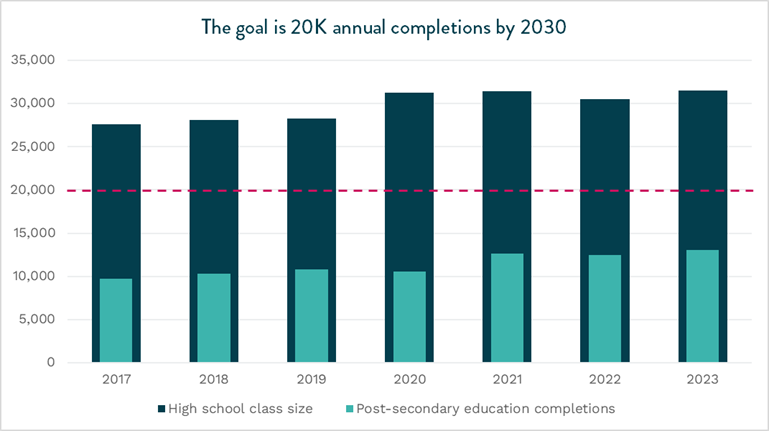
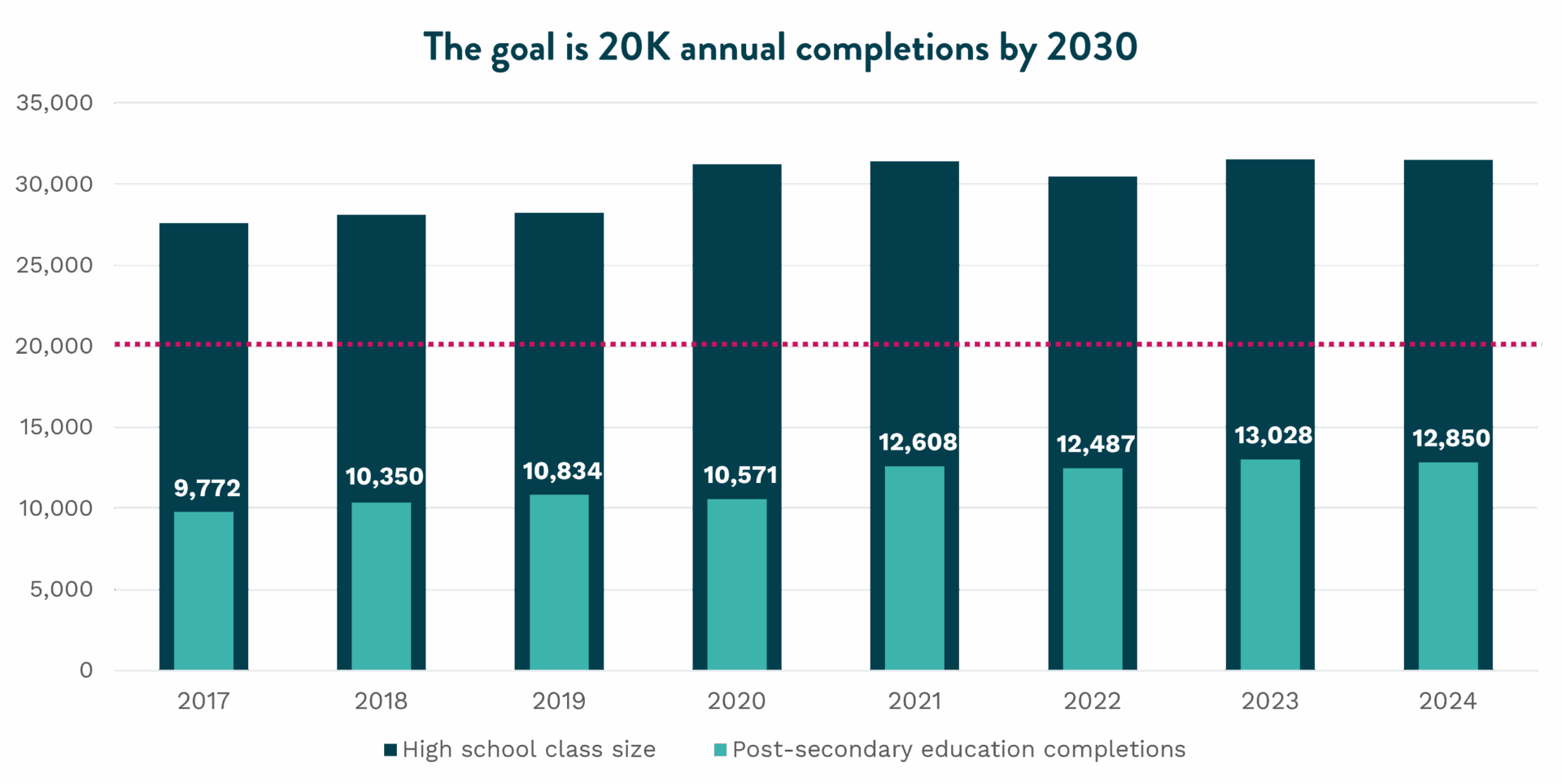
To maintain economic competitiveness, the region needs 20,000 students per year completing post-secondary education within six years of graduating high school.
While progress toward the goal has increased incrementally since 2017, talent scarcity has become the new normal as hiring demand exceeds the supply of talent across industries. Compounding this challenge, student success is demographically uneven as Hispanics and Latinos only account for 17 percent of residents over 25 years old with at least a bachelor’s degree. Employer-led talent pipeline development efforts are critical to the future of San Diego’s economy, and Cajon Valley Union School District is among those working toward a solution.
Meet CVUSD
The Cajon Valley Union School District (CVUSD) serves approximately 18,000 students across 28 schools spanning more than 60-square-miles in East San Diego County. Located in one of the most culturally and linguistically diverse regions of San Diego, the district has earned national recognition for its innovative approach to education, its commitment to whole child development, and its focus on preparing students for meaningful futures. At the center of the district’s work is a mission that guides every aspect of its approach to education: Happy Kids, Healthy Relationships, on a Path to Gainful Employment.
This mission reflects a belief that schools must do more than deliver academic content. Schools must help young people understand who they are, what they care about, and how their strengths can translate into meaningful contributions in the world.
An opportunity to re-define career preparedness
CVUSD serves one of the most diverse student populations in San Diego County. Many students are multilingual learners, newcomers to the United States, or the first in their families to navigate American education systems and postsecondary opportunities.
At the same time, San Diego faces a significant workforce development challenge, requiring education systems to rethink how they prepare students for the future. Historically, K–12 education and workforce development systems were not designed to respond dynamically to labor market changes, emerging industries, or employer needs. CVUSD has addressed this challenge by intentionally redesigning the student experience around identity, relevance, and future readiness.
An innovative approach to career-connected learning
Over the past decade, CVUSD has become nationally recognized for its World of Work framework—an innovative system that integrates career awareness, strengths discovery, and real-world learning experiences throughout the K–8 educational journey. Using the Realistic, Investigative, Artistic, Social, Enterprising, and Conventional career development assessment and model, students research professions aligned with their interests and strengths, interview professionals about their work, and present their findings through projects that connect classroom learning to real professions and pathways.
Career literacy is embedded throughout the curriculum. Students encounter real-world applications within reading and writing assignments, research projects, collaborative problem-solving challenges, and presentations that strengthen both academic and professional communication skills. Equally important, students regularly interact with professionals across San Diego’s major industry sectors.
This approach helps students see purpose in their education. In a recent district survey, 73% of students in fourth through eighth grade agreed with the statement, “The things I’m learning in school are important to my future.” This data reflects a powerful shift in how students experience learning, understanding that what they are studying today connects directly to the opportunities they may pursue tomorrow.
To expand these opportunities even further, CVUSD recently launched the World of Work Foundation, a nonprofit initiative designed to connect schools, employers, and community organizations around a shared vision for workforce development, and therefore expanding mentorship networks, employer partnerships, youth apprenticeship opportunities, and work-based learning experiences for students throughout the region.
In a region working to close opportunity gaps and build a stronger talent pipeline, CVUSD is preparing young people not only to graduate but to thrive.
Join the movement
Progress on EDC’s 2030 Inclusive Growth goals is only achievable with and through the region’s employers scaling innovative and intentional solutions. Anchor institutions like SDG&E are helping to collectively pave the way toward a more inclusive regional economy. Join us:
Endorse the goals, and be part of the change San Diego’s economy demands
June 17—Save the date for EDC’s Inclusive Growth Talent Roundtable
Last month, EDC’s Vice President of Economic Development and Research Eduardo Velasquez reminded us that San Diego stands at an inflection point—where technological transformation is colliding with long‑standing economic challenges in ways previously unseen. His note highlighted a region defined by promise and pressure: Slowing innovation‑sector job growth, rising household incomes shadowed by affordability constraints, and AI reshaping the very nature of work.
A month into 2026, more questions than answers remain, especially when it comes to talent: What is the role of post-secondary education in our changing region? How is AI shifting jobs and industries? And what does this mean for San Diego’s early career talent, our region’s leaders of tomorrow?
Built on talent—but facing new realities
San Diego’s economic engine has always been its people. With more than 100 research and education institutions, our region has long produced the skilled talent that fuels innovation, defense, life sciences, and advanced manufacturing.
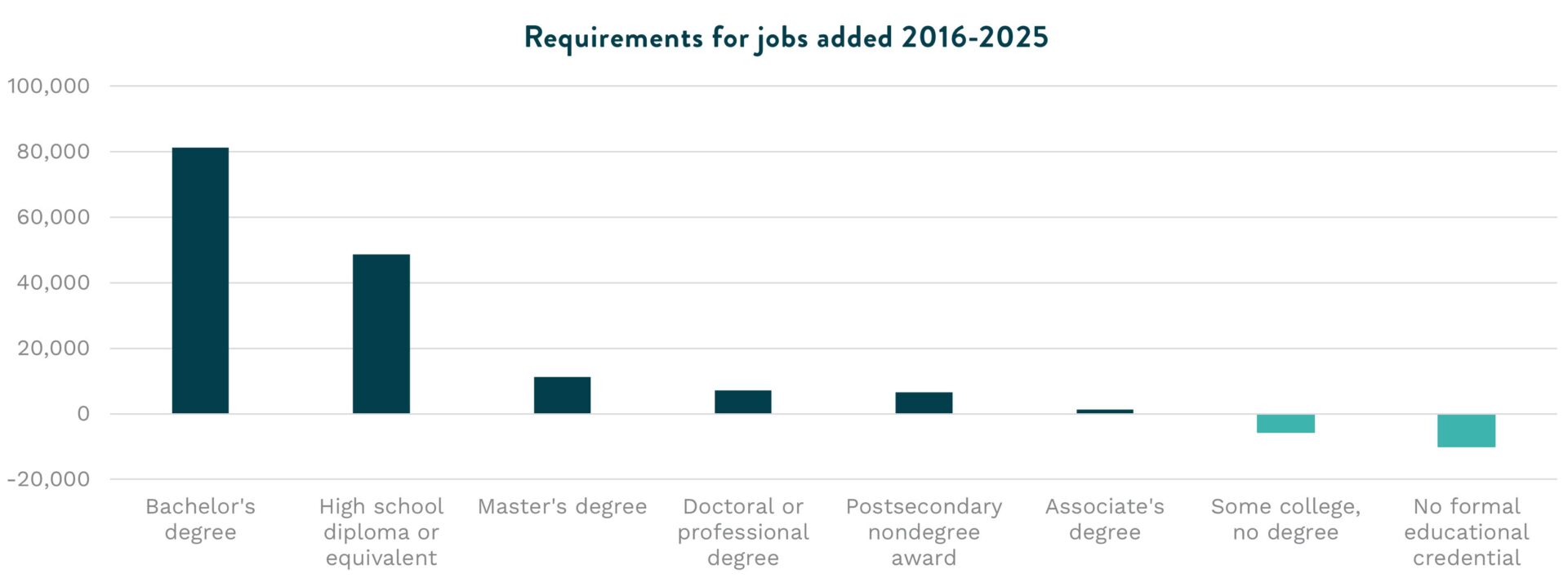
The good news: More San Diego students are completing degrees and credentials than ever before. The region has sustained progress in completions, even as the pandemic’s long‑term impacts remain murky. But the data also makes one thing clear: Post-secondary education is more critical than ever. Jobs requiring a bachelor’s degree or higher continue to grow at a significantly faster rate than those requiring less education. In fact, in 2025, San Diego added six times more jobs requiring a bachelor’s degree or more versus those requiring an associate degree or less.
Additionally, the growth of legacy industry clusters that have served as the backbone of San Diego’s global competitiveness—tech, life sciences, and manufacturing—is slowing down. While bright spots remain in emerging industries like cleantech and aerospace (namely defense technology) that are critical to the region’s future competitiveness, transformations in these industries and varied levels of AI integration represent significant changes to the entire U.S. economy. Their effects will ripple throughout the whole workforce.
Take the cleantech industry, for example, as policy-backed efforts to decarbonize in California are leading to more electrification. As buildings modernize, we might expect increased need for electricians, while the need for gas-line plumbers decreases. The auto mechanic historically focused on combustion engines must now become familiar with hybrid and electric motors. And the manufacturing company that embeds machine learning and automation now requires a person who can analyze and tell a story with the resulting data.
A future workforce that doesn’t yet see a future
Across the U.S., young college‑educated workers are facing a “unique convergence of structural forces” that have severed traditional entry points into white‑collar work.
AI is accelerating this shift. Automation and augmentation are happening within jobs, not just across them. The occupations where automation potential is high are the same ones where augmentation potential is high—meaning AI may not necessarily eliminate an occupation, but rather transform how an employee executes their tasks.
With lower barrier to entry tasks most exposed to automation, the entry-level or new graduate workforce risks being edged out of opportunities to launch. Meanwhile, the nature of the tasks exposed to augmentation will require mid-level workers to continue upskilling to remain competitive.
As for long-term impacts? It’s too early to tell. San Diego’s labor market data does not yet reflect an overhaul of entry-level roles. Job growth across innovation industries at all levels has declined over the last few years, and while entry-level job growth has declined slightly faster, it has not been the job elimination of our nightmares.
What remains constant in our conversations with employers across industries and occupations is a need for soft skills that will never be automated. Skills like communication, empathy, and problem solving are more fashionable than ever. In fact, this demand has been so persistent that workforce developers and educators have taken to calling these “durable” skills—though figuring out how best to cultivate them in students may be the next great challenge.
In a time of transitioning tech, too, regional employers are doubling down on opportunities to future-proof their workforce. We’ve heard from San Diego companies that are making a deliberate effort to traditionally train early career employees in the skills AI could support, both to strengthen institutional knowledge and develop future leaders. And local tech heavyweights are continuing to proactively invest in both tomorrow’s talent and technology, maintaining internship programs that convert as many as three in four interns to full-time roles and leveraging new technologies early to instill technical skills in the emerging workforce.
Lean in with us
To meet these challenges, EDC is doubling down on initiatives that align education, industry, and talent. Through regional and even national partnerships, we will continue to facilitate work-based learning like internships and apprenticeships, and equip the region to better understand its labor market needs.
Here’s how you can lean in:
Host a summer intern from a Verified Program: All intern hosts will work with an employer of record and have access to a pre-vetted batch of resumes. Small businesses may qualify for interns’ wages to be subsidized or fully covered. Learn about our Advancing San Diego internship program.
Hire from Verified Programs in San Diego: These local programs are employer-verified for teaching in-demand skills as well as serving a diverse student population. To connect with a Verified Program, reach out to EDC.
Help us collect critical regional talent data: With so many remaining questions, it has never been more important for training and education institutions to keep a pulse on future talent demand. Our talent data dashboard, annual talent survey, and talent demand reports help local education programs prepare San Diegans with the skills your company needs. If your company is experiencing shifts in talent needs, we want to hear about it.
San Diego’s future workforce is diverse, ambitious, and full of potential—but only if we build the systems that allow every resident to participate in and benefit from our innovation economy.
Your collaboration and investment—whether through hiring, training, curriculum partnerships, or direct support of EDC initiatives—continues to ensure that San Diego can cultivate the talent that creates, attracts, and retains cutting‑edge companies, strengthens our innovation clusters, and secures San Diego’s economic future.
As another year begins, I sit with my crystal ball once again to see what we can glean from the data we’ve received this past year and what implications it may have for our region’s economic growth in the year ahead.
The past year told a complex story, driven by uncertainty. On the surface, the U.S. economy performed remarkably well, achieving 4.3 percent real GDP growth in Q3 2025, representing an acceleration from a year ago. But this growth has been buoyed by unprecedented investment in AI led by a handful of companies, potentially masking deeper structural shifts beneath the surface.
The U.S. achieved this growth while creating just 584,000 jobs—roughly one-third the rate seen in the past decade. And while San Diego gained its fair share, adding 5,800 jobs through November 2025, all our job growth was principally concentrated in higher education, healthcare, and local government.
In 2026, San Diego stands at an inflection point—one where technological transformation collides with traditional economic challenges in ways we haven’t seen before.
Innovation industries are losing steam
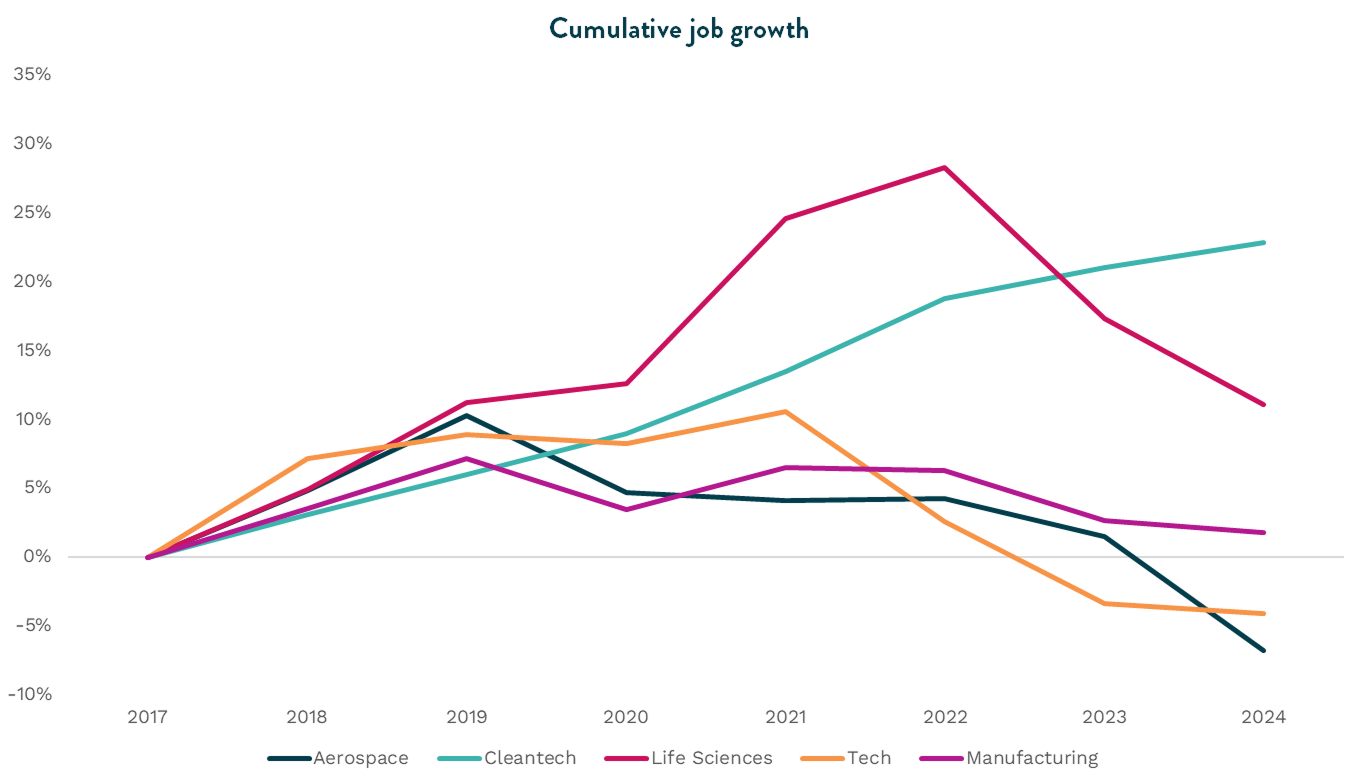
Our region’s innovation engines—the traded clusters that have long defined San Diego’s competitive advantage—are sputtering. Cumulative job growth across aerospace, life sciences, tech, and manufacturing has plateaued or declined from pandemic-era peaks. Cleantech continues to add jobs, though it represents a smaller sliver and is also growing at a slower pace than in previous years. More concerning, it’s not just leaner firms we’re seeing, but fewer firms altogether. Firm growth across these key industries has stagnated, with only defense tech startups providing a bright spot in an otherwise sobering picture.
This matters because innovation industry jobs have an outsized impact on our economy, with each added job supporting another two jobs elsewhere in the economy. When these jobs contract, the ripple effects are significant.
So what’s going on? In part, it’s a tale of structural transformation. Professional, scientific, and technical service jobs, which our innovation cluster relies on, declined 3.3 percent through November 2025. Meanwhile, an additional 550,000 square feet of office space were vacated during the year, bringing total vacant space to 11.3 million square feet in a year with zero new construction. 2025 showed our region’s economy is increasingly dependent on fewer knowledge workers and thus less office space to host those workers.
Yet, investment is happening. Nationwide, construction spending toward data centers is set to eclipse that of traditional office buildings—a trend that accelerated dramatically after ChatGPT’s release. Infrastructure investments are building for servers, not people.
AI is picking up the slack, for now
Amid this disruption comes a silver lining—AI may be delivering what all new technologies promise: Productivity. Looking at inflation-adjusted average wages as a proxy for productivity growth, San Diego’s innovation industries have recovered from the pandemic. AI may be responsible for this recovery, enabling workers to do more with less. This could help explain the decline in local job postings, which fell six percent in 2025.
The question is whether this productivity boost translates into broader prosperity or simply allows companies to operate with smaller teams.
San Diego’s talent landscape reflects this uncertainty. While the value of a degree has been questioned more than perhaps any time in history, it still brings higher income and greater job security in our region. In the past decade, more than twice as many local jobs have been added that require a bachelor’s degree or higher than those requiring associate’s degrees or less. This trend accelerated in 2025, with jobs requiring bachelor’s degrees or higher outnumbering others by a factor of six.
Yet, new graduates are struggling in a job market that increasingly favors experience alongside credentials. The national unemployment rate for young college graduates stands at 4.8 percent, up more than a percentage point compared to before the pandemic.
The market signal is clear: Disruption continues to favor those with degrees and experience, even as the nature of work itself transforms.
Affordability is not a hoax; it’s an enigma
Incomes are up and people are spending their money, but they’re not happy about it. That’s because the essentials like housing, childcare, energy, and transportation continue to get more expensive—local energy prices, for instance, are up nine percent year-over-year as of November 2025.
Housing affordability remains the single biggest threat to regional prosperity. While San Diego’s median household income has increased 25 percent since 2020—a welcome development—the cost of homeownership has far outpaced these gains. The median-priced home fell slightly to $990,000 in Q3 2025, requiring a household income of $263,000 to afford the monthly mortgage payment. Even those looking to rent are facing an average monthly outlay of $2,900, which makes San Diego one of the most expensive counties to rent in the nation.
There’s a glimmer of hope: San Diego home sales increased 14 percent year-over-year in September 2025, suggesting some movement in a frozen market.
Yet meaningful housing market recovery will remain elusive until mortgage rates drop substantially enough to free homeowners locked into historically low rates or make room for significant new supply.
The year ahead
These trends—the pace and composition of job growth, AI’s impact in the demand for talent, and housing affordability—will define San Diego’s 2026.
Can we leverage regional strengths to capture new growth opportunities, particularly in defense tech where startups show momentum? Will hiring priorities shift to tap new pools of talent as employers rethink what it means to be a skilled worker? How do we make room for more housing in a region where working families are increasingly priced out, while the office is increasingly empty?
The answers aren’t in my crystal ball.
They require deliberate action through an intentional, inclusive economic development agenda. We must make sure our region—and our state—is a place that not only cultivates great ideas but also enables the realization of those ideas into solutions, products, and jobs. We must make it easier for builders to build infrastructure and easier for businesses to do business.
In 2026, EDC will work to position San Diego as the destination for defense tech investment, build pipelines to better address employers’ evolving talent needs, and identify opportunities to replace unused office with much needed housing and infrastructure for working families.
But we can only do this with and through you—our partners across industry and academia, local and state government.
Now more than ever, our goal remains constant: To maximize San Diego’s economic prosperity and global competitiveness through meaningful partnerships with our 150+ investors and regional stakeholders. We know where we are and where we need to go. Getting there in 2026 will require resolve, creativity, and bold action—together.
EDC’s Advancing San Diego (ASD) internship program, run in partnership with the Border Region Talent Pipeline K-16 Collaborative and Imperial Valley EDC, has transformed how students across San Diego gain early career experience, while helping local businesses address talent needs. In Summer 2025, the ASD program placed 210 interns at 110 companies across San Diego and Imperial Counties, creating an invaluable bridge between education and industry in high-growth, high-wage fields like engineering, computing, and business. This program plays a crucial role in addressing regional talent shortages, helping local companies access vetted, diverse talent and offering students paid, hands-on learning opportunities in high-demand industries.
Summer 2025 by the numbers
*Priority populations include low-income individuals, first-generation college students, current community college students or community college transfers, veterans and active-duty military students, and students with disabilities
Addressing the talent gap with community impact
At the heart of ASD’s mission is a commitment to reaching under-resourced communities, ensuring that students from diverse backgrounds gain valuable career experience while helping local businesses address critical talent needs. Companies apply each year by early spring to host students from Advancing San Diego Verified Programs to be interns. These Verified Programs are selected based on industry-determined criteria, including industry engagement, diversity, equity, and inclusion, as well as curriculum that teaches the most in-demand skills in computing, engineering, and business. This approach ensures that students’ skills align with evolving workforce demands, enhancing the overall impact of the internship experience.
EDC recruits local small to medium-sized businesses to host interns, and once companies are selected, students from Verified Programs apply for available internship roles. With more student applicants than available positions, students from priority populations receive preferred access to internship positions. In Summer 2025, 82 percent of interns identified with one or more priority populations, up nine percent from 2024. Importantly, the program provides financial support covering intern wages at a competitive rate. In 2025, local companies saved more than $1 million in payroll costs, ensuring businesses can prioritize mentorship and on-the-job training over recruitment logistics.
Real-world experience and career advancement
Each year, the internship program provides students with valuable work experience directly linked to their academic pursuits, equipping them with practical skills and career confidence. At the same time, companies benefit from student contributions. Surveyed companies shared that hosting interns improved their outlook on early-career talent: 91 percent agreed or strongly agreed that the program increased their likelihood of hiring a university student, and 82 percent said the same for community college students. For employers, this means a pipeline of highly motivated, well-prepared candidates who bring immediate value.
Day in the Life of a San Diego Intern video campaign
During the 2025 summer internship program, ASD launched its first “Day in the Life of a San Diego Intern” video campaign, inviting interns to share a glimpse into their internship experience through short videos. Thanks to generous donations from the San Diego Padres, San Diego FC, San Diego Wave FC, San Diego Zoo Wildlife Alliance, and SeaWorld San Diego, ASD was able to give five lucky winners tickets to signature San Diego experiences. The video campaign gave ASD interns the opportunity to share their professional experiences with the local business community and increase exposure of careers in San Diego to diverse groups of local young talent.
“After our sixth year partnering with this valuable program, Left Coast Engineering has hosted more than a dozen interns across electrical, mechanical, and aerospace engineering, plus computer science majors. As a small business here in San Diego since 1999, we see this as an opportunity to help develop and equip these engineering students with both the skillsets and mindset for successful product development. Our goal is to help engineers graduate with more experience and more value to benefit any hiring company.”
—Anita Baranowski, CEO, Left Coast Engineering
Is your company interested in hosting summer interns in 2026?
“Giving Tuesday” officially began in 2012 as a fundraising campaign associated with the 92nd Street YMCA in New York City. Today, it has grown to become a “global generosity movement, unleashing the power of people and organizations to transform their communities and the world.” In just 13 years, the effort has gone from raising a few million dollars to support a single cause/campaign to raising billions of dollars for organizations and causes across the globe.
With the Thanksgiving holiday behind us and the year-end holidays just weeks away, we encourage everyone to continue to practice and promote the generosity and kindness that has had such a strong impact in our community over the last few months and throughout this past year. Our own local ‘generosity movement’ has meant the world to individuals, families, and valued institutions during a very difficult time.
Among the list of important and valuable causes, initiatives, and organizations within our region, one effort that remains near and dear to my heart—and one that our work at EDC has become fully aligned with—is that of youth employment and internship programs. As many of you know, I started my career working in school-to-work and school-to-career programs in Boston’s high schools and community colleges. Decades later, I have seen how those very programs changed and improved lives while strengthening and supporting the city’s economic growth and prosperity. We have started to see the same results here in the San Diego region through our Advancing San Diego program, partners, and the Border Region K-16 Collaborative.
As we head into 2026, Advancing San Diego’s post-secondary internship program that has been so generously supported by JPMorganChase and the state of California over the last few years is seeking new and sustained funding and support. Recognizing it as both a critical and important talent recruitment strategy for employers and an impactful work and learning experience for our local first-generation college students, we are hoping that far more San Diego-based employers will lean in to support the program in 2026. For more information on hosting an intern at your business this coming summer, please contact Taylor Dunne. Just hosting and supporting one more intern makes a world of difference.
And for those who cannot host an intern but still wish to support these efforts financially, we encourage you to make a donation to our 501(c)3 to ensure we can maximize the number of young people we place this summer at small and growing businesses. A $7,500 donation will fully cover the wages for an intern for the entire summer at a San Diego small business. A $500 donation will support the transportation, professional clothing, and any other support services needed by most students (especially those who are from more under-resourced backgrounds). And any donation will help support, grow, and advance this important cause.
We know that there are so many important initiatives and organizations that need support right now, but we also know that this is one way where your donation can help individuals and families within our region while also strengthening our economic outlook for the future.
As always, we cannot thank you enough for your leadership and support over the past year, and we look forward to working by your sides to make the year ahead as strong and stable as possible for our region’s businesses, workers, and households.
Strengthening San Diego’s RN pipeline and expanding specialty training
Healthcare is San Diego’s second largest sector, supporting 160,000 jobs throughout San Diego County and providing critical care for our community. However, a national nursing shortage and aging population are intensifying the demand for skilled healthcare professionals. Simultaneously, communication breakdowns between regional industry and education are leading to misunderstandings around the supply and demand of talent.
To better understand San Diego’s regional demand for talent, EDC’s Advancing San Diego program conducted a comprehensive talent demand survey focused on priority roles in healthcare. The survey engaged nine of the region’s largest healthcare providers, collectively employing 66,000 and operating more than 175 regional facilities, to understand real-time data around critical nursing positions.
Key findings
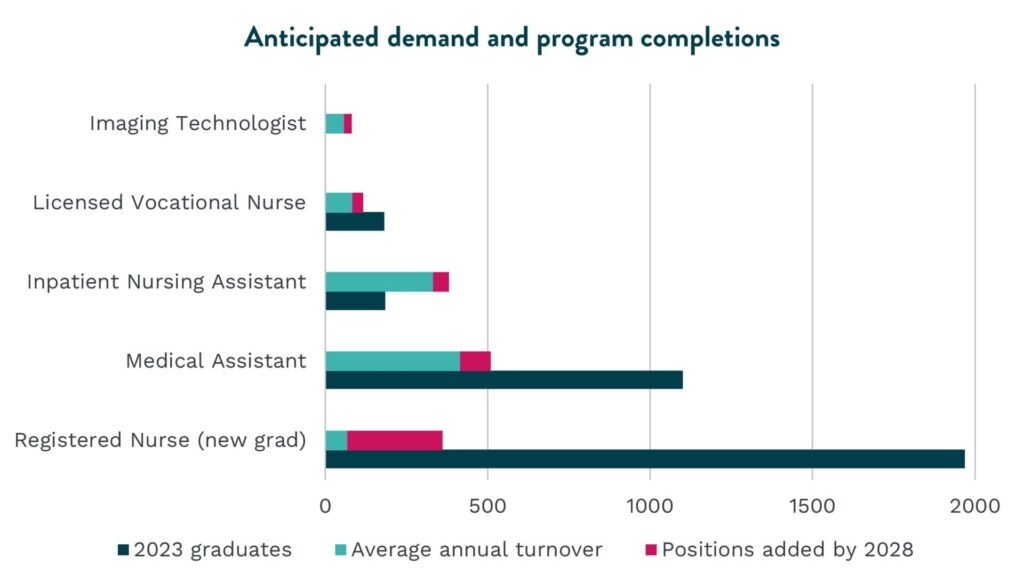
Like much of the nation, San Diego faces a critical shortage of skilled nurses, with the highest demand for Registered Nurses (RNs). Labor market information indicates that the region will need more than 1,500 additional RNs in the next three years, but data from this working group revealed that new graduate nurses—those who have recently completed a training program—account for just 300 of the in-demand roles. Meanwhile, the region is graduating around 2,000 new RNs each year.
Most of the future regional demand for RNs will focus on specialization. Employers identified Operating Room RNs as the highest priority for specialty roles.
Regional healthcare employers reported a misalignment in the training of Radiological Technologists. 100 percent of surveyed employers said that cross-training Radiologic Technologists and Computed Tomography (CT) Technologists would add value to their organizations and emphasized a need for additional Imaging Technologists (X-ray, CT, Sonography, etc.) in the region.
While traditional labor market data shows more than 15,000 regional job postings for RNs in 2024, the bulk of these postings are actually for experienced and specialty nurses, not entry-level roles. At the same time, regional education programs are graduating close to 2,000 RNs each year. The available labor market data does not differentiate demand based on entry-level versus experienced roles, creating a misalignment between employer need and the talent pipeline.
This misalignment illustrates how readily available labor market data—often the primary source for education institutions and policymakers—can misrepresent actual workforce needs
EDC’s employer working group verified this, reporting that regional demand for specialty RNs significantly outpaces demand for new graduate RNs, and ranked Operating Room, ICU/Critical Care, and Labor & Delivery RNs as their top hiring priorities.
Furthermore, as many employers pointed to the oversaturation of new graduate RNs as one reason for the frequently cited shortage of clinical placement opportunities, hospitals must balance the need to upskill incumbent nurses with the growing demand for new grad placements, all while working with an already strained pool of available preceptors. While many hospitals invest heavily in internal training to grow their staff, this model puts the burden of training solely on hospitals who are already feeling the strain of a limited workforce. Limited clinical placement capacity, high costs, and competition across healthcare systems make it increasingly difficult to keep pace with growth and turnover.
Across the nation and in San Diego, specialty RNs remain at the heart of quality care and operational efficiency, nursing career mobility. They support the next generation of nurses through training and precepting – an important factor in retaining talent in the region. Ensuring a steady pipeline of these skilled professionals is not only a workforce issue—it’s also essential to driving the future of San Diego’s innovative healthcare systems and standards of excellence.
San diego’s strong healthcare future
As hospitals focus on building solutions for specialty training, the region must also continue to strengthen the new graduate RN pipeline.
“A balanced healthcare workforce means investing in both new talent and advanced training. By working together as a region, we can create innovative solutions that meet today’s challenges and ensure San Diego’s healthcare system thrives for years to come.”
– Elmerissa Sheets, Senior Director Talent Acquisition and Development, Scripps Health
New graduates trained through local institutions form the foundation of San Diego’s nursing workforce and will be essential in healthcare systems’ ability to meet rising demand.
From there, San Diego’s healthcare providers have a critical opportunity to secure a strong regional talent pipeline and ensure healthy communities into the future—by investing in new graduate RNs and accelerating their pathways into specialty roles.
Explore the full report to learn more and see how the group is beginning to build solutions.
Use EDC’s Data Dashboard to explore how local education programs align with regional workforce needs and identify equity gaps in real-time. The dashboard highlights race and gender disparities, program completions, and connections to priority occupations—all designed to support more data-informed talent development efforts in San Diego County.
“Summer has come and passed The innocent can never last Wake me up when September ends.”
—Green Day
EDC investors, board members, and partners,
It’s that time of year again. If you happen to be a parent or grandparent of a certain age, live near a college or university, or work with or adjacent to higher education in any way, you know that more than 200,000 students have just made their way back to campuses, classrooms, dorm rooms, and lecture halls across our region. All ages and backgrounds. Residents and commuters. Adult learners and recent high school graduates. Hopeful. Motivated. Excited. All the things a region could and should hope for as it looks to grow and sustain a world-class economy and a world-class workforce.
To know and understand anything about the history of San Diego and our economy is to know and understand the value, strength, and importance of higher education. The critical role that our universities, community colleges, and learning communities have played over the last several decades cannot be overstated. As an economic development community, we must never forget what an important role they have played in growing and diversifying our region.
Yet as classes begin this year, unprecedented challenges continue to mount for San Diego and for our nation’s higher education institutions. Federal funding cuts; legal battles for individual universities, systems, and student populations; escalating costs, and constant threats and heated rhetoric coming from Washington, D.C. are all creating strains, burdens, and pressures that will test the system like never before. Even more so within the State of California. But as we look toward an uncertain future, let us continue to draw inspiration, strength, and resolve from the certainty of the past.
The story of higher education in the San Diego region continues to be one of inspirational growth and resilience against the backdrop of near constant challenge. Over the last century, our colleges and universities have grown from educating a few hundred students a year to hundreds of thousands of students a year. Through world wars, depressions and recessions, the rise and fall of industries, near unthinkable technological and scientific advancement, and an almost unimaginable public health pandemic, they have not only endured—they have thrived. As millions of learners have walked across stages to earn their diplomas, they have walked out into our community to start careers, grow businesses, and power industries. The San Diego economy has grown around them and because of them. And it still does.
A new chapter of history surrounds us. The stakes are certainly high for the education community and for the growth and sustainability of our economy. How we react and respond to this moment will tell future generations a great deal about who we were. And someday, if I should appear anywhere in those historical stories and records, you will most certainly find me standing side by side with our leaders and partners in higher education—right where I hope to find all of you as well.
Wishing you well this September,
Mark
P.s., EDC and Junior Achievement are surveying businesses to understand the benefits of hosting interns. If your San Diego company has recently hosted an intern, please share your insight.
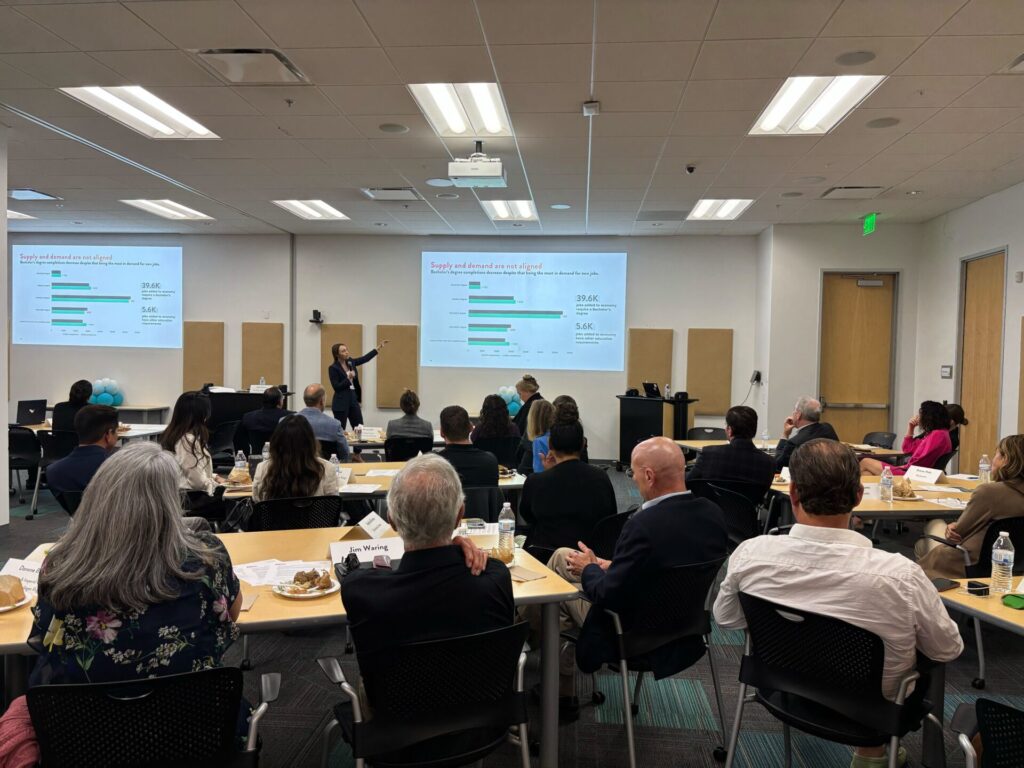
In May, San Diego Regional EDC hosted its quarterly convening on the Inclusive Growth goal focused on skilled talent. With more than 50 leaders from private companies, educational institutions, and nonprofit organizations, the discussion focused on creative ways to grow San Diego’s innovation economy workforce. Participants engaged in critical conversation about the ways work-based learning, credit for prior experience, and new forms of education funding will help the region reach its skilled talent goal.
Within the Inclusive Growth framework, the talent goal is the only one measured in annual cohorts. Each year, EDC tracks the number of San Diegans completing a post-secondary education within six years of high school graduation. The goal is to see 20,000 newly skilled workers in San Diego each year.
Post-secondary education completions include certificates, associate’s degrees, bachelor’s degree and post-graduate degrees. The data focuses on students that completed high school in San Diego County, capturing their post-secondary completions regardless of where they went after high school graduation. The goal is driven by two factors:
A thriving innovation economy and evolving technology in every sector mean that most of the jobs being added to the economy require a post-secondary degree.
As San Diego’s high cost of living continues to threaten talent attraction into the region, it is crucial to ensure access to quality jobs for current residents.
For a full breakdown on the purpose of the goal, take a look at the original report.
The goal update
Of the 31,510 students that graduated from a San Diego high school in 2018, 12,850 of them had completed a post-secondary education by 2024. While we did see a one percent decrease from the last report, completions have generally remained consistent following the largest recorded increase from 2020 to 2021. We are not yet seeing the impacts of the COVID pandemic, and likely will not for another two years.
San Diego K-16 Students have sustained PSE completion rates
A double-click into degree completions
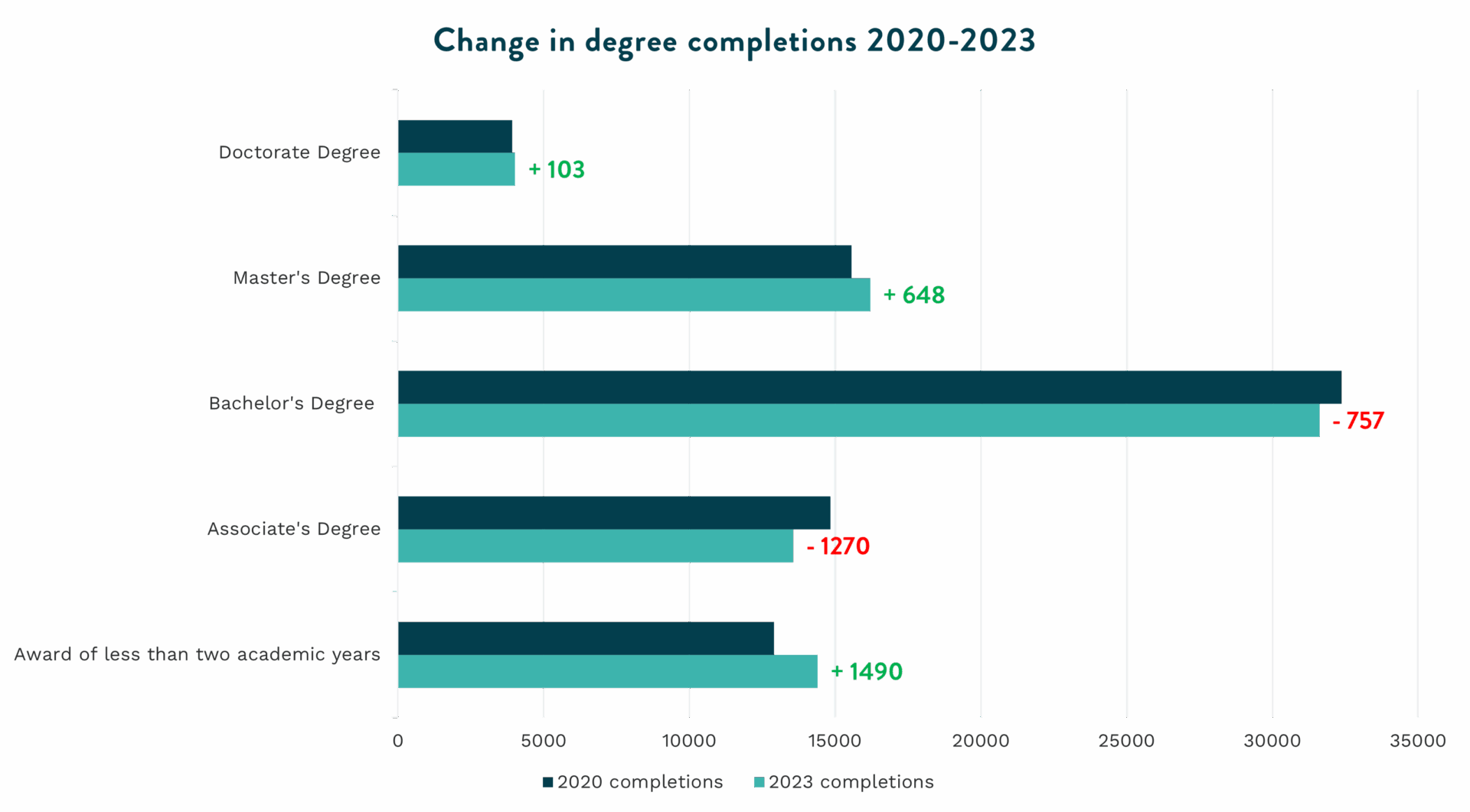
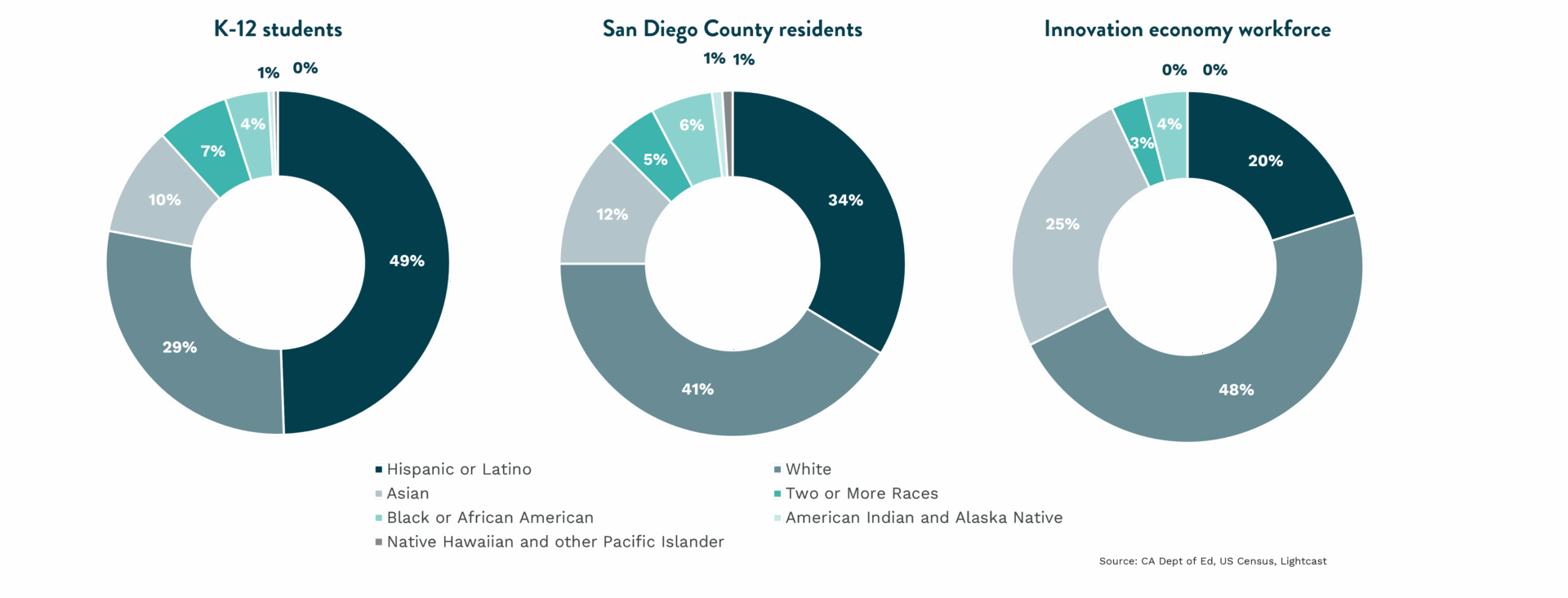
When we look one layer deeper at the students that completed a post-secondary degree by 2024, the data reveals good news for San Diego. The demographic distribution of degree-completers is generally reflective of the region’s demographics, and the areas of study are evenly distributed, with Business Administration boasting the highest portion of graduates. Nevertheless, when comparing the types of degrees conferred from 2020 to 2023, there was a decrease in bachelor’s and associate degrees and a significant increase in awards of less than two academic years. With most of the jobs being added in San Diego’s innovation economy requiring a bachelor’s degree, there is a crucial need for stackable credentials. These credentials would allow certificate holders to follow the path to a bachelor’s degree but offer the option to pause along the way while still being qualified for a good job.
The ability to move between the education system and a career is a win for everyone involved. Employers often struggle with unrealistic expectations or an inability to apply theory when hiring people from the academic system with little to no time in industry. On the student side, the cost of getting an education can be a barrier to student completion. Many people benefit from programs that are broken up into more “bite-size pieces,” allowing them to save up between sections/courses. Notably, education institutions that receive additional funding for successful student completion are able to count the same person multiple times when programs are broken up into smaller pieces. This opens the door for more funding opportunities.
Bachelor’s degree completions decrease despite that being the most in demand for new jobs
Talent is evenly distributed, opportunity is not
Despite being an epicenter for innovation and groundbreaking ideas, not all of San Diego’s residents have access to that innovation economy. Poverty disproportionately affects people of color, leading to barriers in educational attainment and the ability to compete for innovation jobs.
Additionally, shrinking high school class sizes mean that the portion of high school graduates going on to complete a post-secondary degree will need to increase for the region to meet its annual goal of 20,000 new skilled workers.
All of this is compounding to create a challenging hiring environment for employers. Even when the economy is facing higher levels of unemployment, the long-term trends around skill alignment and the need for more workers with a post-secondary education remains constant.
As mentioned before, one potential solution is for the region (and the country) to invest in more ways for learners to obtain industry-recognized degrees and credentials. Credit for prior learning or experience, dual-enrollment, and generally improved alignment across education systems become critical.
Innovation economy demographics are not reflective of regional demographics, or the workforce of tomorrow
Addressing the talent gap with strategic partnerships
During the May roundtable, a few partners were able to share how they are working to integrate the education and work journeys for participants.
Companies like Vertex Pharmaceuticals, in partnership with Junior Achievement of San Diego County, offer high school internship programs to support students in exploring the professional world and understanding their career aspirations before ever leaving the K-12 system.
The community college system is working with employers like GKN to build an apprenticeship hub the enables more earn-and-learn models without the headache that often comes with standing up a registered apprenticeship.
Organizations such as Family Health Centers of San Diego have been exploring loan forgiveness as a retention tool for staff, while ASML is investing in internal upskilling to support employee advancement and long-term workforce development.
Call to action
EDC cannot do this work alone. Progress on the 2030 Inclusive Growth goals is only achievable with and through the region’s employers scaling innovative and intentional solutions. If you want to be a part of the incredible group of organizations that are carrying the torch to 2030, EDC invites you to endorse the goals, use data tools like our talent dashboard and the progress reports to tell San Diego’s story, and share with us how you are driving progress toward an Inclusive San Diego.
Also: EDC and Junior Achievement are surveying businesses to understand the benefits of hosting interns. If your San Diego company has recently hosted an intern, please share your insight.
To celebrate and inspire the efforts of regional employers, EDC’s Inclusive Growth blog series highlights San Diego companies and organizations helping to drive progress on the 2030 Inclusive Growth goals. Below we feature San Diego’s comprehensive human services provider Neighborhood House Association (NHA).
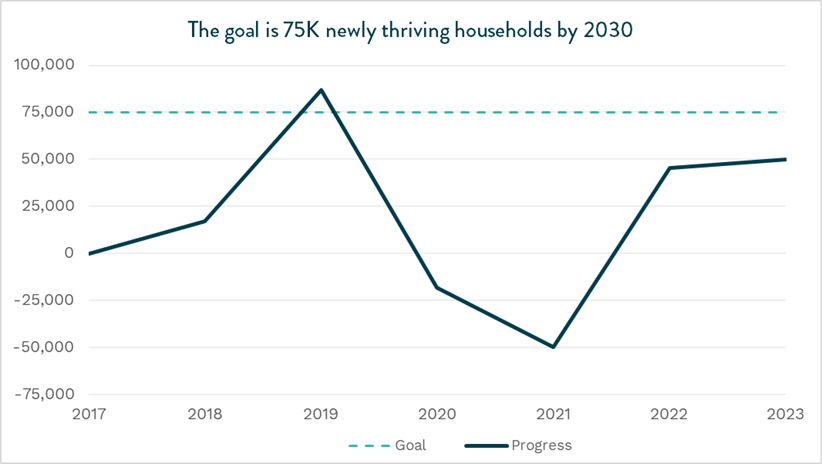
Launched in 2018 and informed by a partnership with the Brookings Institution, the Inclusive Growth initiative sets 2030 goals including increasing the number of thriving households locally, and making the business case for economic inclusion. Decreasing affordability in San Diego threatens progress toward all of the goals and disproportionately impacts communities of color. Household incomes have not kept pace with the cost-of-living, leaving only one in 10 households able to afford the median-priced home in the region. As of 2023, San Diego has added 49,916 newly thriving households (chart below) bringing the total number of San Diego’s thriving households in the region to 610,983.
Supporting households through a continuum of education and wellness
The Neighborhood House Association (NHA) was founded during the settlement house movement in 1914 to assist immigrants as they transitioned to living in the country.
NHA today
As a major employer and one of the largest nonprofit social services agencies in San Diego, NHA works through its Continuum of Care Model, a wrap-around service delivery model supporting households from prenatal to senior care. Its mission: To enrich lives through a continuum of education and wellness services, nurturing children and families from the earliest stages of life through adulthood, providing youth development and career exploration opportunities that allow them eventually to join the region’s workforce with a direct pipeline to workforce opportunities within NHA.
Challenges in grant-funded household support
Currently, NHA supports more than 5,000 community members by advocating for additional funding that addresses household affordability and accessibility challenges to realize dreams for as many households as possible. Because healthy and educated communities are where dreams become reality.
With federal and state grants, each program participant is assisted through a two-year enrollment period with direct support from an NHA family service worker outlining goals and needs, often including early childhood education programs and childcare services. Funds allow for more classrooms slots for children meaning that parents in households and members of the NHA workforce can go to work and school. With this, NHA sustains competitive pay with cost-of-living adjustments alongside annual merit increases to attract the best teaching and support staff for households.
Most of NHA’s programs are funded by federal and state grants, and as funding for programs like Head Start is challenged at the federal level, NHA continues to actively work with regional, state, and national leaders to ensure that program participants and employees are self-sufficient in supporting themselves and their families.
In addition to visiting state and national offices, NHA invites lawmakers to visit NHA to see programs at work in-person with the goal of increasing visibility and understanding of how the agency impacts the local economy. With an economic impact of more than $200 million each year, NHA operations are making a difference in the lives of team members, program participants, and the entire San Diego region.
As a large local nonprofit, NHA often highlights its value in San Diego’s economic development as a major local employer that allows pathways to education and workforce development. NHA President and CEO Rudy Johnson and have both served on the EDC Board of Directors and strongly believe in EDC’s work. NHA has found great value in joining EDC’s leadership trips and is a proud endorser of the Inclusive Growth initiative.
Join the movement
Progress on EDC’s 2030 Inclusive Growth goals is only achievable with and through the region’s employers scaling innovative and intentional solutions. Organizations like NHA are helping to collectively pave the way toward a more inclusive regional economy.
Endorse the goals, and be part of the change San Diego’s economy demands.