
An inflection point
As another year begins, I sit with my crystal ball once again to see what we can glean from the data we’ve received this past year and what implications it may have for our region’s economic growth in the year ahead.
The past year told a complex story, driven by uncertainty. On the surface, the U.S. economy performed remarkably well, achieving 4.3 percent real GDP growth in Q3 2025, representing an acceleration from a year ago. But this growth has been buoyed by unprecedented investment in AI led by a handful of companies, potentially masking deeper structural shifts beneath the surface.
The U.S. achieved this growth while creating just 584,000 jobs—roughly one-third the rate seen in the past decade. And while San Diego gained its fair share, adding 5,800 jobs through November 2025, all our job growth was principally concentrated in higher education, healthcare, and local government.
In 2026, San Diego stands at an inflection point—one where technological transformation collides with traditional economic challenges in ways we haven’t seen before.
Innovation industries are losing steam
Our region’s innovation engines—the traded clusters that have long defined San Diego’s competitive advantage—are sputtering. Cumulative job growth across aerospace, life sciences, tech, and manufacturing has plateaued or declined from pandemic-era peaks. Cleantech continues to add jobs, though it represents a smaller sliver and is also growing at a slower pace than in previous years. More concerning, it’s not just leaner firms we’re seeing, but fewer firms altogether. Firm growth across these key industries has stagnated, with only defense tech startups providing a bright spot in an otherwise sobering picture.
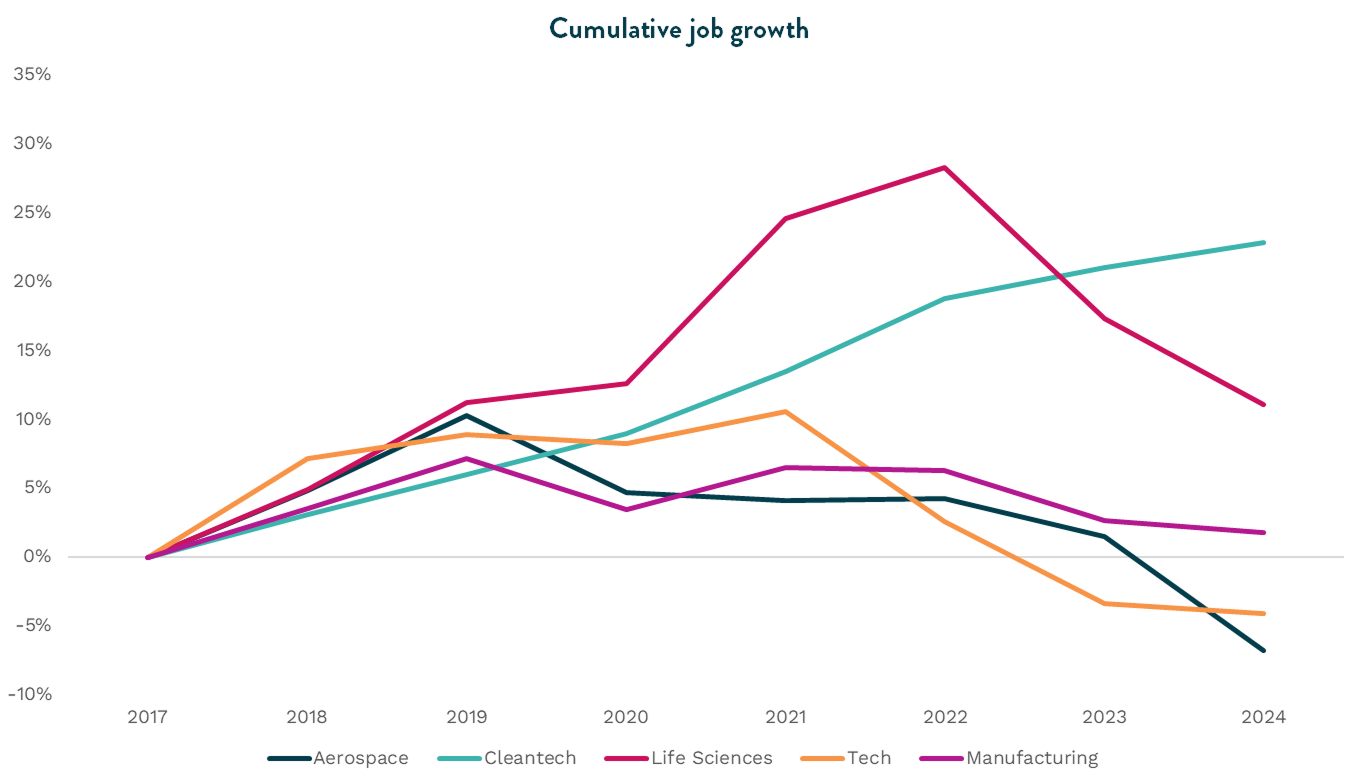
This matters because innovation industry jobs have an outsized impact on our economy, with each added job supporting another two jobs elsewhere in the economy. When these jobs contract, the ripple effects are significant.
So what’s going on? In part, it’s a tale of structural transformation. Professional, scientific, and technical service jobs, which our innovation cluster relies on, declined 3.3 percent through November 2025. Meanwhile, an additional 550,000 square feet of office space were vacated during the year, bringing total vacant space to 11.3 million square feet in a year with zero new construction. 2025 showed our region’s economy is increasingly dependent on fewer knowledge workers and thus less office space to host those workers.
Yet, investment is happening. Nationwide, construction spending toward data centers is set to eclipse that of traditional office buildings—a trend that accelerated dramatically after ChatGPT’s release. Infrastructure investments are building for servers, not people.
AI is picking up the slack, for now
Amid this disruption comes a silver lining—AI may be delivering what all new technologies promise: Productivity. Looking at inflation-adjusted average wages as a proxy for productivity growth, San Diego’s innovation industries have recovered from the pandemic. AI may be responsible for this recovery, enabling workers to do more with less. This could help explain the decline in local job postings, which fell six percent in 2025.
The question is whether this productivity boost translates into broader prosperity or simply allows companies to operate with smaller teams.
San Diego’s talent landscape reflects this uncertainty. While the value of a degree has been questioned more than perhaps any time in history, it still brings higher income and greater job security in our region. In the past decade, more than twice as many local jobs have been added that require a bachelor’s degree or higher than those requiring associate’s degrees or less. This trend accelerated in 2025, with jobs requiring bachelor’s degrees or higher outnumbering others by a factor of six.
Yet, new graduates are struggling in a job market that increasingly favors experience alongside credentials. The national unemployment rate for young college graduates stands at 4.8 percent, up more than a percentage point compared to before the pandemic.
The market signal is clear: Disruption continues to favor those with degrees and experience, even as the nature of work itself transforms.
Affordability is not a hoax; it’s an enigma
Incomes are up and people are spending their money, but they’re not happy about it. That’s because the essentials like housing, childcare, energy, and transportation continue to get more expensive—local energy prices, for instance, are up nine percent year-over-year as of November 2025.
Housing affordability remains the single biggest threat to regional prosperity. While San Diego’s median household income has increased 25 percent since 2020—a welcome development—the cost of homeownership has far outpaced these gains. The median-priced home fell slightly to $990,000 in Q3 2025, requiring a household income of $263,000 to afford the monthly mortgage payment. Even those looking to rent are facing an average monthly outlay of $2,900, which makes San Diego one of the most expensive counties to rent in the nation.
There’s a glimmer of hope: San Diego home sales increased 14 percent year-over-year in September 2025, suggesting some movement in a frozen market.
Yet meaningful housing market recovery will remain elusive until mortgage rates drop substantially enough to free homeowners locked into historically low rates or make room for significant new supply.
The year ahead
These trends—the pace and composition of job growth, AI’s impact in the demand for talent, and housing affordability—will define San Diego’s 2026.
Can we leverage regional strengths to capture new growth opportunities, particularly in defense tech where startups show momentum? Will hiring priorities shift to tap new pools of talent as employers rethink what it means to be a skilled worker? How do we make room for more housing in a region where working families are increasingly priced out, while the office is increasingly empty?
The answers aren’t in my crystal ball.
They require deliberate action through an intentional, inclusive economic development agenda. We must make sure our region—and our state—is a place that not only cultivates great ideas but also enables the realization of those ideas into solutions, products, and jobs. We must make it easier for builders to build infrastructure and easier for businesses to do business.
In 2026, EDC will work to position San Diego as the destination for defense tech investment, build pipelines to better address employers’ evolving talent needs, and identify opportunities to replace unused office with much needed housing and infrastructure for working families.
But we can only do this with and through you—our partners across industry and academia, local and state government.
Now more than ever, our goal remains constant: To maximize San Diego’s economic prosperity and global competitiveness through meaningful partnerships with our 150+ investors and regional stakeholders. We know where we are and where we need to go. Getting there in 2026 will require resolve, creativity, and bold action—together.
LGSD!

Eduardo Velasquez
Vice President, Economic Development & Research
Explore economic trends from prior years:
- Looking into the 2025 crystal ball
- Looking into the 2024 crystal ball
- Looking into the 2023 crystal ball