A note from Taylor: San Diego’s workforce in 2026

Dear EDC investors and partners,

Last month, EDC’s Vice President of Economic Development and Research Eduardo Velasquez reminded us that San Diego stands at an inflection point—where technological transformation is colliding with long‑standing economic challenges in ways previously unseen. His note highlighted a region defined by promise and pressure: Slowing innovation‑sector job growth, rising household incomes shadowed by affordability constraints, and AI reshaping the very nature of work.

A month into 2026, more questions than answers remain, especially when it comes to talent: What is the role of post-secondary education in our changing region? How is AI shifting jobs and industries? And what does this mean for San Diego’s early career talent, our region’s leaders of tomorrow?

Built on talent—but facing new realities

San Diego’s economic engine has always been its people. With more than 100 research and education institutions, our region has long produced the skilled talent that fuels innovation, defense, life sciences, and advanced manufacturing.

The good news: More San Diego students are completing degrees and credentials than ever before. The region has sustained progress in completions, even as the pandemic’s long‑term impacts remain murky. But the data also makes one thing clear: Post-secondary education is more critical than ever. Jobs requiring a bachelor’s degree or higher continue to grow at a significantly faster rate than those requiring less education. In fact, in 2025, San Diego added six times more jobs requiring a bachelor’s degree or more versus those requiring an associate degree or less.

Additionally, the growth of legacy industry clusters that have served as the backbone of San Diego’s global competitiveness—tech, life sciences, and manufacturing—is slowing down. While bright spots remain in emerging industries like cleantech and aerospace (namely defense technology) that are critical to the region’s future competitiveness, transformations in these industries and varied levels of AI integration represent significant changes to the entire U.S. economy. Their effects will ripple throughout the whole workforce. 

Take the cleantech industry, for example, as policy-backed efforts to decarbonize in California are leading to more electrification. As buildings modernize, we might expect increased need for electricians, while the need for gas-line plumbers decreases. The auto mechanic historically focused on combustion engines must now become familiar with hybrid and electric motors. And the manufacturing company that embeds machine learning and automation now requires a person who can analyze and tell a story with the resulting data.

A future workforce that doesn’t yet see a future

Across the U.S., young college‑educated workers are facing a “unique convergence of structural forces” that have severed traditional entry points into white‑collar work.

AI is accelerating this shift. Automation and augmentation are happening within jobs, not just across them. The occupations where automation potential is high are the same ones where augmentation potential is high—meaning AI may not necessarily eliminate an occupation, but rather transform how an employee executes their tasks. 

With lower barrier to entry tasks most exposed to automation, the entry-level or new graduate workforce risks being edged out of opportunities to launch. Meanwhile, the nature of the tasks exposed to augmentation will require mid-level workers to continue upskilling to remain competitive. 

As for long-term impacts? It’s too early to tell. San Diego’s labor market data does not yet reflect an overhaul of entry-level roles. Job growth across innovation industries at all levels has declined over the last few years, and while entry-level job growth has declined slightly faster, it has not been the job elimination of our nightmares. 

What remains constant in our conversations with employers across industries and occupations is a need for soft skills that will never be automated. Skills like communication, empathy, and problem solving are more fashionable than ever. In fact, this demand has been so persistent that workforce developers and educators have taken to calling these “durable” skills—though figuring out how best to cultivate them in students may be the next great challenge. 

In a time of transitioning tech, too, regional employers are doubling down on opportunities to future-proof their workforce. We’ve heard from San Diego companies that are making a deliberate effort to traditionally train early career employees in the skills AI could support, both to strengthen institutional knowledge and develop future leaders. And local tech heavyweights are continuing to proactively invest in both tomorrow’s talent and technology, maintaining internship programs that convert as many as three in four interns to full-time roles and leveraging new technologies early to instill technical skills in the emerging workforce.

Lean in with us

To meet these challenges, EDC is doubling down on initiatives that align education, industry, and talent. Through regional and even national partnerships, we will continue to facilitate work-based learning like internships and apprenticeships, and equip the region to better understand its labor market needs.

Here’s how you can lean in:

  • Host a summer intern from a Verified Program: All intern hosts will work with an employer of record and have access to a pre-vetted batch of resumes. Small businesses may qualify for interns’ wages to be subsidized or fully covered. Learn about our Advancing San Diego internship program.
  • Hire from Verified Programs in San Diego: These local programs are employer-verified for teaching in-demand skills as well as serving a diverse student population. To connect with a Verified Program, reach out to EDC.
  • Help us collect critical regional talent data: With so many remaining questions, it has never been more important for training and education institutions to keep a pulse on future talent demand. Our talent data dashboard, annual talent survey, and talent demand reports help local education programs prepare San Diegans with the skills your company needs. If your company is experiencing shifts in talent needs, we want to hear about it.

San Diego’s future workforce is diverse, ambitious, and full of potential—but only if we build the systems that allow every resident to participate in and benefit from our innovation economy.

Your collaboration and investment—whether through hiring, training, curriculum partnerships, or direct support of EDC initiatives—continues to ensure that San Diego can cultivate the talent that creates, attracts, and retains cutting‑edge companies, strengthens our innovation clusters, and secures San Diego’s economic future.

Taylor Dunne
Taylor Dunne

Director, Talent Initiatives

More FROM Advancing SaN Diego

More on inclusive growth

A note from Eduardo: Looking into the 2026 crystal ball

An inflection point

As another year begins, I sit with my crystal ball once again to see what we can glean from the data we’ve received this past year and what implications it may have for our region’s economic growth in the year ahead.

The past year told a complex story, driven by uncertainty. On the surface, the U.S. economy performed remarkably well, achieving 4.3 percent real GDP growth in Q3 2025, representing an acceleration from a year ago. But this growth has been buoyed by unprecedented investment in AI led by a handful of companies, potentially masking deeper structural shifts beneath the surface.

The U.S. achieved this growth while creating just 584,000 jobs—roughly one-third the rate seen in the past decade. And while San Diego gained its fair share, adding 5,800 jobs through November 2025, all our job growth was principally concentrated in higher education, healthcare, and local government.

In 2026, San Diego stands at an inflection point—one where technological transformation collides with traditional economic challenges in ways we haven’t seen before.

Innovation industries are losing steam

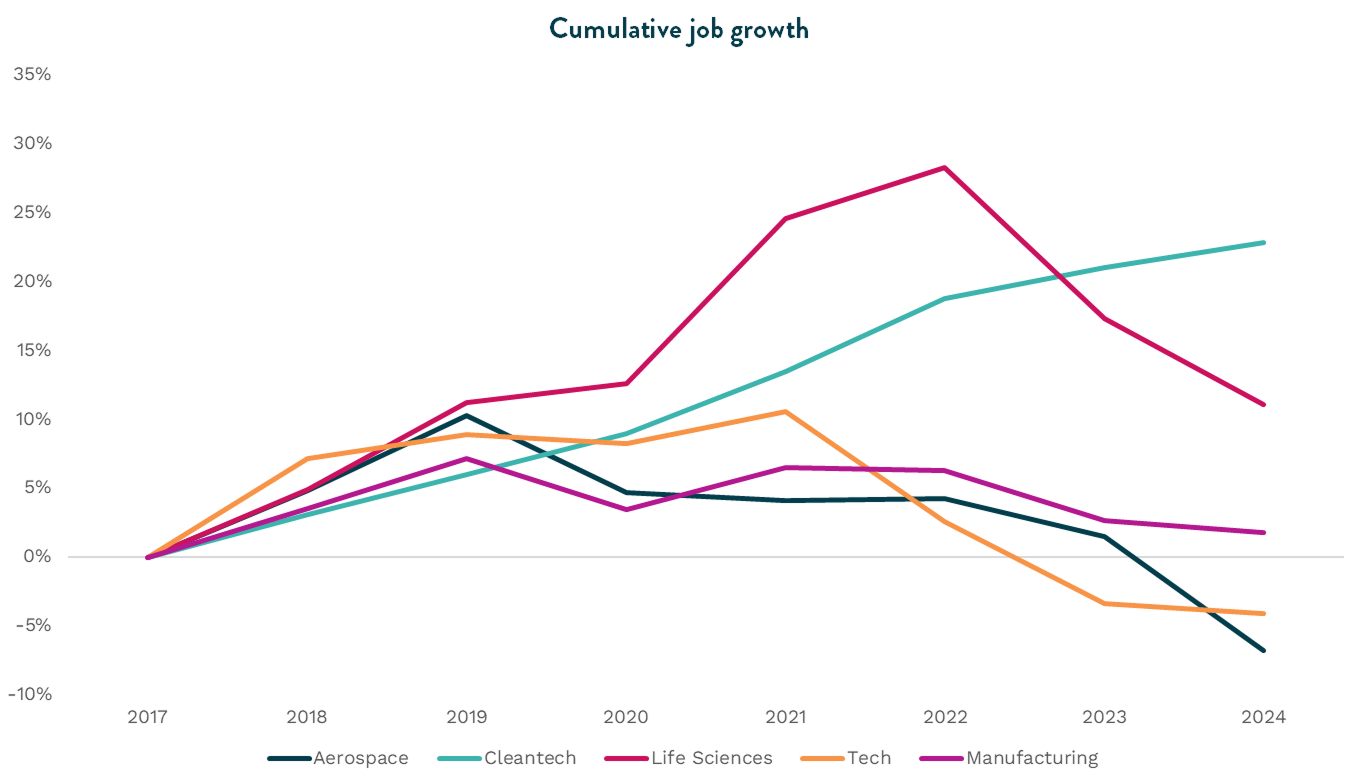
Our region’s innovation engines—the traded clusters that have long defined San Diego’s competitive advantage—are sputtering. Cumulative job growth across aerospace, life sciences, tech, and manufacturing has plateaued or declined from pandemic-era peaks. Cleantech continues to add jobs, though it represents a smaller sliver and is also growing at a slower pace than in previous years. More concerning, it’s not just leaner firms we’re seeing, but fewer firms altogether. Firm growth across these key industries has stagnated, with only defense tech startups providing a bright spot in an otherwise sobering picture.


This matters because innovation industry jobs have an outsized impact on our economy, with each added job supporting another two jobs elsewhere in the economy. When these jobs contract, the ripple effects are significant.

So what’s going on? In part, it’s a tale of structural transformation. Professional, scientific, and technical service jobs, which our innovation cluster relies on, declined 3.3 percent through November 2025. Meanwhile, an additional 550,000 square feet of office space were vacated during the year, bringing total vacant space to 11.3 million square feet in a year with zero new construction. 2025 showed our region’s economy is increasingly dependent on fewer knowledge workers and thus less office space to host those workers.

Yet, investment is happening. Nationwide, construction spending toward data centers is set to eclipse that of traditional office buildings—a trend that accelerated dramatically after ChatGPT’s release. Infrastructure investments are building for servers, not people.

AI is picking up the slack, for now

Amid this disruption comes a silver lining—AI may be delivering what all new technologies promise: Productivity. Looking at inflation-adjusted average wages as a proxy for productivity growth, San Diego’s innovation industries have recovered from the pandemic. AI may be responsible for this recovery, enabling workers to do more with less. This could help explain the decline in local job postings, which fell six percent in 2025.

The question is whether this productivity boost translates into broader prosperity or simply allows companies to operate with smaller teams.

San Diego’s talent landscape reflects this uncertainty. While the value of a degree has been questioned more than perhaps any time in history, it still brings higher income and greater job security in our region. In the past decade, more than twice as many local jobs have been added that require a bachelor’s degree or higher than those requiring associate’s degrees or less. This trend accelerated in 2025, with jobs requiring bachelor’s degrees or higher outnumbering others by a factor of six.

Yet, new graduates are struggling in a job market that increasingly favors experience alongside credentials. The national unemployment rate for young college graduates stands at 4.8 percent, up more than a percentage point compared to before the pandemic.

The market signal is clear: Disruption continues to favor those with degrees and experience, even as the nature of work itself transforms.

Affordability is not a hoax; it’s an enigma

Incomes are up and people are spending their money, but they’re not happy about it. That’s because the essentials like housing, childcare, energy, and transportation continue to get more expensive—local energy prices, for instance, are up nine percent year-over-year as of November 2025.

Housing affordability remains the single biggest threat to regional prosperity. While San Diego’s median household income has increased 25 percent since 2020—a welcome development—the cost of homeownership has far outpaced these gains. The median-priced home fell slightly to $990,000 in Q3 2025, requiring a household income of $263,000 to afford the monthly mortgage payment. Even those looking to rent are facing an average monthly outlay of $2,900, which makes San Diego one of the most expensive counties to rent in the nation.

There’s a glimmer of hope: San Diego home sales increased 14 percent year-over-year in September 2025, suggesting some movement in a frozen market.

Yet meaningful housing market recovery will remain elusive until mortgage rates drop substantially enough to free homeowners locked into historically low rates or make room for significant new supply.

The year ahead

These trends—the pace and composition of job growth, AI’s impact in the demand for talent, and housing affordability—will define San Diego’s 2026.

Can we leverage regional strengths to capture new growth opportunities, particularly in defense tech where startups show momentum? Will hiring priorities shift to tap new pools of talent as employers rethink what it means to be a skilled worker? How do we make room for more housing in a region where working families are increasingly priced out, while the office is increasingly empty?

The answers aren’t in my crystal ball.

They require deliberate action through an intentional, inclusive economic development agenda. We must make sure our region—and our state—is a place that not only cultivates great ideas but also enables the realization of those ideas into solutions, products, and jobs. We must make it easier for builders to build infrastructure and easier for businesses to do business.

In 2026, EDC will work to position San Diego as the destination for defense tech investment, build pipelines to better address employers’ evolving talent needs, and identify opportunities to replace unused office with much needed housing and infrastructure for working families.

But we can only do this with and through you—our partners across industry and academia, local and state government.

Now more than ever, our goal remains constant: To maximize San Diego’s economic prosperity and global competitiveness through meaningful partnerships with our 150+ investors and regional stakeholders. We know where we are and where we need to go. Getting there in 2026 will require resolve, creativity, and bold action—together.

LGSD!

Eduardo Velasquez
Eduardo Velasquez

Vice President, Economic Development & Research


Explore economic trends from prior years:

More FROM EDC’s research bureau

More on inclusive growth

A note from Eduardo: San Diego’s 2025 mid-year check-in

At the top of each year, we try to look ahead to which trends are most worth tracking for the potential impact each can have on our local economy. We began 2025 watching AI and affordability, as well as whether massive investments from both corporations and the federal government would translate into job growth.

We also began 2025 flagging that there would be many wild cards in the year ahead that could knock us off course. As we enter the second half of the year, we want to pause to take stock of what has been a very tumultuous six months, with both immediate impacts and long-term implications.

Affordability and AI

The housing affordability picture looks mostly the same as it did in January: dire. Mortgage rates have bounced around a narrow range while staying above six percent, and the median home price remains just above $1 million, translating to a monthly mortgage payment of about $5,300. This means the annual household income needed to qualify for a conventional loan is more than $260,000, which roughly 12 percent of all households in the region can afford.

AI adoption remains one of the most profound questions in workforce development. San Diego has once again been identified as a ‘star hub’ for AI capacity and adoption, predominantly as a region with high rates of firm readiness and job exposure to generative AI. Tech giants continue to race for AI dominance, which has led to eye-watering compensation packages, record valuations for chipmakers, and $70 billion announced in new federal investments for data centers and power grid upgrades.

What the cut?

Speaking of federal funding, the impact of federal investments on local job growth is more immediate. That’s because all the money that the federal government lined up to invest in re-shoring manufacturing, capacity building for semiconductors, and sustainable energy projects in the last few years has been cut off, significantly scaled back, or temporarily tied up. Oh, and don’t forget state and local public funding cuts.

It is worth noting that much of this remains to be settled as the courts figure out what the Trump administration can legally defund. Yet, much of it is already impacting San Diego’s economy.

New jobs data shows that through the first half of 2025, the region lost 4,900 jobs. This is not as bad as the first six months of 2024 but still trending in the wrong direction. June’s unemployment rate jumped to 4.9 percent (from 4.0 percent in May) as the number of people unemployed rose 14,200—the largest month-over-month increase since the pandemic lockdowns of April 2020.

Private sector job losses are even deeper, down 8,400 year-to-date. Every major sector in San Diego has shed jobs through mid-2025, with the exceptions of Healthcare and Social Services, Leisure and Hospitality, and State and Local Government.

Way too many wild cards in this deck

The pace of new policy directives from D.C. has been overwhelming. The lack of clarity as to whether these policy proposals will be implemented, or are legally enforceable, has been paralyzing. Whether it’s consumers, homebuilders, or manufacturers, the sentiment remains weak.

In San Diego, it’s not just bad vibes. The impacts are real.

The newly-created Department of Government Efficiency (DOGE)’s contract cancellations have started chipping away at our federal workforce, including DoD which spent $20 billion here last year. Proposals to reduce indirect costs associated with federal research grants have led to hiring freezes and layoffs in higher education and could evaporate nearly $448 million from the regional economy. The proposed cuts to NIH and NSF funding would nearly cut in half the region’s $1.1 billion that fuels the research that has led to 99 percent of drugs approved a decade ago. Congress’ latest tax law is set to increase the population of uninsured patients by 1.7 million across California and is already manifesting in workforce reductions at local hospitals, which hasn’t yet showed up in the data.

The up and down tariff threats are the top concern of local businesses that sell in global markets. As one company executive put it, retaliation from countries like China has “completely changed the growth strategy.” These impacts are felt locally in jobs losses to industries like Transportation and Warehousing (down 10 percent, year-to-date) and Retail (down almost five percent). These impacts are also felt by $1 billion less in venture capital, $500 million less in export sales, and 770 fewer employers looking to hire than a year ago in San Diego.

“If you want to go far, go together.”

There are many famous quotes about navigating uncertainty and how resilience drives success. At EDC, we often quote an African proverb: “If you want to go fast, go alone. If you want to go far, go together.”

Collaboration has often defined success in this region; it’s what makes us different.

Whether the winds change and we need to adjust our sails, or whether we fall seven times but pick ourselves up eight, let’s do it together.

As I look into my crystal ball again, I see the next six months will continue to be riddled with uncertainty and unexpected challenges. I also still see a region that is a top three Life Sciences market, a top three market for startups, has the largest concentration of military assets in the world, and the busiest land port in the Western hemisphere. So, we have a lot to build on. As your business works to navigate changing rules, reach new markets, or find talent, don’t go it alone. EDC is here to help.

Onward and upward,

Eduardo Velasquez
Eduardo Velasquez

Vice President, Economic Development & Research

More FROM EDC’s research bureau

More on inclusive growth

A note from Eduardo: Looking into the 2025 crystal ball

The map is not the terrain

As I return to the crystal ball in 2025, never have I seen such a wide range of possibilities. Both the national policy and technology landscapes are primed for major disruptions that could shape San Diego’s economic fortunes in more ways than we can count. While the map provides a fairly clear direction, the terrain is difficult to predict and sure to throw us off course at some point, at least temporarily.

What is certain is that we have just wrapped up what should be viewed as another solid year for the U.S. economy. The nation added 2.2 million jobs, a growth rate slightly above the average of the last 10 years. The economy expanded at an annualized growth rate of 3.1 percent, primarily driven by consumer spending, exports, business investment, and federal government spending. Inflation has continued to moderate with the price of energy and goods falling, while the price of services continues to rise.

I see the money, show me the jobs

Locally, San Diego continues to draw venture capital to fund young companies in both Tech and Life Sciences, to the tune of nearly $6 billion in 2024. The region also added jobs, but at about half the rate of the U.S. Recent job growth has been driven by locally serving industries like full service restaurants, whereas our innovation industries have shed jobs during the last 12 to 18 months. Some of this is right sizing after a pandemic fueled surge in Life Sciences. Some of it is driven by federal incentives that have led to relocation and expansion of Manufacturing jobs outside our region.

Federal funding has fueled a half trillion-dollar investment into new manufacturing facilities nationwide over the last three years. Pre-pandemic, manufacturing employment growth in San Diego outpaced both the state and nation; since then, that trend has completely reversed.

Meanwhile, there are $132 billion in federally appropriated funds for renewable energy that remain unspent. San Diego has a small but growing Cleantech cluster that continues to innovate and provide high-paying jobs.

Additionally, the private sector has more than bought into the promise of AI, with a third of the large companies looking to pour tens of millions of dollars more into the tech and build upon the positive returns on the past investments. The question here is whether San Diego can catch the wave of investment that is going into all these foundational and enabling technologies so that our region can also benefit from the growth will bring.

AI’s double-edged sword

Speaking of AI, 2025 may be the year that will truly test the hype. Yes, investment is up, way up (see last paragraph), but job postings requiring skills in developing AI have barely budged since the launch of ChatGPT in November 2022.

Yet, the application of GenAI is seemly impacting the skills employers are looking for in new hires. Since 2019, six of the 10 fastest growing occupations in Life Sciences have been for non-scientific and non-technical roles. In Tech, seven of the 10 fastest growing occupations have been non-engineering, non-software roles. In fact, demand for software developers has fallen 80 percent during that time—the occupation that has topped job postings lists for the last decade in San Diego. Time will tell if the AI hype is real, but for now, there are fewer Tech jobs in San Diego than there were pre-pandemic and AI’s impact on the labor market is certainly a factor.

Affordability is about payments, not prices

Another factor impacting San Diego’s Tech cluster is remote work availability, which was lower in 2024 than in 2023 and lags the national average. Remote jobs outside of the region can be especially attractive considering San Diego’s high cost of living.

However, 2024 did bring some relief in terms of housing costs. Rents in San Diego grew much more slowly compared to recent year, up 2.6 percent. The median-priced home fluctuated throughout the year but ended where it began at just above $1 million. However, mortgage rates continued to rise, driving up the monthly payment on that same million-dollar home by $730. There are signs that it is less of a seller’s market: homes have not sold above asking price for most of the past 12 months and for-sale inventory is higher than it’s been in years. Still, the big variable in the housing market is whether mortgage rates can fall enough to spur owners currently locked into historically low rates to sell.

The year ahead

These trends—converting capital to job growth, harnessing AI to boost productivity, and unlocking home sales—will help define our regional economy in the year ahead. Of course, so will several other wild cards, such as looming public budget constraints, the prospect of trade wars, global conflict, and climate change impacts. Nonetheless, the goal remains the same: to maximize San Diego’s economic prosperity and global competitiveness through an inclusive economic development agenda, and doing so with and through our network of 150+ investors and regional partners.

In 2025, EDC will focus on amplifying the economic impact of large-scale, mixed-use developments to grow and retain quality jobs and deliver much needed housing. We will also work to elevate the value of our unique assets as a military economy, cross-border region, and innovation hub. We know where we are and where we want to go—getting there will certainly be a ride.

Happy new year,

Eduardo Velasquez
Eduardo Velasquez

Vice President, Economic Development & Research


Read 2024’s editionLooking into the 2024 crystal ball

Read 2023’s editionLooking into the 2023 crystal ball

More FROM EDC’s research bureau

More on inclusive growth

Best practices for AI in higher education

takeaways from Advancing San Diego’s AI Best Practices event

In a regional economy where one in four local firms utilizes Artificial Intelligence (AI), it is essential that San Diego students be prepared with the skills necessary to maximize the use of AI. To address this need, Deloitte and San Diego Regional EDC convened nearly 50 faculty and administrators from Advancing San Diego’s Verified Programs to collaborate and workshop the future of AI implementation in higher education.

Six THINGS WE LEARNED:

  1. Personalize learning and content

    AI can revolutionize personalized learning by analyzing student performance data to identify areas where students need more support and adjust curriculum accordingly. Additionally, AI enables educators to quickly adjust to student needs by creating lecture materials, interactive learning modules, and more. This dual capability expands educators’ ability to create tailored content and saves time on resource creation, enhancing both the learning experience and instructional quality.

  1. Streamline administrative tasks

    AI tools can manage routine administrative tasks such as scheduling, grading, and responding to common student questions. This can reduce the administrative burden on educators, allowing them to concentrate more on teaching and mentoring, thereby improving overall efficiency.

  1. AI literacy and prompt engineering

    Understanding prompt engineering, the skill of constructing the right questions, can significantly enhance the utility of AI in educational settings. The way questions are framed can drastically impact AI responses and, if done properly, reduce the risk of “hallucinations,” AI-generated information that may be incorrect or outdated. This literacy ensures that these tools are used to their full potential, providing accurate and relevant information that supports learning objectives. It also effectively prepares students for jobs in San Diego’s innovation economy, which is already adopting AI at staggering rates .

  1. Emphasize higher-order thinking

    The integration of AI in education is shifting instructive approaches, emphasizing higher-order thinking skills outlined in Bloom’s Taxonomy. With AI handling lower-order tasks such as remembering and understanding information, educators can focus on fostering analysis, evaluation, and creation in students. This shift encourages deeper learning and critical thinking, preparing students for complex real-world challenges.

  1. Establish effective governance frameworks

    Integrating AI into education will require strong governance frameworks to address ethical concerns like bias and privacy, clear policies and guidelines for its use in assignments and assessments, and a regular process for evaluating and updating these frameworks to keep pace with the evolving AI landscape.

  1. Mitigate bias and protect privacy

    Addressing bias in AI training data is important for fair educational outcomes. Ensuring AI models are trained on diverse, representative datasets can improve accuracy and inclusiveness. Privacy concerns are also paramount; public AI tools can inadvertently use any input data for retraining, risking exposure of sensitive information. Enterprise-specific models, which do not learn off of private data, might offer a more secure solution for educational institutions.

To learn more and get involved in EDC’s work, contact:

Contact SDREDC
To learn more, please contact us.

aPPLY TO BE A VERIFIED PROGRAM

sEE edc’S AI series

The economic impact of San Diego’s RNA cluster

EDC study explores the power and impact of RNA before and beyond COVID-19

Together with 1STRAND, EDC released “San Diego’s RNA cluster: Powering public health and the economy,” a comprehensive overview and economic impact assessment of San Diego’s RNA cluster, including direct input from industry representatives and stakeholders.

The power of gene expression manipulation has unlocked possibilities that were once unthought of—advanced treatments for cancer, HIV vaccines, personalized medicine, and more. These scientific achievements, discoveries, and events have catalyzed the growth of RNA innovation and therapeutics.

Home to dozens of RNA firms supporting more than 11,000 jobs, San Diego is especially well positioned to lead in RNA therapeutics innovation, promising a bright future for the region’s Life Sciences ecosystem and the broader economy.

KEY report FINDINGS

  • San Diego’s RNA cluster is a major contributor to the regional economy, with a nearly $6 billion annual impact. For every 100 jobs generated within the cluster, an additional 150 jobs are supported across the region.
  • San Diego’s RNA cluster has capabilities in both research and development (R&D) and manufacturing. While R&D leads RNA activities in the region, San Diego’s expertise in advanced manufacturing offers a solid foundation for further growth.
  • Leveraging its expertise in RNA technology, San Diego proved resilient and important in the fight against COVID-19. The region drew in $59 million from the National Institutes of Health (or NIH) and employment grew nine percent through 2021.
  • Software development jobs continue to grow within San Diego RNA firms. Demand for these professionals is expected to rise as Artificial Intelligence and Machine Learning (AI-ML) are further integrated.
  • Talent attraction is a major challenge for local RNA companies. Compensation is not keeping pace with San Diego’s high cost of living and puts the region seventh out of 10 in average wages among peer metros.

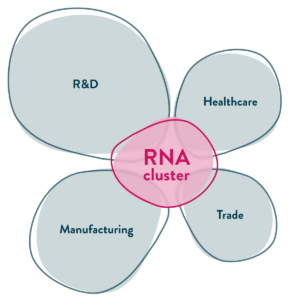
RNA and RNA therapeutics sit at the intersection of four sectors: R&D, manufacturing, trade, and healthcare. These include operations such as medical laboratories, production of biological materials and lab instruments, drug wholesalers, and consulting services to name a few—all of which are part of a broader ecosystem of industries fueling San Diego’s RNA cluster. This broader ecosystem feeds RNA clusters across the country, and San Diego consistently ranks among the top 10 metros in terms of total jobs, job concentration, and average wages. Peer metros includes Life Sciences heavyweights Boston and San Francisco, as well as parts of the North Carolina Research Triangle and tech hubs Seattle and San Jose.

Among peer metros, San Diego ranks:

  • #2 in job growth (nine percent) from 2021
  • #2 in projected job growth (13 percent) by 2027
  • #3 in number of job postings
  • #4 in median advertised salary for RNA jobs at just under $85,000
  • #7 in average hourly compensation ($56.68) for RNA jobs
  • Home to #5 most funded institution in the U.S. in RNA-related projects, and #2 in California – UCSD

The study was produced by EDC on behalf of 1STRAND in June 2023. Learn more about EDC’s research here.

SEE THE FULL REPORT HERE

Learn more on Life Sciences in San Diego

Pushing forward – AI and San Diego

For the past two years alongside underwriter Booz Allen Hamilton, EDC has released a series of five studies on the proliferation of Artificial Intelligence and Machine Learning (AI-ML) within San Diego County’s key economic clusters. The reports represent the most comprehensive deep dive on San Diego’s AI-ML ecosystem—evolving and growing since the baseline report was published in December 2020.

The reports found, by and large, that AI-ML technologies are creating new jobs, not eliminating them. Furthermore, the high pay commanded by workers in AI-concentrated fields has positive ripple effects in the local economy; for every 1,000 jobs gained in this industry, another 1,400 are created in other sectors. And while San Diego is well-positioned to welcome a new era of this innovation, accessibility and compensation remain ongoing challenges across the region.

The growing talent gap

In order to maximize the full potential of AI-ML integration, San Diego must grow its skilled workforce. Demand for AI-ML talent is more than double our regional supply. In fact, San Diego produced fewer than 3,000 AI-ML-related graduates in 2021, meanwhile, more than 7,800 local unique job postings required AI-ML skills in 2022.

San Diego’s colleges, universities, and training programs are hard at work to bridge this gap. The region boasts a collective 118 degree-track programs focused on cybersecurity, many of which include AI-ML training, as well as numerous certificates on AI-ML methods. The growth of cybersecurity, smart urban development, and life sciences innovation will depend on the development of AI skills in the next generation of workers.

Connecting with a wide array of training programs, such as community colleges, certificate programs, and bootcamps, can help San Diego companies source talent locally.

Inclusion is key

Even as San Diego’s existing AI-ML talent supply is more racially diverse than the national average, it still lags in comparison to the region’s population demographics. Making growing industries and high-wage roles accessible to San Diego’s Black and Hispanic talent—our region’s fastest growing populations—would help San Diego companies enjoy a talent surplus, strengthen our region’s competitiveness, and enhance our ability to drive life-changing innovation. Ultimately, greater diversity in the workforce will make AI-ML tools more powerful.

More on inclusive growth

When implemented, AI-ML has the potential to help San Diego companies expedite life-saving drug discovery, thwart cyber threats, and revolutionize transportation and logistics. More importantly, AI-ML can help cities and regions improve affordability and quality of life for residents, as well as support job growth and business expansion.

“EDC’s AI series underscored that AI-ML adoption is creating new job opportunities, and the demand for these skills far outpaces the supply,” said Teddy Martinez, Senior Research Manager, EDC. “As we wrap with a focus on Smart Cities, it is clear that if done right, AI-ML also has the potential to advance economic inclusion and improve quality of life for more San Diegans.”

You can read our entire AI series here:

  1. Baseline AI-ML: Report | Summary
  1. AI-ML in Cybersecurity: Report | Summary
  1. AI-ML in Transportation: : Report | Summary
  1. AI-ML in Life Sciences: : Report | Summary
  1. AI-ML in Smart Cities: Report | Summary

Thank you to our underwriter Booz Allen Hamilton.

Learn more about EDC’s Research Bureau here

Get involved with EDC

Study: Artificial Intelligence has potential to supercharge San Diego Smart Cities efforts

EDC study assesses the economic impact of AI in Smart Cities

Today alongside underwriter Booz Allen Hamilton, San Diego Regional EDC released the fifth study in a series on the proliferation of Artificial Intelligence and Machine Learning (AI-ML) within San Diego County’s key economic clusters. “Designing the Future: Artificial Intelligence for Smart, Thriving Cities” explore the history and evolution of Smart Cities efforts around the world, and investigate whether these technologies can enable cities to be both more efficient and more inclusive.

By 2050, it is projected that more than two-thirds of the global population will reside in an urban area. This massive and rapid urbanization presents new challenges for cities around the world—San Diego included. Between 2010–2020, San Diego’s population increased 8.35 percent from 3 million to 3.3 million residents. As the region has grown, affordability, sustainability, and mobility have become major priorities for sustaining economic competitiveness and inclusion. AI-ML technology presents new opportunities, and new responsibility, for urban areas to unlock the potential of innovation to cultivate smart, thriving cities.

Underwritten by Booz Allen Hamilton, the web-based study—smartcities.sandiegoAI.org—includes San Diego case studies on use of AI-ML in Smart Cities, a ‘tour’ of Smart Cities efforts around the globe, and makes the business case for prioritizing economic inclusion in Smart Cities efforts, among other assessments.

“EDC’s AI series underscored that AI-ML adoption is creating new job opportunities, and the demand for these skills far outpaces the supply,” said Teddy Martinez, Senior Research Manager, EDC. “As we wrap with a focus on Smart Cities, it is clear that if done right, AI-ML also has the potential to advance economic inclusion and improve quality of life for more San Diegans.”

KEY FINDINGS

  • AI-ML integration with Smart Cities efforts is still in the early stages. Smart Cities initiatives have evolved around the world from connected sensors and devices to promoting sustainability, efficiency, and mobility. Yet, local governments and businesses in San Diego have not yet fully integrated AI-ML into Smart Cities efforts.
  • Demand for AI-ML talent is more than double the supply in San Diego. The region produced fewer than 3,000 AI-ML-related graduates in 2021, meanwhile, more than 7,800 local unique job postings required AI-ML skills in 2022.
  • San Diego has above average concentrations in key industries that drive Smart Cities efforts, providing 50,454 jobs and an economic impact of $21.2 billion. Seven industries within the Professional, Scientific, and Technical Services sector also have the strongest appetite for AI-ML skills, responsible for one-in-four unique job postings in 2022.
  • Moving from smart to thriving is the next chapter for technologically advanced cities. Smart Cities technologies have contributed to efficiencies, but do not yet drive economic growth. With greater intention, these technologies can improve affordability and quality of life, as well as support job growth and business expansion.

San Diego’s growing innovation economy has gotten rightful praise as a “World’s Smart City” by National Geographic, and recently as a “World Design Capital” alongside Tijuana. Home to established companies Booz Allen Hamilton and Qualcomm, or scaling startups like Kneron and Measurabl, the region is largely defying the ‘tech correction’ and experiencing massive growth to drive AI-ML innovation locally and beyond.

“Measurabl uses AI-ML to revolutionize how businesses approach energy management. By providing real-time insights about energy use and identifying areas of inefficiency, we empower our clients to make data-driven decisions that cut costs and reduce environmental impact—ensuring company ESG (environment, social, governance) goals are measurable, manageable, and auditable,” said Frank Pressel, Data Science and Data Engineering Manager, Measurabl, founded in San Diego.

“As a proud part of San Diego’s tech ecosystem, Booz Allen—with 1,300 employees in the region—is hiring in droves for roles in software development, AI-ML, data engineering, and computer engineering. Together with industry, research, and academia, San Diego has the ingredients to lead in a Smart Cities future,” said Joe Rohner, Vice President at Booz Allen Hamilton and a leader in the firm’s AI practice. “With the right integration and investments in AI-ML, our region can meet ambitious goals in sustainability, transportation, and inclusion. Developing the talent, and ensuring community buy-in, are critical to that success.”

The study series is underwritten by Booz Allen Hamilton and produced by EDC. Learn more about EDC’s research here.

read the report at smartcities.sandiegoAI.org

see the full ai series here

Study: San Diego’s Life Sciences cluster in the early stages of AI-ML boom

EDC study quantifies the impact of AI in region’s Life Sciences cluster

Today alongside underwriter Booz Allen Hamilton, San Diego Regional EDC released the fourth study in a series on the proliferation of Artificial Intelligence and Machine Learning (AI-ML) within San Diego County’s key economic clusters. “Diagnosing the Future: AI and San Diego’s Life Sciences Cluster” quantifies the economic impact of the region’s Life Sciences cluster and explores the proliferation of AI and ML technologies being used to diagnose disease and develop drugs, among other lifesaving products and solutions.

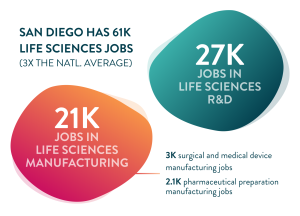
While the pandemic devastated many sectors of our economy, the Life Sciences cluster experienced a striking 11.2 percent job growth (51 percent over the last decade). The cluster boasts a $27 billion annual economic impact, with 1,800 Life Sciences firms employing more than 61,000 San Diegans—nearly three times as many Life Sciences jobs as the national average. Taking advantage of the region’s innovation ecosystem, San Diego’s Life Sciences cluster has increasingly integrated software and technology to maximize its impact, save time, and reduce costs.

Underwritten by Booz Allen Hamilton, the web-based study—lifesciences.sandiegoAI.org—includes company case studies on local use of AI-ML, San Diego’s standing relative to peer metros in AI-ML integration, a timeline on the history of Life Sciences in San Diego, and the business case for economic inclusion within the cluster, among other assessment.

“This series serves to spotlight the importance of AI-ML application within the region’s key industries, helping drive productivity, job growth, and scientific innovation here and around the globe. With so many Life Sciences companies yet to fully tap into AI-ML, the impact we are already seeing in San Diego is just beginning,” said Mark Cafferty, president and CEO, EDC. “As always, EDC is committed to helping these firms thrive, creating more quality jobs for San Diegans.”

KEY FINDINGS

  • San Diego is a top Life Sciences growth market among AI-ML peer metros. The region has nearly three times as many Life Sciences jobs as the national average and commanded more than 13 percent of domestic venture funding into the industry in 2021.
  • San Diego’s Life Sciences companies are in the early stages of AI-ML adoption, paving way for exponential impact. While several San Diego Life Sciences subindustries have leveraged AI-ML technology in significant ways, just 18 percent of local firms are engaging with AI-ML.
  • San Diego Life Sciences companies have an outsized appetite for AI-ML talent but lag peer metros in accessibility and compensation. Local Life Sciences employers’ hiring for AI-ML talent largely demand post-secondary education but offer relatively low advertised compensation as compared to peer metros, which hinders the ability to compete for talent.
  • San Diego’s AI-ML talent pool is active and growing. The region already has a strong and growing supply of more than 15,000 AI-ML professionals across all industries. Rising degree completions in interdisciplinary fields, alongside new programs dedicated to producing AI-ML talent promise to deepen the talent pool.

“Whether for venture capital investment, jobs, talent, or innovation, San Diego is an undeniable leader in Life Sciences—changing the way patients around the world experience healthcare,” said Jennie Brooks, Senior Vice President at Booz Allen Hamilton—board chair and underwriter of the EDC study series—and leader of the firm’s 1,200+ person San Diego office. “For less time and money, the integration of AI-ML can help firms further accelerate scientific discovery, but we need the talent to make it happen. While the Life Sciences proved resilient amid the pandemic, talent gaps are pervasive—with pay and access as the primary threats to our economic competitiveness.”

Life Sciences is an integral and rapidly growing piece of the San Diego regional economy. In 2021 alone, San Diego Life Sciences companies pulled in 13.1 percent of the $38.6 billion invested into Life Sciences nationwide. Supporting this growth, San Diego ranks fourth (4,300 in 2020) in Life Sciences degree completions among peer metros. Future and ongoing investment in Life Sciences companies and talent—most especially around compensation and accessibility—will ensure the longevity of this high impact industry and support its ability to compete.

“Our Informatics and Predictive Sciences team in San Diego is deploying AI-ML to accelerate the drug discovery process. These approaches benefit virtually every aspect of drug discovery from accelerating the rate at which our chemistry teams can optimize compounds, to allowing us to better predict which patient populations are most likely to benefit from a novel medicine. The objective is to enable BMS to bring successful and safe medications to patients faster by leveraging AI-ML,” said Neil Bence, Ph.D., Vice President of Oncology Discovery and San Diego Site Head, Bristol Myers Squibb

The study series is underwritten by Booz Allen Hamilton and produced by San Diego Regional EDC.  Learn more about EDC’s research here.

FULL STUDY AT LIFESCIENCES.SANDIEGOAI.ORG

Read the full AI series

Study: AI helps catalyze 10% employment growth in San Diego Transportation cluster through the pandemic

San Diego Regional EDC study quantifies the impact of AI in region’s Transportation cluster

Today, alongside Booz Allen Hamilton, San Diego Regional EDC released the third study in a series on the proliferation of Artificial Intelligence (AI) and Machine Learning (ML) within San Diego County’s key economic clusters. “Mobilizing the Future: AI and San Diego’s Transportation Cluster” quantifies the economic impact of the region’s Transportation cluster and explores how AI and ML technologies have helped position San Diego as a global trade hub.

While people begin to get more comfortable with the notion of autonomous-driving cars, San Diego is deploying AI and ML in Transportation even beyond consumer use. One in three Transportation and related Manufacturing companies in San Diego are either developing or adopting AI and ML technologies, thus achieving levels of precision and accuracy otherwise unattainable by humans. This is measurably higher than the average engagement rate of 25 percent across all industries.

Local startups like Airspace and Boxton are enabling the shipment of goods in the quickest, most cost effective way; large firms Lytx® and TuSimple are improving safety in transportation; established brands Cubic and SANDAG are streamlining travel and commutes for individuals; and defense contractors BAE Systems and General Dynamics NASSCO are mobilizing troops and supplies to drive mission success and safety.

Underwritten by Booz Allen Hamilton, the web-based study—transportation.sandiegoAI.org—includes video case studies on local Transportation companies, details on the $11 billion economic impact of the Transportation cluster including interactive data visuals, and demonstrates overall how the region’s rapid adoption of AI in Transportation has helped propel San Diego into the global magnet it is today.

“San Diego is home to some of the most innovative and influential Transportation technology companies in the world. The rapid development and adoption of AI in Transportation has uniquely positioned the region as a leader in solving global challenges such as climate change and supply chain disruptions brought about by the pandemic,” said Eduardo Velasquez, Research Director at San Diego Regional EDC.

KEY FINDINGS

  • San Diego’s Transportation cluster is big and growing. The cluster supports more than 90,000 local jobs and contributes $11 billion to the regional economy each year. Despite the pandemic, employment in the cluster has increased 10 percent during the last five years.
  • AI and ML in transportation is much more than just autonomous vehicles. Local developers are creating AI- and ML-based solutions to optimize shipping routes, automate and secure mass-transit fare collection systems, improve safety on roadways, and achieve extreme precision in the manufacturing of ships and aircraft.
  • The Transportation cluster drives global connectivity and competitiveness. These innovations bring enormous economic benefit to the region, including advanced manufacturing jobs, while propelling San Diego’s role in the global marketplace.

“It is important to remember that transportation in San Diego includes not only our personal vehicles, but also a globally connected market supported by an international border crossing, a shipping port, and an international airport,” said Joe Rohner, Director of Artificial Intelligence at Booz Allen Hamilton and leader of the firm’s West Coast AI business. “The study series continues to illustrate how the implementation of AI and ML technologies across diverse industries is perpetuating San Diego’s leadership in tackling global challenges. Booz Allen is ready to engage with our region’s leaders and industry partners to support this work.” Booz Allen employs approximately 1,400 professionals in San Diego, working on cybersecurity, analytics, engineering, and IT modernization.

Transportation is a key and rapidly growing piece of the San Diego regional economy. While employment in all other sectors contracted 2.3 percent since 2016, Transportation employment saw 10 percent growth even amid the coronavirus pandemic. This includes Transportation Manufacturing, Logistics and Freight, Passenger Transportation including Mass Transit, and Other Transportation Services. Importantly, each Transportation job creates another job in other local industries; this means 4,000 more jobs have been created elsewhere in the economy due to Transportation’s 10 percent growth over the last five years.

“At Lytx, we combine video telematics with machine vision (MV), AI, and driving data to help solve the transportation industry’s most critical problems, like distracted driving. We pioneered the use of MV + AI in fleet management solutions, and we firmly believe in this powerful technology’s ability to empower drivers, protect fleets, and create safer roadways—in San Diego and around the world,” said Rajesh Rudraradhya, Chief Technology Officer at Lytx. “The latest report in the series by EDC reinforces the importance of implementing advanced technologies such as AI and the increasing need for companies like ours to continue to innovate and improve outcomes in this space; doing so fuels regional growth while also increasing driver safety.”

With this growth, and a unique convergence of public and private entities, among other factors, San Diego’s Transportation cluster is leading in the global fight against climate change and supply chain disruption.

The study series is underwritten by Booz Allen Hamilton and produced by San Diego Regional EDC. This report was sponsored by Northrop Grumman and Lytx.

Read the full study at transportation.sandiegoAI.org

Read the full AI series