
San Diego’s 2026 mid-year check-in
Dear EDC investors and partners,
We start each year with a look ahead to what trends we think will be most significant to San Diego’s economy. We entered 2026 knowing our region is facing a critical inflection point—one where our growth engines are no longer propelling our region forward. This harsh reality has emerged against the backdrop of profound changes in trade policy, technological transformation, and federal funding in innovation.
Midway through the year, the significance of this inflection point is becoming clearer. What is also becoming clearer are the actions San Diego must take—with and through you—to restart our region’s economic engines and retain our global competitiveness.
Confronting the brutal facts
First, we must acknowledge what the data have demonstrated: San Diego’s economic engines have stalled out, dragging overall job growth down with it. This is because when one job is added in our innovation industries (life sciences, aerospace, tech, cleantech), another two are added elsewhere in the economy. New data shows that job declines in these innovation industries continued throughout 2025 (see chart). Overall, the region had 2,200 fewer jobs in 2025 than in 2024. Between 2024 and 2025, employment in the region increased by just 0.7 percent, which is half the annual average since 1990—meaning the pace of job growth over the last two years was four times slower than the historical average.
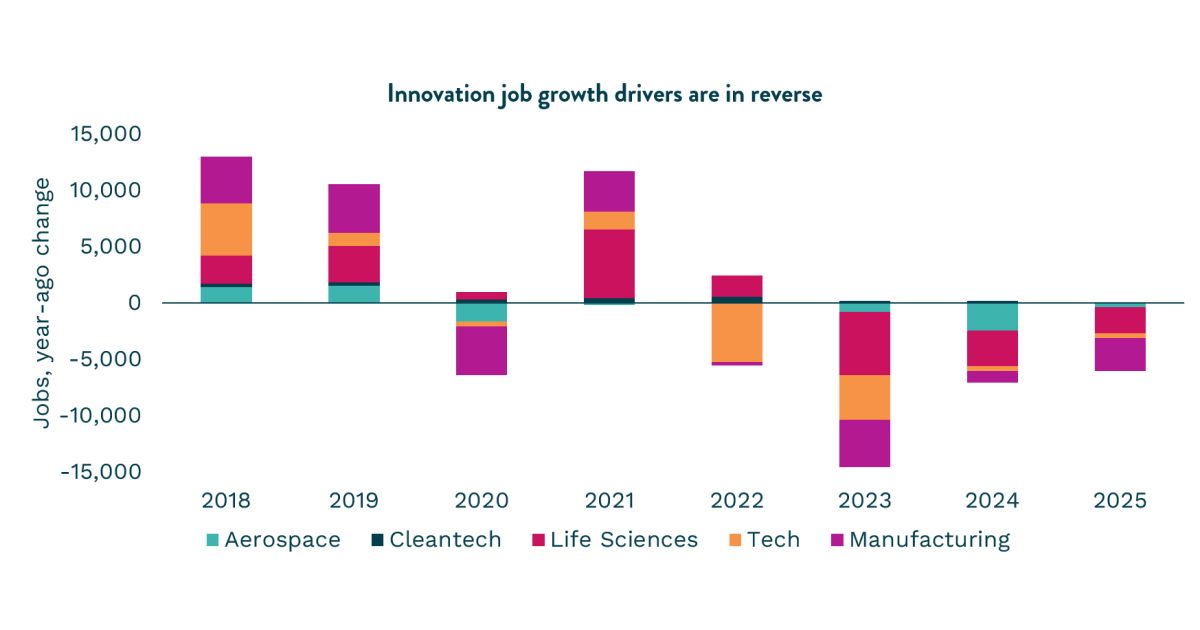
During the first half of 2026, San Diego has recovered some of this job loss, adding 4,200 jobs through June. However, all this growth is being buoyed by two sectors: healthcare and social assistance, and leisure and hospitality. Without these, San Diego would have 10,900 fewer jobs. While growth in these two sectors is welcome, the employment opportunities they create are both lower-paying on average and historically tend to be fueled by growth in innovation and other traded sectors as opposed to fueling growth in them.
The current composition of job growth in the region looks nothing like previous periods of economic expansion. Knowing what innovation jobs mean to our regional economy, the status quo is not sustainable.
It is not yet clear to me whether the weak job market of the last 12-18 months is reflective of current market disruptions from tariffs, inflation, and federal funding cuts or something more structural such as population decline and AI (likely a combination of all the above). Regardless, San Diego must adapt to the current headwinds and leverage our strengths to propel new job growth, foster a more resilient workforce, and cultivate the next generation of innovation.
Creating jobs
One area the federal government has clearly communicated its willingness to expand appropriations is defense. Congress is currently negotiating a policy framework for $1.15 trillion in defense spending. In addition to housing the largest concentration of military assets and personnel in the world, San Diego has demonstrated its technological primacy in areas such as autonomous vehicles and advanced materials sciences, drawing tens of billions in defense contracts annually.
The Department of War has issued new guidelines on procurement aimed at more rapidly deploying dollars and our region needs to be better positioned to compete for those funds. With support from defense primes such as Booz Allen, dozens of defense technology startups, and our two R1 universities—UC San Diego and San Diego State University—EDC will release a Defense Innovation Roadmap this October to ensure our region has a coordinated set of strategies for catalyzing investment and growing jobs in the defense industry.
Sign up to receive EDC’s research in your inbox
Developing talent
While job growth is a challenge in 2026, another difficulty is determining what skills workers must develop to remain competitive as AI emerges as both tool and threat. San Diego must best position itself to both ride the wave of investment to capture new technology jobs, as well as prepare our workforce to adapt and thrive amid this technological revolution. That is why EDC is excited to join Opportunity@Work and the Brookings Institution for the inaugural AI Readiness Lab, as part of a national peer learning network.
Our economy runs on exactly the kind of skilled, career-building roles that AI is reshaping fastest. We already see a widening gap between economic growth and entry-level hiring in the occupations our young workers count on to launch their careers. Getting this transition right is critical to our region’s prosperity and competitiveness, and we’re excited to learn alongside five peer regions working to turn AI from a threat into an engine of opportunity.
Crafting the market
Earlier this year, I had the privilege of participating in a two-day workshop with some of the most thoughtful and intentional economic development practitioners in the country. The purpose of the gathering was not to “admire the problem” facing regional economies today, but rather to recognize that market forces can be deliberately shaped to produce more of what a region needs.
We know what our region needs: quality jobs, skilled talent, and thriving households. We need to better define the challenge before us to effectively mobilize business, government, and civic leaders to maximize our region’s economic prosperity and global competitiveness.
San Diego is facing new challenges and we must adapt to reinvigorate job growth and prepare our workforce for rapid transformation. Fortunately, our region has a long history of reinvention and reimagination. It’s time to do it again. Let’s get to work.
With gratitude and respect,

Eduardo Velasquez
Vice President, Economic Development & Research