A note from our Vice President

San Diego’s 2026 mid-year check-in

Dear EDC investors and partners,

We start each year with a look ahead to what trends we think will be most significant to San Diego’s economy. We entered 2026 knowing our region is facing a critical inflection point—one where our growth engines are no longer propelling our region forward. This harsh reality has emerged against the backdrop of profound changes in trade policy, technological transformation, and federal funding in innovation.

Midway through the year, the significance of this inflection point is becoming clearer. What is also becoming clearer are the actions San Diego must take—with and through you—to restart our region’s economic engines and retain our global competitiveness.

Confronting the brutal facts

First, we must acknowledge what the data have demonstrated: San Diego’s economic engines have stalled out, dragging overall job growth down with it. This is because when one job is added in our innovation industries (life sciences, aerospace, tech, cleantech), another two are added elsewhere in the economy. New data shows that job declines in these innovation industries continued throughout 2025 (see chart). Overall, the region had 2,200 fewer jobs in 2025 than in 2024. Between 2024 and 2025, employment in the region increased by just 0.7 percent, which is half the annual average since 1990—meaning the pace of job growth over the last two years was four times slower than the historical average.
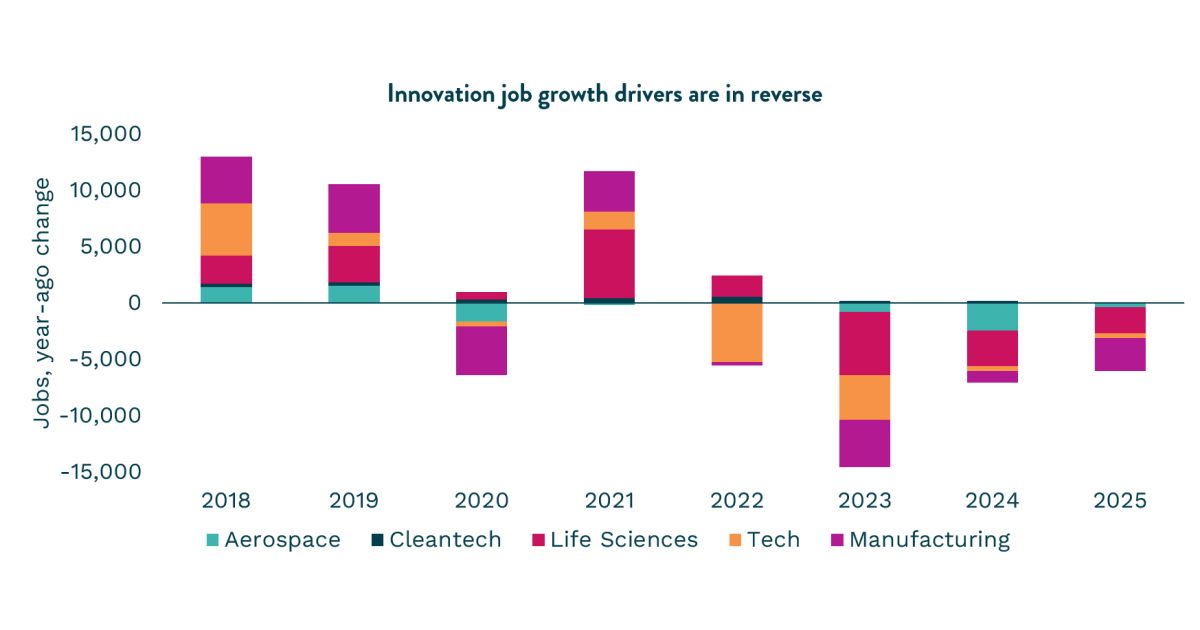
During the first half of 2026, San Diego has recovered some of this job loss, adding 4,200 jobs through June. However, all this growth is being buoyed by two sectors: healthcare and social assistance, and leisure and hospitality. Without these, San Diego would have 10,900 fewer jobs. While growth in these two sectors is welcome, the employment opportunities they create are both lower-paying on average and historically tend to be fueled by growth in innovation and other traded sectors as opposed to fueling growth in them.

The current composition of job growth in the region looks nothing like previous periods of economic expansion. Knowing what innovation jobs mean to our regional economy, the status quo is not sustainable.

It is not yet clear to me whether the weak job market of the last 12-18 months is reflective of current market disruptions from tariffs, inflation, and federal funding cuts or something more structural such as population decline and AI (likely a combination of all the above). Regardless, San Diego must adapt to the current headwinds and leverage our strengths to propel new job growth, foster a more resilient workforce, and cultivate the next generation of innovation.

Creating jobs

One area the federal government has clearly communicated its willingness to expand appropriations is defense. Congress is currently negotiating a policy framework for $1.15 trillion in defense spending. In addition to housing the largest concentration of military assets and personnel in the world, San Diego has demonstrated its technological primacy in areas such as autonomous vehicles and advanced materials sciences, drawing tens of billions in defense contracts annually.

The Department of War has issued new guidelines on procurement aimed at more rapidly deploying dollars and our region needs to be better positioned to compete for those funds. With support from defense primes such as Booz Allen, dozens of defense technology startups, and our two R1 universities—UC San Diego and San Diego State University—EDC will release a Defense Innovation Roadmap this October to ensure our region has a coordinated set of strategies for catalyzing investment and growing jobs in the defense industry.

Sign up to receive EDC’s research in your inbox

Developing talent

While job growth is a challenge in 2026, another difficulty is determining what skills workers must develop to remain competitive as AI emerges as both tool and threat. San Diego must best position itself to both ride the wave of investment to capture new technology jobs, as well as prepare our workforce to adapt and thrive amid this technological revolution. That is why EDC is excited to join Opportunity@Work and the Brookings Institution for the inaugural AI Readiness Lab, as part of a national peer learning network.

Our economy runs on exactly the kind of skilled, career-building roles that AI is reshaping fastest. We already see a widening gap between economic growth and entry-level hiring in the occupations our young workers count on to launch their careers. Getting this transition right is critical to our region’s prosperity and competitiveness, and we’re excited to learn alongside five peer regions working to turn AI from a threat into an engine of opportunity.

Learn more

Crafting the market

Earlier this year, I had the privilege of participating in a two-day workshop with some of the most thoughtful and intentional economic development practitioners in the country. The purpose of the gathering was not to “admire the problem” facing regional economies today, but rather to recognize that market forces can be deliberately shaped to produce more of what a region needs.

We know what our region needs: quality jobs, skilled talent, and thriving households. We need to better define the challenge before us to effectively mobilize business, government, and civic leaders to maximize our region’s economic prosperity and global competitiveness.

San Diego is facing new challenges and we must adapt to reinvigorate job growth and prepare our workforce for rapid transformation. Fortunately, our region has a long history of reinvention and reimagination. It’s time to do it again. Let’s get to work.

With gratitude and respect,

Eduardo Velasquez
Eduardo Velasquez

Vice President, Economic Development & Research

A note from our Vice President

The nobility of business

Dear EDC investors and partners,

Each year, EDC organizes a leadership trip to another metro in our country to learn about their economic development challenges and draw inspiration for tackling our own as we strive toward a more competitive, and inclusive San Diego.

Earlier this summer, we traveled to Chicago with a 40-person executive delegation where we learned about the City’s network of corporate philanthropic partners focused on systemic change and a university-led, multi-state collaborative competing for the jobs of the future through its Quantum and Microelectronics Park that has drawn $100M+ in federal funding—all culminating with a moving preview visit to the Obama Center and Presidential Library.

Yet, among all the exciting efforts we learned about and all the amazing speakers we heard from, the thing that has continued to resonate with me most nearly three months later is the simple but powerful statement from former U.S. Commerce Secretary Penny Pritzker: “Building a business and growing jobs, in and of itself, is a noble cause.”

As someone who has spent the past decade working to support businesses that want to grow and expand in our region, these were words that I needed to hear. Building a business…is a noble cause.

Doing business today is hard

Small and medium-sized businesses are the backbone of our regional economy. Those with fewer than 100 employees represent 99% of businesses in our region and they collectively employ 60% of our regional workforce, which is nearly double the national average. Since the pandemic, we have seen a steady rise in new business formation while the job market has remained weak, and our economic engines have sputtered. Brave individuals have decided to take on the noble pursuit of forming their own enterprise with all the risk that it brings.

Choosing to start a business is a major endeavor. Building that business, while running that business, is a 24-hour job. Operating a business in the state of California is no easy task (insert your favorite scoff here). And with all the uncertainty that business owners face today, from tariffs to AI, growing a business has never been nobler.

Celebrating business impact

That is why last week we hosted the second annual San Diego Business Impact Awards. With more than 300 people in attendance, EDC and JPMorganChase celebrated businesses, and their owners, for continuing to persevere and for choosing to invest in growing here in San Diego.

But the Business Impact Awards go even further. We aim to not only honor businesses for growing, but also for how that growth is landing in our region.

We wanted to know: Is a business hiring local? Sourcing locally? Training the next generation of workers? Building something that draws on all the great assets that our region has to offer?

In just our second year, we received twice as many nominations as in 2025—and the quality of the submissions was remarkable.

What that tells me is that the San Diego’s business community is eager to be seen not just as growing companies (noble as it is) but also as good stewards of our region.

The ripple effects

Collectively, this year’s honorees employ more than 13,000 people. They generated more than $9 billion in combined revenue. They paid out more than $1.5 billion in wages and salaries in FY 2024-25. And year-over-year, they added more than 1,500 net new jobs to this region. Through their supply chains and labor income, these 100 businesses added more than $6 billion to the regional economy; that’s more than our Cyber industry, our RNA industry—and the equivalent of 38 Comic-Cons.

These are not just abstract statistics.

That’s 13,000 households with paychecks that contribute to local schools, dine at local restaurants—and in many cases, 13,000 people who chose to plant their careers here because one of those companies gave them a reason to.

When EDC talks about building a more competitive San Diego, a more inclusive San Diego economy, this is what we mean.

These companies represent every corner of our county—spanning life sciences, clean energy, technology, consumer brands, food and beverage, defense, and professional services. They are young companies and companies that have been around for more than six decades. But they all share a common thread: a genuine commitment to San Diego.

To our honorees, and to all the 100,000+ businesses across our region, thank you. Please keep striving, please keep investing in our region—your efforts are both noble and impactful. And we have your back.

With gratitude and respect,

Eduardo Velasquez
Eduardo Velasquez

Vice President, Economic Development & Research

A note from Mark

Our collective power in a time of need

“I am grateful for what I am and have. My thanksgiving is perpetual.”

— Henry David Thoreau

Dear EDC board-members, investors, and friends,

I hope this message finds you well as we head into the final months of the year. It is almost impossible for me to believe that 2026 is right around the corner.

Ensuring San Diego is an attractive and affordable place for talent and businesses remains more important than ever to our region’s resilience and competitiveness. As we all know and understand, the shutdown of our federal government and additional challenges coming from Washington, D.C. are creating undue stresses, strains, and hardship for families, workers, and businesses across our region—at a time when nearly half of all local households are already struggling. Just 51.7 percent of San Diego household incomes have kept pace with the region’s cost of living, meaning that many San Diegans sacrifice quality of life to pay for basic household needs such as transportation, grocery expenditures, and childcare—pressures that disproportionately impact communities of color.

I offer no political observations or critique other than to say that our charity for our neighbors and fellow citizens should never be needed because our government refuses to do its job. Yet in this season of thanksgiving, it is our charity for our neighbors and fellow citizens that is needed most.

With all that said, I could not feel more pride and gratitude for our EDC investors and partners who have been organizing efforts to help those most in need. I am grateful for:

…and many, many more that are a constant resource to families, such as Lifeline Community Services, Neighborhood House Association, YMCA of San Diego County, and local educational institutions and government partners. I see the very best of who we are as a region reflected in the actions, intentions, and service of these partners and leaders. For all of them, my thanksgiving is perpetual.

It is never lost on me that when I write these messages I am writing to our region’s most influential and important leaders. Collectively, you have the power to move mountains. As we head into a holiday season and new year that may continue to add undue stresses, strains, and hardship to the lives of so many around us, let’s not forget the power we have to make people’s days (and lives) better and brighter. Please consider donating to, aligning with, and supporting the work of the organizations listed above, or other organizations in the community whose missions and values best align with yours.

Forever grateful for what I am and have. Forever grateful for all of you.

All my best,

Mark Cafferty
Mark Cafferty

President & CEO

Read EDC’s monthly report

A note from Mark in September: From classrooms to careers

“Summer has come and passed
The innocent can never last
Wake me up when September ends.”
—Green Day

EDC investors, board members, and partners,

It’s that time of year again. If you happen to be a parent or grandparent of a certain age, live near a college or university, or work with or adjacent to higher education in any way, you know that more than 200,000 students have just made their way back to campuses, classrooms, dorm rooms, and lecture halls across our region. All ages and backgrounds. Residents and commuters. Adult learners and recent high school graduates. Hopeful. Motivated. Excited. All the things a region could and should hope for as it looks to grow and sustain a world-class economy and a world-class workforce.

To know and understand anything about the history of San Diego and our economy is to know and understand the value, strength, and importance of higher education. The critical role that our universities, community colleges, and learning communities have played over the last several decades cannot be overstated. As an economic development community, we must never forget what an important role they have played in growing and diversifying our region.

Yet as classes begin this year, unprecedented challenges continue to mount for San Diego and for our nation’s higher education institutions. Federal funding cuts; legal battles for individual universities, systems, and student populations; escalating costs, and constant threats and heated rhetoric coming from Washington, D.C. are all creating strains, burdens, and pressures that will test the system like never before. Even more so within the State of California. But as we look toward an uncertain future, let us continue to draw inspiration, strength, and resolve from the certainty of the past.

The story of higher education in the San Diego region continues to be one of inspirational growth and resilience against the backdrop of near constant challenge. Over the last century, our colleges and universities have grown from educating a few hundred students a year to hundreds of thousands of students a year. Through world wars, depressions and recessions, the rise and fall of industries, near unthinkable technological and scientific advancement, and an almost unimaginable public health pandemic, they have not only endured—they have thrived. As millions of learners have walked across stages to earn their diplomas, they have walked out into our community to start careers, grow businesses, and power industries. The San Diego economy has grown around them and because of them. And it still does.

A new chapter of history surrounds us. The stakes are certainly high for the education community and for the growth and sustainability of our economy. How we react and respond to this moment will tell future generations a great deal about who we were. And someday, if I should appear anywhere in those historical stories and records, you will most certainly find me standing side by side with our leaders and partners in higher education—right where I hope to find all of you as well.

Wishing you well this September,

Mark

P.s., EDC and Junior Achievement are surveying businesses to understand the benefits of hosting interns. If your San Diego company has recently hosted an intern, please share your insight.

Mark Cafferty
Mark Cafferty

President & CEO

STAY ENGAGED WITH EDC

A note from Mark: Summer in San Diego

Another special San Diego summer

EDC investors, board members, and partners,

No matter what may be happening in the world around us, almost any day of the summer months in San Diego might lead you to believe that everything is perfect. And while we all know that perfection is largely unattainable, what is undeniable is that it (once again) feels like a very special summer in San Diego.

From the moment Pride flags are raised throughout our neighborhoods, and the San Diego Convention Center begins its heroic transformation into host, setting, and backdrop for Comic-Con International, the city’s streets truly come to life in July. Over the last 55 years, Comic-Con has grown to become a beloved international brand within the entertainment industry while remaining an anchor event for San Diego’s tourism engine. Meanwhile, San Diego’s Pride Parade/Week continues to attract more than 300,000 attendees and remains the largest annual civic event in the City of San Diego.

As August begins, we have seen San Diego nonprofit Curebound once again raise millions of dollars in its effort to “end cancer in our lifetimes” through its (growing) Curebound Cancer Challenge. Originally known as Padres Pedal the Cause, the event moved from its exciting venue at Petco Park to its new home on the scenic Torrey Pines Mesa. This past weekend, EDC team members joined tens of thousands of cyclists, walkers, and fundraisers as they made their way past the campuses of the very institutions responsible for the scientific research and breakthroughs that are keeping San Diego at the forefront of this global fight.

And whether the remainder of the summer sees you tuning in to the Padres pennant race, attending a concert with the San Diego Symphony at the Rady Shell, or enjoying time on San Diego’s 70+ miles of beaches and coastline, we hope that the warm days and nights ahead remain (near) perfect and special for you, your business, your friends, and your family.

We hope to see you soon at our:

  • Summer Bash on August 14 for a night of networking with more than 300 innovators, live music, delicious bites and drinks, and a short keynote from Kate Therapeutics’ Kevin Forrest, in conversation with LYZZ Capital’s Court Turner.
  • Inclusive Growth Roundtable on August 20 for a progress update on our region’s Quality Jobs Goal, and a roundtable discussion on equipping small businesses to compete.

With respect and admiration,
Mark

Mark Cafferty
Mark Cafferty

President & CEO

STAY ENGAGED WITH EDC

A note from our Talent Initiatives Director

Education & how business can fill the gap left by government funding

In the past five months, we have seen our education systems face cuts that threaten our most vulnerable communities. To help contextualize their impact, here’s what we know about the current state of education funding for our region:

  • The Governor is proposing a 7.95 percent cut to the CSU and UC systems. This equates to $128 million in cuts to San Diego alone and makes up nearly 40 percent of all state budget reductions.
  • The House Education and Workforce Committee has proposed $351 billion in budget cuts, including adjusted requirements for Pell Grant eligibility that would impact more than 125,000 students in the CSU system alone.
  • Federal agency research funding faces significant threats. This funding accounts for more than half of total research awards in the UC system, which produced 78 startups in FY23 alone.
  • The state continues to cut funding to the California Strong Workforce Program, impacting its ability to support career education. These cuts could reduce access to direct workforce training and supportive services, limiting opportunities for both students and workers.

Now more than ever, we are challenged to come together, discuss, and ideate. As San Diego emerges from the shock and chaos this year’s headlines have already caused, let’s pause to think about the opportunity ahead of us.

What is not news is that many of our systems, in their current forms, often struggle to serve the individuals and communities that need them most. While we know higher education to be an effective vehicle for socio-economic mobility, we continue to see a positive correlation between income and the test scores that determine college eligibility. Proposed reductions to Pell Grant availability, especially impacting individuals that must work full-time to make ends meet, will exacerbate these issues and make educational attainment even more challenging for low-income individuals.

In order to meet business needs for our future workforce and ensure all San Diegans have an opportunity to succeed—two goals that inextricably go hand in hand—we need creative and cross-functional solutions. Where the government divests, enterprise must invest to ensure its most critical asset, its people, remain available and prepared.

San Diego Regional EDC will continue to serve as a convener for the region, bringing the right people to the table for collaborative solutions. With changes in technology, an ever-increasing cost of living, and significant shifts in skills needs, EDC will advocate for a less linear and more intertwined relationship between industry and education. This comes in the form of:

  1. frequent exposure to the World of Work through experienceships and company tours;
  2. internships, like those available through Advancing San Diego and the K-16 Collaborative;
  3. and skills-first hiring practices like those available through apprenticeship models and advocated for by Opportunity @ Work.

EDC will also continue to explore new and innovative ways for businesses to help fill gaps, such as company-supported ScholarShare 529 plans or loan forgiveness programs for upskilling education.

Join us on May 21 for our Q2 Inclusive Growth Roundtable to learn more about this work and see how you can get involved. This small lunchtime event aims to bring together investors and partners engaged in the Inclusive Growth Initiative—especially the talent goal—to discuss where we stand as a region on doubling the number of skilled workers with just five years left in our timeline. If you are interested in joining that lunch, drop us a line!

Thank you,

Contact SDREDC
To learn more, please contact us.

A note from Mark

Keep the “Good News” coming

EDC investors, board members, and partners,

I hope this message finds you well. While the news and the constant barrage of information surrounding us these days can feel a bit heavy and negative, I want to remind you all that for the last 13 years, the EDC team has been putting out “Good News of the Week” every Friday to make sure San Diegans end the week on the highest possible note. We always do our best to filter through everything we can to find news of businesses expanding and growing, universities receiving new accolades and funding, non-profit partners improving the community while improving the economy, and other milestone achievements advancing San Diego’s regional and global competitiveness.

Still, we would love to hear more milestones in innovation, collaboration, creativity, integrity, and inspiration that are found in all corners of our county and our binational region. Consider this my invitation and reminder to submit your own Good News and make sure we don’t miss out on elevating your stories.

In the spirit of sharing “Good News”, the incomparable Sir Elton John is coming back to Petco Park to perform at Curebound’s Concert for Cures on Friday, May 9. As we heard from EDC Investor and Curebound CEO Anne Marbarger in our January EDC Board Meeting, the nonprofit raises money for grants that support San Diego’s top research institutions in the fight against cancer. Join Lauree, me, and the broader San Diego business community as we help raise critical funds for cancer research, and officially say farewell to Sir Elton John. Explore Curebound’s Concert for Cures table and ticket information, or contact Anne directly at anne@curebound.org.

So again—keep the “Good News” coming. I can assure you there is not a week that goes by where someone in this community (or even outside of this community) doesn’t remind me of how uplifting it is to read about your collective successes, breakthroughs, wins, and moments worth celebrating.

Thank you as always for your leadership and support, and for continuing to make San Diego the unique and amazing place that it is.

With respect and admiration,
Mark

Mark Cafferty
Mark Cafferty

President & CEO

Read EDC’s monthly report

Buy your tickets

A note from Mark…

Celebrating 60 years & our honorees

EDC investors, partners, and colleagues:

Each year when we give out awards at our Annual Dinner, I think of the two people who inspired them—Duane Roth and Herb Klein. And while we now call them our “Life. Changing.” Awards in alignment with our regional branding and communications efforts, I am reminded again that both Duane and Herb changed many lives. Mine included.

This year marks EDC’s 60th Anniversary. And while our Annual Dinner is always a big event that means a great deal to our team and the broader economic development community we work with and through, this year it feels like it means even more.

Part of what makes it more significant for me is thinking about how perfectly our award winners represent both the spirit of our work, and all that is truly special about the region we call home. As we celebrate six decades of economic development, we are really celebrating the people and the businesses who have paved the way and made this journey possible.

The first award is given to an individual who has gone above and beyond the responsibilities of their job to make San Diego a better place for all. Perhaps no person embodies this description more than Dr. Constance Carroll. Dr. Carroll served as the chancellor for San Diego Community College District for 17 years—the longest tenure of any chancellor in district history. She has served on countless local, state, national, and international boards and committees for both education and the arts. Dr. Carroll played a critical role in raising the profile of community colleges in the eyes of business and industry leaders throughout the region, and she is responsible for establishing and expanding the offerings of four-year bachelor’s degrees within the community college system. She has also done as much to advance the causes of economic equity and inclusion as any San Diegan I can think of.

The second award celebrates a business or organization that is changing the world from San Diego through science, technology, and innovation. Again, few organizations better embody this description than General Atomics (GA). A home-grown San Diego success story, GA has been a cornerstone of San Diego’s innovation economy since 1955. From aerospace and defense to electronics and energy, GA has become a global leader all while maintaining its headquarters in the heart of the Torrey Pines Mesa. GA boasts one of the region’s most talented and diverse workforces, and has significant education and workforce development partnerships with all of the region’s colleges, universities, and community colleges. GA co-owner and vice chairman Linden Blue has served on EDC’s board of directors for more than 25 years and was an executive committee member for more than a decade. GA’s impact exactly emulates the Life. Changing. Award.

So, during an iconic year for our organization, we are hoping that you can join us in recognizing the contributions of an iconic leader and company, and the ‘Life. Changing.’ roles they have played within our region.

Please join us May 15 at EDC’s Annual Dinner.

With gratitude,

Mark Cafferty
Mark Cafferty

President & CEO

Read EDC’s monthly report

Buy your tickets

A note from Nikia: WTCSD on trade

Navigating trade uncertainty in a binational region

As tariff threats loom and the country teeters on the brink of an all-out trade war, we all wonder what it means for our binational region, the future of the popular USMCA, and the hundreds of thousands of jobs tied to global commerce in San Diego.

This will be a volatile period for the North American supply chains that enable this region to compete globally. We have been here before.

In all the economic development work we do in this region, we strive to do it binationally, as a metropolitan region of close to seven million bisected by an international border. We travel together on investment attraction missions to South Korea or Singapore; we advocate together in Washington, D.C. and Mexico City for better infrastructure; and we work every day with counterparts in Tijuana to help companies create deep and resilient binational supply chains in critical industries.

What we have learned is that in the midst of uncertainty, we should return to what we know to be true about this binational region:

  • We know that our border economy, anchored by the busiest port of entry in the Western Hemisphere, has been a tremendous driver of economic growth, job creation, and competitiveness—not just for San Diego, but for America as a whole.
  • We know that what we do here is not trade, it is co-production: a single component—in an automobile or a medical device—may cross the border six to eight times, with value added at each stop, before finally reaching its customer. This means that 40 percent of what we import from Mexico was made by American workers in the first place. For imports from China by contrast, that number is less than four percent.
  • We know that this ability to regionally produce goods is a compelling reason why foreign companies invest here, and why local companies can compete globally and export their goods and technologies around the world, creating hundreds of thousands of jobs in this region alone.
  • And we also know how critical these supply chains—in aerospace, electronics, semiconductors, and medical devices—are to the broader U.S. economy. Notably, 60 percent of all medical devices imported to treat patients in hospitals in Boston and Atlanta are produced in this region and cross this border every day.
  • Finally, we know how important long-term investments in infrastructure—like Otay Mesa East or the Cross Border Xpress terminal—are to enhancing the remarkable economic engine we have created in this region.

Here in San Diego we have been finding solutions for decades, by working collaboratively to build border infrastructure, to facilitate trade and immigration, to fight crime and enhance education, and to create better outcomes for businesses, for consumers, and for communities.

The coming weeks and months will be bumpy—as barriers to trade and market access rise around the world—and they will be especially difficult for the 98 percent of U.S. exporters that are small businesses. Yet despite this turbulence, the overall calculus for American policy makers and global business leaders has been consistent for well over a decade: Regionalize supply chains closer to the customers they serve, and rebuild U.S. manufacturing capabilities in industries critical to national security and competitiveness. And there is no way to achieve those goals without relying on our North American neighbors. Even in the most extreme tariff scenarios, trade with Mexico and Canada would likely increase, but businesses and consumers would pay higher prices for the pleasure.

Our job in this moment is to be agile and creative in helping firms of every size—who have played by the rules and made significant investments in this country and its neighbors—to navigate uncertainty, continue to reach their customers and suppliers, and maintain jobs and supply chains in our most critical industries.

Nikia Clarke
Nikia Clarke

Chief Strategy Officer, EDC; Exec. Director, WTCSD


Resources and action:

  • Understand San Diego’s Foreign Trade Zones (FTZ) Program, which allows for duty free imports and warehousing. Learn more
  • Apply by June 30 to WTCSD’s MetroConnect export accelerator program supporting small- and medium-sized businesses in going global
  • Stay tuned for WTCSD’s upcoming Binational Trade & Competitiveness Report, launching Q3 2025

Need support? Contact our team.

EDC and WTCSD work directly with companies—free of charge—to help them grow in San Diego.

Contact us

Small, localized commitments mean huge economic impacts in San Diego

Op-ed originally published by San Diego Business Journal

Authored by Eduardo Velasquez, Sr. Research & Economic Development Director at San Diego Regional EDC, and Jennie Brooks, EDC Board Chair and Executive Vice President at Booz Allen Hamilton

Hosted in San Diego last month, the Department of the Navy Gold Coast Small Business Exposition brings together hundreds of government and defense contracting leaders to talk all things DOD procurement. Self-proclaimed as the big business event for small businesses, Navy Gold Coast serves to ‘leverage small business capabilities to seize opportunities for strengthening national security.’

Boasting the largest concentration of military assets in the world, San Diego has an incredible and important opportunity to tap our region’s small businesses not only to support military interests, but also to drive inclusive economic growth across the region.

As we track toward our region’s 2030 Inclusive Growth goals, it is imperative that our economic development strategies prioritize small businesses, which represent more than 98 percent of all local businesses and employ 59 percent of San Diego’s workforce. They are not just contributors to the local economy; they support jobs for 807,540 San Diegans across industries. But they are challenged to remain competitive. Small businesses pay on average 38 percent less than their large business counterparts, and in 2023, under one-third (or 244,794) of small business jobs were considered quality jobs—those paying $46,846 plus healthcare benefits. Not to mention the challenge small businesses face in succession planning, accessing capital, and generally staying afloat in one of the most costly regions in the country.

Together, San Diego’s large employers can have enormous impacts on our region’s small business community. In fact, a 2021 EDC study found that anchor institutions—such as universities and hospitals, as well as utilities, local government, and even sports teams—that are physically bound to the region collectively purchase tens of billions of dollars in goods and services every year. Yet, it is estimated that local anchors spend about one-quarter of all procurement dollars on suppliers from outside the region, with a fraction going to small and minority-owned businesses. EDC found that if anchors shifted just one percent to local, small, or diverse suppliers, San Diego would see millions of dollars in economic impact and thousands of jobs.

Booz Allen Hamilton has been committed to partnering with small and diverse suppliers across the San Diego region. In 2023, the firm’s local spend in the San Diego area with small businesses was more than $50 million, a 24 percent increase from 2022. We’re also inspired by San Diego Gas & Electric, the County of San Diego, and others making measured and meaningful commitments to support our region’s small and diverse businesses.

So, what can you do? To maximize their collective economic development impact, we need three key things from the region’s anchors.

First, we need consistency and coordination, both in terms of definitions and processes, to increase accessibility. Every institution tracks its spending differently, and each has its own requirements and processes for bidding out contracts. A consistent set of definitions and even some coordination in bidding processes will not only facilitate tracking and collective goal setting, but also increase access to a new pool of potential vendors and suppliers.

Second, leadership and resourcing are needed to establish and meet procurement goals. It is important that both organizational leadership and procurement staff agree on the value of these goals, thus creating accountability, aligning incentives, and implementing change.

Last, anchors leverage their large prime contractors to meet procurement goals. Take construction for example: large projects are often sub-contracted out by prime contractors to smaller suppliers and vendors, and many anchors lack visibility into these sub-contractors. Engaging primes in anchors’ goal setting increases visibility and opportunity for smaller suppliers while also ensuring that prime contractors have the capacity to fulfill project deliverables.

With intentional and localized commitments, we can create an economy that benefits more San Diegans, grows more jobs, and helps small businesses become the Qualcomms, Dexcoms, and Booz Allen Hamiltons of the future.

Let Navy Gold Coast serve as a potent and timely reminder to prioritize small businesses and inclusion for the betterment of our economy.

To learn more and get involved, contact:

Eduardo Velasquez
Eduardo Velasquez

Vice President, Economic Development & Research