For the past two years alongside underwriter Booz Allen Hamilton, EDC has released a series of five studies on the proliferation of Artificial Intelligence and Machine Learning (AI-ML) within San Diego County’s key economic clusters. The reports represent the most comprehensive deep dive on San Diego’s AI-ML ecosystem—evolving and growing since the baseline report was published in December 2020.
The reports found, by and large, that AI-ML technologies are creating new jobs, not eliminating them. Furthermore, the high pay commanded by workers in AI-concentrated fields has positive ripple effects in the local economy; for every 1,000 jobs gained in this industry, another 1,400 are created in other sectors. And while San Diego is well-positioned to welcome a new era of this innovation, accessibility and compensation remain ongoing challenges across the region.
The growing talent gap
In order to maximize the full potential of AI-ML integration, San Diego must grow its skilled workforce. Demand for AI-ML talent is more than double our regional supply. In fact, San Diego produced fewer than 3,000 AI-ML-related graduates in 2021, meanwhile, more than 7,800 local unique job postings required AI-ML skills in 2022.
San Diego’s colleges, universities, and training programs are hard at work to bridge this gap. The region boasts a collective 118 degree-track programs focused on cybersecurity, many of which include AI-ML training, as well as numerous certificates on AI-ML methods. The growth of cybersecurity, smart urban development, and life sciences innovation will depend on the development of AI skills in the next generation of workers.
Connecting with a wide array of training programs, such as community colleges, certificate programs, and bootcamps, can help San Diego companies source talent locally.
Inclusion is key
Even as San Diego’s existing AI-ML talent supply is more racially diverse than the national average, it still lags in comparison to the region’s population demographics. Making growing industries and high-wage roles accessible to San Diego’s Black and Hispanic talent—our region’s fastest growing populations—would help San Diego companies enjoy a talent surplus, strengthen our region’s competitiveness, and enhance our ability to drive life-changing innovation. Ultimately, greater diversity in the workforce will make AI-ML tools more powerful.
When implemented, AI-ML has the potential to help San Diego companies expedite life-saving drug discovery, thwart cyber threats, and revolutionize transportation and logistics. More importantly, AI-ML can help cities and regions improve affordability and quality of life for residents, as well as support job growth and business expansion.
“EDC’s AI series underscored that AI-ML adoption is creating new job opportunities, and the demand for these skills far outpaces the supply,” said Teddy Martinez, Senior Research Manager, EDC. “As we wrap with a focus on Smart Cities, it is clear that if done right, AI-ML also has the potential to advance economic inclusion and improve quality of life for more San Diegans.”
You can read our entire AI series here:
Thank you to our underwriter Booz Allen Hamilton.
Learn more about EDC’s Research Bureau here
Get involved with EDC
- Invest in EDC’s inclusive growth and business assistance work.
- Subscribe to receive our newsletters and research products.
- Keep in touch via our Twitter, Facebook, and LinkedIn.
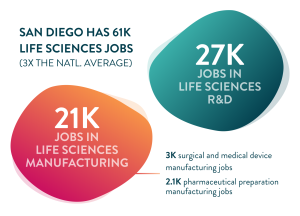 Life Sciences is an integral and rapidly growing piece of the San Diego regional economy. In 2021 alone, San Diego Life Sciences companies pulled in 13.1 percent of the $38.6 billion invested into Life Sciences nationwide. Supporting this growth, San Diego ranks fourth (4,300 in 2020) in Life Sciences degree completions among peer metros. Future and ongoing investment in Life Sciences companies and talent—most especially around compensation and accessibility—will ensure the longevity of this high impact industry and support its ability to compete.