A note from Lucas: Trade and San Diego in 2026

Playing offense in an uncertain 2026

Dear EDC investors and partners,

For those who joined us at board meeting in January to hear EDC VP Eduardo Velasquez present, one message was clear: Our regional economy is entering a period not simply of slowdown or acceleration—but of structural change.

The global economy is being rewired in real time. Trade relationships are being reassessed. Supply chains are shifting. Capital is flowing more selectively. And uncertainty—particularly around tariffs, court proceedings, and the upcoming 2026 U.S.-Mexico-Canada Agreement (USMCA) joint review—has become a defining feature of the landscape.

Here at home, the innovation drivers powering San Diego’s growth for more than a decade are beginning to show signs of strain. This is unfolding amid a more protectionist national posture, higher costs of capital, heightened geopolitical tension and wartime, and rapid advances in artificial intelligence that could reshape industries almost overnight.

Just last month, the Supreme Court struck down the use of the International Emergency Economic Powers Act (IEEPA) as justification for broad-based tariffs imposed over the past year. The ruling reaffirmed that sweeping tariff authority rests with Congress, not the executive branch. While tariffs are not eliminated outright, the decision introduces further uncertainty around their continuation and potential reimbursement of duties already paid. For companies on the ground, the message is clear: Trade policy remains fluid.

Time and again, we hear from businesses like yours that uncertainty—more than any single policy—is the primary concern of 2026.

The proof is in the data

Periods of trade volatility are not new. In 2018, amid similar tensions, EDC and WTCSD commissioned our North American Trade & Competitiveness Study to better understand the cross-border economy defining the Cali Baja region and to equip leaders with credible data.

Last November, we refreshed that work with the release of our Binational Trade & Competitiveness Report—a comprehensive assessment of the economic engine powering our region.

The findings are clear. Nearly 95,000 regional jobs are supported by binational trade. Since the USMCA took effect in 2020, trade with North American partners has grown by nearly one-third and continues moving up the value chain into sectors such as medical devices, aerospace, and semiconductors. Ninety-seven percent of San Diego’s goods exports go to Mexico alone, underscoring the deeply integrated nature of our intermediate goods trade. Meanwhile, services exports have risen 54 percent in recent years.

Trade is not a side story—it is the bloodstream of our innovation ecosystem.

Building on this foundation, we are now refreshing our Go Global: Trade & Investment Plan, the framework that launched WTCSD more than a decade ago. In partnership with Boston Consulting Group and regional stakeholders, we will conduct new analysis and executive engagement to ensure our roadmap through 2030 reflects today’s global realities. We invite you to join this initiative and consider sponsoring the upcoming report.

MetroConnect: Building resilience where it matters

While we focus on long-term positioning, we remain committed to near-term resilience. Our small and mid-sized businesses must be ready.

Last month, we welcomed 15 companies into MetroConnect VIII, our flagship international sales accelerator. Replicated across North America and recognized with a Presidential “E” Award in 2023, the program provides structured export training and more than 200 hours of no-cost expert consulting support through our role as the region’s official Export SBDC.

Competitiveness is built not in calm moments, but through preparation and deliberate action.

Japan 2026: Playing offense

As we take on 2026, we intend to play offense.

Asia now accounts for roughly half of global foreign direct investment flows. Within that trend, Japan stands out as the largest foreign investor in the U.S. and, over the past decade, the top foreign investor in San Diego County. Prime Minister Sanae Takaichi has pledged $550 billion in new U.S.-bound investment in the coming years, emphasizing defense, energy, and security—sectors where San Diego holds distinct strengths.

This fall, WTCSD will lead a delegation of approximately 35 business leaders to Tokyo, Yokohama, and Osaka. These trade missions are not symbolic; they are strategic.

We annually position San Diego as a premier landing zone for investment, engage senior government and corporate leaders, and align our region with the next wave of trusted global capital flows. In a world where reliability increasingly defines opportunity, Japan is a natural partner—and San Diego is a natural platform.

Looking ahead

We are entering 2026 with clear priorities: Strengthen our competitive advantages, deepen trusted global partnerships, and convert regional strengths into global relevance. The next era of globalization will be more selective, and more strategic. Regions that prepare early and act deliberately will outperform those that wait for certainty to return.

We invite you to engage—whether by supporting MetroConnect companies, joining us for an upcoming Global Competitiveness Council meeting, maximizing opportunity for our Japan trade mission, or contributing to our refreshed global strategy. Together, we can ensure that San Diego not only weathers the storms ahead, but emerges stronger, more globally connected, and more competitive than ever.

Lucas Coleman
Lucas Coleman

Director, World Trade Center San Diego

More from WTCSD

San Diego’s Good News of the Week – March 6, 2026

Every week, ‘Good News of the Week’ features a curation of positive headlines from San Diego, delivered straight to your inbox. A blend of aggregated stories from San Diego’s most trusted news sources and original EDC-created content, GNOTW provides a comprehensive recap of the region’s best stories from the past week. GNOTW is sponsored by Manpower.

Get Good News of the Week in your inbox every Friday. → Sign up

For the week of March 6, 2026, here’s what we’re reading:

…and here are some events and opportunities:

From our partners:

2025 Thriving Households update: Affordability pressures persisted

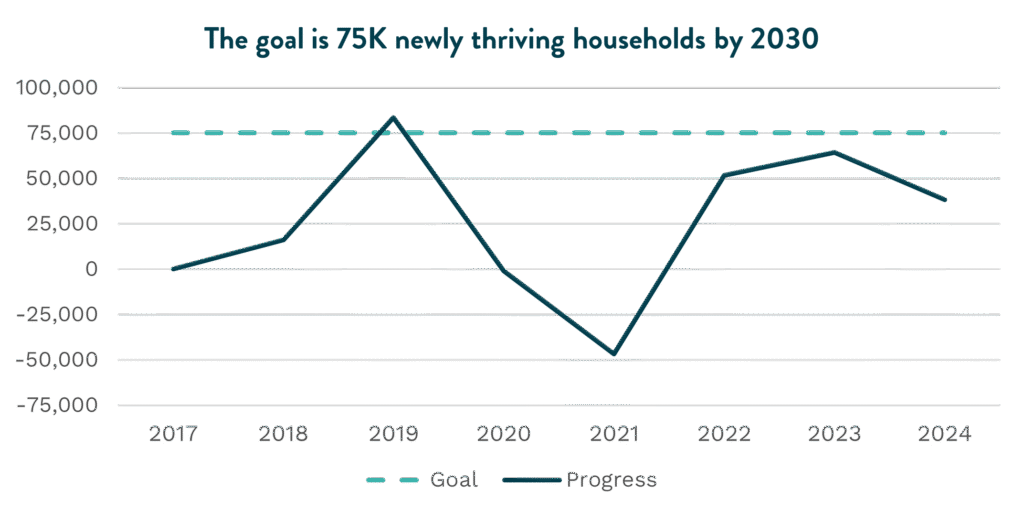
As of 2024, San Diego has added 38,157 newly thriving households since Inclusive Growth tracking began—a decrease from 2023 levels. The decline reflects eroding household purchasing power amid continued price pressures on essential goods including housing, groceries, and energy.

See the Update


Business information and resources page

Be in the know – sign up below to receive future editions of GNOTW.

Want to submit your event or news update to our weekly newsletter? Contact us for more information.

sign up for gnotw

Enya Castañeda
Enya Castañeda

Coordinator, Investor Relations & Marketing Communications

2025 Thriving Households update: Affordability pressures persisted

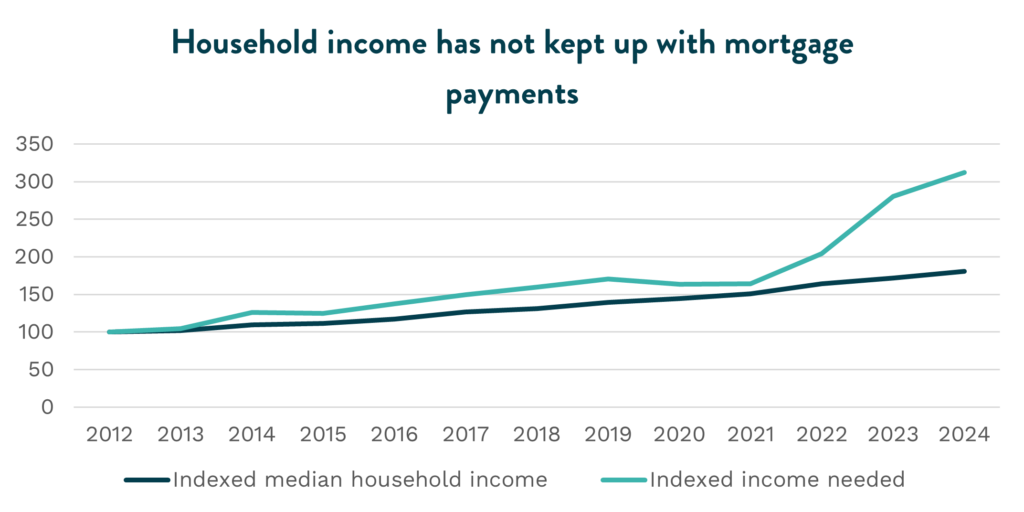
San Diego has continued to show progress in reaching our Inclusive Growth goals with 2024 median household income experiencing a 29 percent increase since 2019. Despite promising recent growth in annual earnings across the county, San Diego remains one of the most expensive metros in the U.S. By the end of 2024, households needed an income exceeding $235,000 to afford the median-priced home, a threshold that, combined with elevated interest rates, places homeownership further out of reach for most San Diegans.

On average, homeowners faced housing costs of $4,748 per month in 2024, 55.5 percent higher than 2019 costs. Because household income growth has failed to keep pace with the cost of living, the gap between local housing costs and incomes continues to widen despite home prices stabilizing.

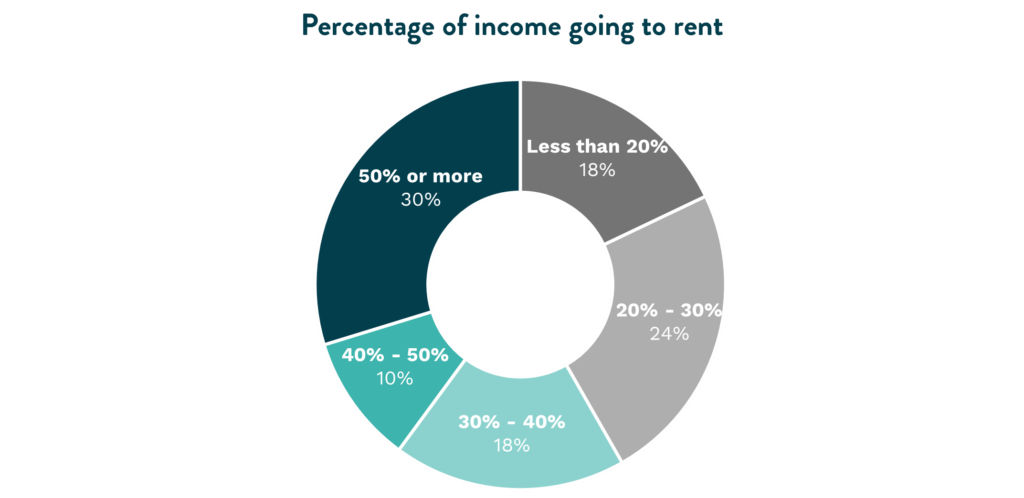
Renters face similar pressures. Average rent prices reached $4,039 in 2024, increasing by 8.3 percent over a year and 38 percent over five years. As household income struggles to catch up to increasing prices, 58 percent of renters remain cost-burdened, spending more than 30 percent of their income on rent.

Progress toward the goal

By the end of the decade, EDC estimated the region would need to add 75,000 newly thriving households. To be considered ‘thriving’ in 2024, a renter-occupied household needs at least $84,816 in household income per year, while a homeowner-occupied household needs $139,872 per year.

As of 2024, San Diego has added 38,157 newly thriving households since tracking began—a decrease from 2023 levels. The decline reflects eroding household purchasing power amid continued price pressures on essential goods including housing, groceries, and energy.

Addressing the supply challenge

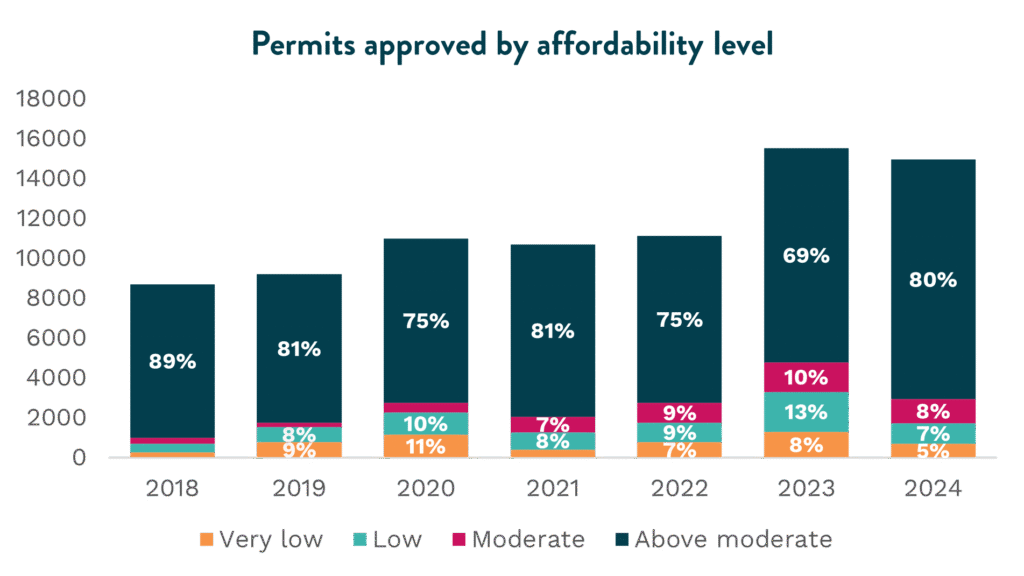
To increase housing supply, local jurisdictions have made notable progress in streamlining permitting processes. Nearly 15,000 housing permits were approved in 2024, demonstrating continued momentum despite a slight decrease from 2023. However, the number of permits for moderate income housing dropped by 18.8 percent, highlighting the persistent challenge of the “missing middle” and insufficient affordable housing production. Furthermore, permits for low and very low income households dropped 47.4 percent compared to 2023.

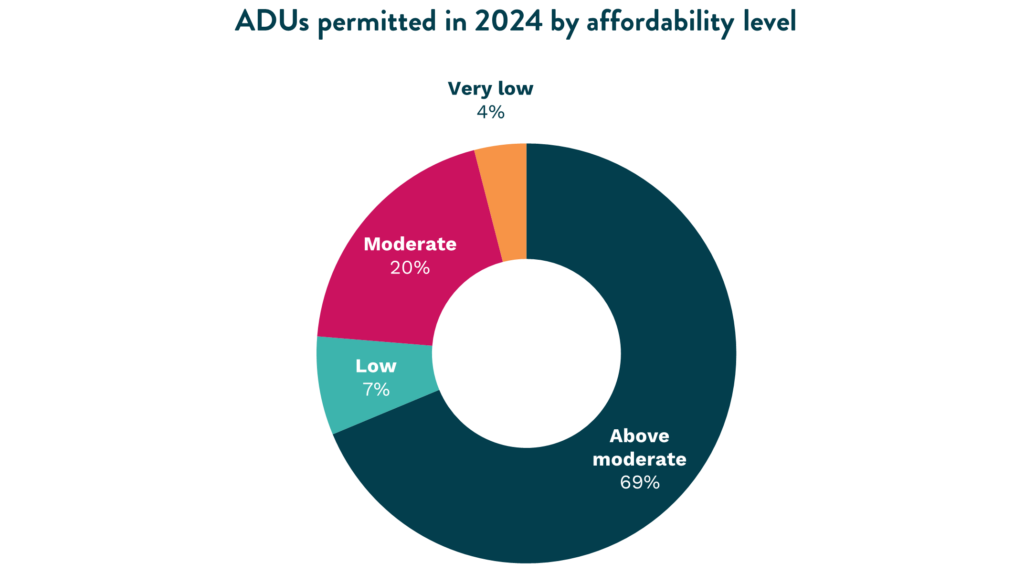
Accessory Dwelling Units (ADUs) represented nearly 27 percent of all permits approved in 2024—up from 22 percent in 2023—and 66 percent of all permits approved at moderate level pricing. However, those priced above moderate continue to make up most of ADU permits. While ADUs offer an opportunity to increase housing stock in existing single-family home lots, they’re unlikely to solve the region’s housing crises alone.

Developers cite several obstacles hampering housing production. The multifamily development market has become oversaturated, reducing incentives for new entrants. Current policies favor small units that do little to address the scale of San Diego’s housing needs. Rising construction costs, coupled with high insurance premiums and litigation risks, have the power to prevent projects from ever breaking ground.

At a broader level, California continues to experience a decline in construction employment, with a 1.9 percent annual decrease in 2024. This could be a potential contributing factor to slowed construction in coming years. This is especially relevant in states like California where the construction workforce is particularly reliant on immigrant workers. In fact, 40 percent of the construction workforce is comprised of foreign-born labor, potentially affecting construction-related labor under the current immigration enforcement landscape.

Extended timelines from permitting to groundbreaking further diminish project viability. Addressing these barriers will require better incentives for risk-taking and access to more flexible financing options.

Creative solutions for persistent challenges

Recent announcements signal significant office space vacancies in downtown San Diego. Major real estate firms including the Irvine Co. have been divesting San Diego office towers since 2024, reflecting broader shifts in the commercial real estate market. This challenge presents an opportunity.

Converting vacant office space into housing could revitalize areas where commercial properties no longer contribute meaningfully to the local economy. However, conversion costs can be prohibitively high. In many cases, demolishing outdated office buildings to construct multifamily housing may prove more economically feasible.

Similarly, conversions of single-family home lots into multiple single-family lots could have significant impact on housing affordability. According to LISC’s single family lot size reduction analysis, allowing multiple townhomes on one single family lot could lower home prices by 42 percent. Additionally, if 1.4 percent of the City of San Diego’s current single family lots were allowed to build multiple townhomes on one single family lot, the amount of new property taxes generated would be approximately $450 million each year, just for the County of San Diego. These innovative efforts require streamlined permitting, supportive re-zoning, and infrastructure assessment from local governments.

Identifying which vacant office properties are suited for conversion—or demolition and redevelopment—should be the first step. Addressing San Diego’s supply-constrained market will require strong public-private collaboration and regional strategies to explore innovative solutions at the scale needed to meet the region’s housing demands.

In February 2026, EDC’s Thriving Households Roundtable provided an opportunity to discuss employer-led solutions to these pressing challenges and to hear about innovative initiatives from local leaders such as LISC, cREate Development, and Center for Housing Policy and Design.

Join the movement. Endorse our Inclusive Growth goals.

Bree Burris
Bree Burris

Sr. Director, Communications & Community Engagement

Monthly Report – March 2026

The global economy is being rewired in real time. Trade relationships are being reassessed. Supply chains are shifting. Capital is flowing more selectively. Here at home, the innovation drivers powering San Diego’s growth for more than a decade are beginning to show signs of strain.

Time and again, we hear from businesses like yours that uncertainty—more than any single policy—is the primary concern of 2026.

more from Our wtcsd director

By the numbers

  • 1.4% increase in employment in Q4 2025
  • 47% decrease in Life Sciences VC funding in 2025
  • $31B in economic impact is tied to Life Sciences in 2025
  • 2.3% decline in jobs leading in the in the innovation industry in Q4 20205

Featured stories

New and renewing investors

  • California Schools VEBA
  • COX
  • Endeavor Bank
  • Gafcon
  • General Atomics
  • H.G. Fenton Company
  • MedWest Realty
  • SAIC
  • Sycuan Band of the Kumeyaay Nation
  • YMCA of San Diego County

See our current Monthly Report

San Diego’s Good News of the Week – February 27, 2026

Every week, ‘Good News of the Week’ features a curation of positive headlines from San Diego, delivered straight to your inbox. A blend of aggregated stories from San Diego’s most trusted news sources and original EDC-created content, GNOTW provides a comprehensive recap of the region’s best stories from the past week. GNOTW is sponsored by Manpower.

Get Good News of the Week in your inbox every Friday. → Sign up

For the week of February 27, 2026, here’s what we’re reading:

…and here are some events and opportunities:

From our partners:

EDC’s Q4 2025 Economic Snapshot

In Q4 2025, San Diego saw a 1.4 percent year over year increase in job growth. On the flipside, this growth masked declines in innovation jobs and VC and research investment amid a year of heightened economic uncertainty.

Dive into the Data


Business information and resources page

Be in the know – sign up below to receive future editions of GNOTW.

Want to submit your event or news update to our weekly newsletter? Contact us for more information.

sign up for gnotw

Enya Castañeda
Enya Castañeda

Coordinator, Investor Relations & Marketing Communications

San Diego’s Good News of the Week – February 20, 2026

Every week, ‘Good News of the Week’ features a curation of positive headlines from San Diego, delivered straight to your inbox. A blend of aggregated stories from San Diego’s most trusted news sources and original EDC-created content, GNOTW provides a comprehensive recap of the region’s best stories from the past week. GNOTW is sponsored by Manpower.

Get Good News of the Week in your inbox every Friday. → Sign up

For the week of February 20, 2026, here’s what we’re reading:

…and here are some events and opportunities:

From our partners:

From statewide leadership to regional execution: San Diego’s role in fusion’s next chapter

With North America’s largest tokamak reactor in Poway, key contributions to international fusion project ITER, and top-tier technical talent, San Diego’s opportunity for successful fusion commercialization is undeniable. With statewide momentum and investment potential, our region has a chance to double down and capture the full economic benefit of fusion’s next chapter.

Learn More


Business information and resources page

Be in the know – sign up below to receive future editions of GNOTW.

Want to submit your event or news update to our weekly newsletter? Contact us for more information.

sign up for gnotw

Enya Castañeda
Enya Castañeda

Coordinator, Investor Relations & Marketing Communications

From statewide leadership to regional execution: San Diego’s role in fusion’s next chapter

California is a global leader in fusion research and development. As detailed in EDC’s 2025 statewide fusion energy study, the state is home to 16 core fusion companies—representing more than a third of all U.S. fusion firms. This rapidly expanding industry is supported by world-class universities and national laboratories located in the state and anchored by San Diego’s fusion energy expertise, which together have attracted more than $2.2 billion in public and private investment. Collectively, these assets put California in pole position for realizing the potential of fusion energy.

Sustaining that leadership—and translating it into energy production—will depend not only on statewide leadership and investment, but on the ability of individual regions within California to position themselves as specialized hubs for commercialization. Fusion’s path forward will be inherently place-based, requiring access to talent, regional supply chains, and pilot-scale infrastructure necessary to move from demonstration to deployment. Within this landscape, San Diego stands out as one of California’s most critical regional hubs.

Fusion pedigree with global reach

In San Diego, the fusion energy industry already generates more than $442 million in annual economic output and supports more than 1,600 regional jobs—evidence of a mature foundation for continued growth as fusion technology progresses toward commercialization. Our region further distinguishes itself by the breadth of our fusion capabilities, with strong legacy of companies, talent, and R&D supporting both magnetic and inertial confinement, the two primary fusion approaches. Combined, these assets position San Diego as a cross-cutting fusion hub.

At the center of San Diego’s fusion ecosystem is General Atomics, whose decades-long presence has shaped both national and international fusion progress. The company plays a central role across the world’s fusion landscape, supplying the components, systems, and diagnostics critical to both fusion industry partners and national laboratories.

In San Diego, General Atomics operates DIII-D, North America’s largest tokamak reactor, on behalf of the U.S. Department of Energy. A critical magnetic fusion research facility, DIII-D serves as a global collaboration platform that produces scientific insights and technological advances to support fusion development.

General Atomics’ fusion capabilities extend further through its Poway-based magnet facility, where it developed and built the world’s largest, most powerful pulsed superconducting magnet for recent installation at ITER, a 35-nation collaborative effort toward power plant scale fusion energy located in France. The expertise demonstrated at this facility represents a potential resource for developing future fusion blankets—the systems that surround the fusion reaction and convert its energy into usable heat while protecting the reactor, which are critical components across most fusion power plant designs. As fusion technologies progress toward pilot-scale deployment, sites like General Atomics’ magnet facility will become increasingly valuable in addressing both scientific and engineering challenges to commercialization.

San Diego’s highly-skilled fusion talent pipeline

Talent is critical to fusion’s development and commercialization. A strong academic pipeline anchored by UC San Diego complements our region’s industrial assets, offering established strengths in engineering, plasma physics, and materials science that support both fusion technology research and a skilled emerging workforce.

UC San Diego’s Jacobs School of Engineering, a top 10 U.S. engineering school that graduates about 3,000 students each year, houses the university’s Fusion Engineering Institute which brings together interdisciplinary teams to address complex technical challenges. At the same time, UC San Diego’s collaborative efforts such as its Fusion Data Science and Digital Engineering Center—led jointly with General Atomics—apply advanced computation, artificial intelligence, and digital engineering to accelerate fusion testing and development timelines.

This kind of cross-institutional collaboration reflects San Diego’s interconnected ecosystem and is increasingly essential as fusion companies move toward commercialization.

Hurdles to scale: Competing in a rapidly evolving national landscape

As fusion technologies move closer to commercialization, regions across the U.S. are beginning to compete on more than research capabilities alone. Local and state governments are increasingly deploying economic and regulatory tools to attract fusion companies—and their growing economic impact—as they transition from research to deployment. These tools include property tax abatements, accelerated environmental review planning, coordination with local utilities, and, in California, the establishment of recent California Environmental Quality Act (CEQA) exemptions that protect permitting timelines from costly legal challenges and signal regulatory clarity to fusion companies.

In San Diego, we have the opportunity to learn from other regions’ wins. Albuquerque City Council’s recent approval of a major incentive package for California-based Pacific Fusion—along with similar efforts by other regions, including Virginia’s recent success in securing the move of MIT-rooted Commonwealth Fusion Systems—illustrates both the scale and impact of the tools available to local municipalities and underscores that the race for fusion is underway.

San Diego cannot rest on its laurels; we must proactively address the challenges that inhibit the building of test facilities and pilot plants. Our region has an opportunity to build for the future, to both maintain our leadership position and capture the emerging economic benefits of fusion commercialization.

Translating strength into impact

The good news: San Diego is entering the fusion energy race with clear advantages. We have a dynamic innovation economy, a strategic position in the fusion supply chain, world-renowned institutions, and a robust, highly-skilled talent pipeline. We can learn from other regions’ wins and losses, strengthening the local infrastructure, incentives, and partnerships critical to fusion companies’ success in San Diego.

But turning scientific leadership into lasting economic value will also require a statewide policy environment that makes it easier to build, scale, and integrate fusion energy projects. That is exactly the role programs like California Jobs First are designed to play: Helping regions like San Diego align workforce training, infrastructure investment, and economic development strategies so emerging industries like fusion translate into high-quality jobs, more resilient local supply chains, and broadly-shared prosperity. Here, California has the opportunity to invest in this fast-growing sector to strengthen both our economic and our long-term climate resilience.

With statewide investment and momentum, San Diego will be able to double down on the opportunities most critical to the fusion energy industry—from workforce development to streamlined siting, permitting, and grid readiness—to ensure our region captures the full economic benefit of fusion’s next chapter.

Ready to locate or grow your fusion company in San Diego?

contact us for no-cost support

San Diego’s Good News of the Week – February 13, 2026

Every week, ‘Good News of the Week’ features a curation of positive headlines from San Diego, delivered straight to your inbox. A blend of aggregated stories from San Diego’s most trusted news sources and original EDC-created content, GNOTW provides a comprehensive recap of the region’s best stories from the past week. GNOTW is sponsored by Manpower.

Get Good News of the Week in your inbox every Friday. → Sign up

For the week of February 13, 2026, here’s what we’re reading:

…and here are some events and opportunities:

From our partners:

A note from Taylor: San Diego’s workforce in 2026

San Diego’s economic engine has always been its people. And as EDC’s Director of Talent Initiatives Taylor Dunne takes a look ahead at “a year defined by promise and pressure, we have more questions than answers: What is the role of post-secondary education in our changing region? How is AI shifting jobs and industries? And what does this mean for San Diego’s early career talent, our region’s leaders of tomorrow?”

Lean in with EDC


Business information and resources page

Be in the know – sign up below to receive future editions of GNOTW.

Want to submit your event or news update to our weekly newsletter? Contact us for more information.

sign up for gnotw

Enya Castañeda
Enya Castañeda

Coordinator, Investor Relations & Marketing Communications

A note from Taylor: San Diego’s workforce in 2026

Dear EDC investors and partners,

Last month, EDC’s Vice President of Economic Development and Research Eduardo Velasquez reminded us that San Diego stands at an inflection point—where technological transformation is colliding with long‑standing economic challenges in ways previously unseen. His note highlighted a region defined by promise and pressure: Slowing innovation‑sector job growth, rising household incomes shadowed by affordability constraints, and AI reshaping the very nature of work.

A month into 2026, more questions than answers remain, especially when it comes to talent: What is the role of post-secondary education in our changing region? How is AI shifting jobs and industries? And what does this mean for San Diego’s early career talent, our region’s leaders of tomorrow?

Built on talent—but facing new realities

San Diego’s economic engine has always been its people. With more than 100 research and education institutions, our region has long produced the skilled talent that fuels innovation, defense, life sciences, and advanced manufacturing.

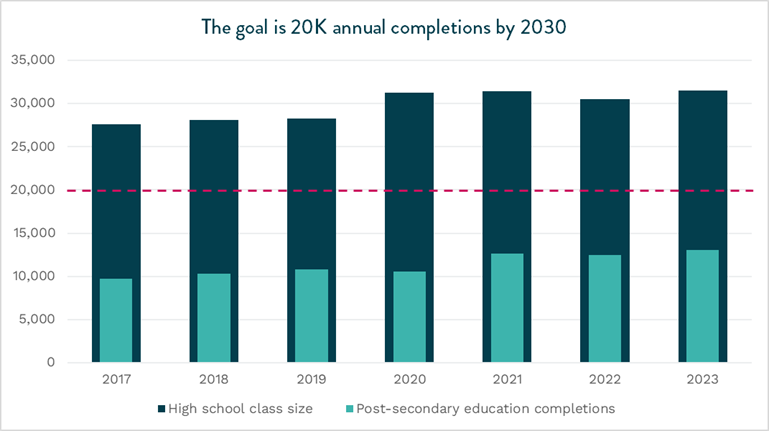
The good news: More San Diego students are completing degrees and credentials than ever before. The region has sustained progress in completions, even as the pandemic’s long‑term impacts remain murky. But the data also makes one thing clear: Post-secondary education is more critical than ever. Jobs requiring a bachelor’s degree or higher continue to grow at a significantly faster rate than those requiring less education. In fact, in 2025, San Diego added six times more jobs requiring a bachelor’s degree or more versus those requiring an associate degree or less.

Additionally, the growth of legacy industry clusters that have served as the backbone of San Diego’s global competitiveness—tech, life sciences, and manufacturing—is slowing down. While bright spots remain in emerging industries like cleantech and aerospace (namely defense technology) that are critical to the region’s future competitiveness, transformations in these industries and varied levels of AI integration represent significant changes to the entire U.S. economy. Their effects will ripple throughout the whole workforce. 

Take the cleantech industry, for example, as policy-backed efforts to decarbonize in California are leading to more electrification. As buildings modernize, we might expect increased need for electricians, while the need for gas-line plumbers decreases. The auto mechanic historically focused on combustion engines must now become familiar with hybrid and electric motors. And the manufacturing company that embeds machine learning and automation now requires a person who can analyze and tell a story with the resulting data.

A future workforce that doesn’t yet see a future

Across the U.S., young college‑educated workers are facing a “unique convergence of structural forces” that have severed traditional entry points into white‑collar work.

AI is accelerating this shift. Automation and augmentation are happening within jobs, not just across them. The occupations where automation potential is high are the same ones where augmentation potential is high—meaning AI may not necessarily eliminate an occupation, but rather transform how an employee executes their tasks. 

With lower barrier to entry tasks most exposed to automation, the entry-level or new graduate workforce risks being edged out of opportunities to launch. Meanwhile, the nature of the tasks exposed to augmentation will require mid-level workers to continue upskilling to remain competitive. 

As for long-term impacts? It’s too early to tell. San Diego’s labor market data does not yet reflect an overhaul of entry-level roles. Job growth across innovation industries at all levels has declined over the last few years, and while entry-level job growth has declined slightly faster, it has not been the job elimination of our nightmares. 

What remains constant in our conversations with employers across industries and occupations is a need for soft skills that will never be automated. Skills like communication, empathy, and problem solving are more fashionable than ever. In fact, this demand has been so persistent that workforce developers and educators have taken to calling these “durable” skills—though figuring out how best to cultivate them in students may be the next great challenge. 

In a time of transitioning tech, too, regional employers are doubling down on opportunities to future-proof their workforce. We’ve heard from San Diego companies that are making a deliberate effort to traditionally train early career employees in the skills AI could support, both to strengthen institutional knowledge and develop future leaders. And local tech heavyweights are continuing to proactively invest in both tomorrow’s talent and technology, maintaining internship programs that convert as many as three in four interns to full-time roles and leveraging new technologies early to instill technical skills in the emerging workforce.

Lean in with us

To meet these challenges, EDC is doubling down on initiatives that align education, industry, and talent. Through regional and even national partnerships, we will continue to facilitate work-based learning like internships and apprenticeships, and equip the region to better understand its labor market needs.

Here’s how you can lean in:

  • Host a summer intern from a Verified Program: All intern hosts will work with an employer of record and have access to a pre-vetted batch of resumes. Small businesses may qualify for interns’ wages to be subsidized or fully covered. Learn about our Advancing San Diego internship program.
  • Hire from Verified Programs in San Diego: These local programs are employer-verified for teaching in-demand skills as well as serving a diverse student population. To connect with a Verified Program, reach out to EDC.
  • Help us collect critical regional talent data: With so many remaining questions, it has never been more important for training and education institutions to keep a pulse on future talent demand. Our talent data dashboard, annual talent survey, and talent demand reports help local education programs prepare San Diegans with the skills your company needs. If your company is experiencing shifts in talent needs, we want to hear about it.

San Diego’s future workforce is diverse, ambitious, and full of potential—but only if we build the systems that allow every resident to participate in and benefit from our innovation economy.

Your collaboration and investment—whether through hiring, training, curriculum partnerships, or direct support of EDC initiatives—continues to ensure that San Diego can cultivate the talent that creates, attracts, and retains cutting‑edge companies, strengthens our innovation clusters, and secures San Diego’s economic future.

Taylor Dunne
Taylor Dunne

Director, Talent Initiatives

More FROM Advancing SaN Diego

More on inclusive growth

San Diego’s Good News of the Week – February 6, 2026

Every week, ‘Good News of the Week’ features a curation of positive headlines from San Diego, delivered straight to your inbox. A blend of aggregated stories from San Diego’s most trusted news sources and original EDC-created content, GNOTW provides a comprehensive recap of the region’s best stories from the past week. GNOTW is sponsored by Manpower.

Get Good News of the Week in your inbox every Friday. → Sign up

For the week of February 6, 2026, here’s what we’re reading:

…and here are some events and opportunities:

From our partners:

Redefine the future of medicine: Build your career in cell and gene therapy

San Diego is fast becoming a global launchpad for cell and gene therapy breakthroughs—and the companies behind these innovations are hiring. Discover how this fast‑growing sector is reshaping modern medicine and why top scientists and engineers are building their careers here in San Diego.

Learn More


Business information and resources page

Be in the know – sign up below to receive future editions of GNOTW.

Want to submit your event or news update to our weekly newsletter? Contact us for more information.

sign up for gnotw

Enya Castañeda
Enya Castañeda

Coordinator, Investor Relations & Marketing Communications