Advancing San Diego summer internships bridge education and industry

Advancing San Diego: Building talent pipelines

EDC’s Advancing San Diego (ASD) internship program, run in partnership with the Border Region Talent Pipeline K-16 Collaborative and Imperial Valley EDC, has transformed how students across San Diego gain early career experience, while helping local businesses address talent needs. In Summer 2025, the ASD program placed 210 interns at 110 companies across San Diego and Imperial Counties, creating an invaluable bridge between education and industry in high-growth, high-wage fields like engineering, computing, and business. This program plays a crucial role in addressing regional talent shortages, helping local companies access vetted, diverse talent and offering students paid, hands-on learning opportunities in high-demand industries.

Summer 2025 by the numbers


*Priority populations include low-income individuals, first-generation college students, current community college students or community college transfers, veterans and active-duty military students, and students with disabilities

Addressing the talent gap with community impact

At the heart of ASD’s mission is a commitment to reaching under-resourced communities, ensuring that students from diverse backgrounds gain valuable career experience while helping local businesses address critical talent needs. Companies apply each year by early spring to host students from Advancing San Diego Verified Programs to be interns. These Verified Programs are selected based on industry-determined criteria, including industry engagement, diversity, equity, and inclusion, as well as curriculum that teaches the most in-demand skills in computing, engineering, and business. This approach ensures that students’ skills align with evolving workforce demands, enhancing the overall impact of the internship experience.

EDC recruits local small to medium-sized businesses to host interns, and once companies are selected, students from Verified Programs apply for available internship roles. With more student applicants than available positions, students from priority populations receive preferred access to internship positions. In Summer 2025, 82 percent of interns identified with one or more priority populations, up nine percent from 2024. Importantly, the program provides financial support covering intern wages at a competitive rate. In 2025, local companies saved more than $1 million in payroll costs, ensuring businesses can prioritize mentorship and on-the-job training over recruitment logistics.

Real-world experience and career advancement

Each year, the internship program provides students with valuable work experience directly linked to their academic pursuits, equipping them with practical skills and career confidence. At the same time, companies benefit from student contributions. Surveyed companies shared that hosting interns improved their outlook on early-career talent: 91 percent agreed or strongly agreed that the program increased their likelihood of hiring a university student, and 82 percent said the same for community college students. For employers, this means a pipeline of highly motivated, well-prepared candidates who bring immediate value.

Day in the Life of a San Diego Intern video campaign

During the 2025 summer internship program, ASD launched its first “Day in the Life of a San Diego Intern” video campaign, inviting interns to share a glimpse into their internship experience through short videos. Thanks to generous donations from the San Diego Padres, San Diego FC, San Diego Wave FC, San Diego Zoo Wildlife Alliance, and SeaWorld San Diego, ASD was able to give five lucky winners tickets to signature San Diego experiences. The video campaign gave ASD interns the opportunity to share their professional experiences with the local business community and increase exposure of careers in San Diego to diverse groups of local young talent.


“After our sixth year partnering with this valuable program, Left Coast Engineering has hosted more than a dozen interns across electrical, mechanical, and aerospace engineering, plus computer science majors. As a small business here in San Diego since 1999, we see this as an opportunity to help develop and equip these engineering students with
both the skillsets and mindset for successful product development. Our goal is to help engineers graduate with more experience and more value to benefit any hiring company.

—Anita Baranowski, CEO, Left Coast Engineering


Is your company interested in hosting summer interns in 2026?

Apply now

Learn more about San Diego’s workforce trends and insights

Explore the talent dashboard

To learn more and get involved in EDC’s work, contact:

Emily Chowaniec
Emily Chowaniec

Coordinator, Talent Initiatives

A note from Mark on Giving Tuesday

Dear EDC board members, investors, and friends,

“Giving Tuesday” officially began in 2012 as a fundraising campaign associated with the 92nd Street YMCA in New York City. Today, it has grown to become a “global generosity movement, unleashing the power of people and organizations to transform their communities and the world.” In just 13 years, the effort has gone from raising a few million dollars to support a single cause/campaign to raising billions of dollars for organizations and causes across the globe.

With the Thanksgiving holiday behind us and the year-end holidays just weeks away, we encourage everyone to continue to practice and promote the generosity and kindness that has had such a strong impact in our community over the last few months and throughout this past year. Our own local ‘generosity movement’ has meant the world to individuals, families, and valued institutions during a very difficult time.

Among the list of important and valuable causes, initiatives, and organizations within our region, one effort that remains near and dear to my heart—and one that our work at EDC has become fully aligned with—is that of youth employment and internship programs. As many of you know, I started my career working in school-to-work and school-to-career programs in Boston’s high schools and community colleges. Decades later, I have seen how those very programs changed and improved lives while strengthening and supporting the city’s economic growth and prosperity. We have started to see the same results here in the San Diego region through our Advancing San Diego program, partners, and the Border Region K-16 Collaborative.

As we head into 2026, Advancing San Diego’s post-secondary internship program that has been so generously supported by JPMorganChase and the state of California over the last few years is seeking new and sustained funding and support. Recognizing it as both a critical and important talent recruitment strategy for employers and an impactful work and learning experience for our local first-generation college students, we are hoping that far more San Diego-based employers will lean in to support the program in 2026. For more information on hosting an intern at your business this coming summer, please contact Taylor Dunne. Just hosting and supporting one more intern makes a world of difference.

And for those who cannot host an intern but still wish to support these efforts financially, we encourage you to make a donation to our 501(c)3 to ensure we can maximize the number of young people we place this summer at small and growing businesses. A $7,500 donation will fully cover the wages for an intern for the entire summer at a San Diego small business. A $500 donation will support the transportation, professional clothing, and any other support services needed by most students (especially those who are from more under-resourced backgrounds). And any donation will help support, grow, and advance this important cause.

We know that there are so many important initiatives and organizations that need support right now, but we also know that this is one way where your donation can help individuals and families within our region while also strengthening our economic outlook for the future.

As always, we cannot thank you enough for your leadership and support over the past year, and we look forward to working by your sides to make the year ahead as strong and stable as possible for our region’s businesses, workers, and households.

May all of your days ahead be merry and bright.

With gratitude and respect,

Mark Cafferty
Mark Cafferty

President & CEO

Support the internship program

San Diego’s Good News of the Week – November 21, 2025

Every week, ‘Good News of the Week’ features a curation of positive headlines from San Diego, delivered straight to your inbox. A blend of aggregated stories from San Diego’s most trusted news sources and original EDC-created content, GNOTW provides a comprehensive recap of the region’s best stories from the past week. GNOTW is sponsored by ACE Parking.

Get Good News of the Week in your inbox every Friday. → Sign up

For the week of November 21, 2025, here’s what we’re reading:

…and here are some events and opportunities:


From our partners:

Note from Mark: Our collective power in a time of need

The federal government shutdown and challenges have created undue stresses, strains, and hardship for families, workers, and businesses across our region—at a time when nearly half of all local households are already struggling. EDC’s Mark Cafferty shares, “I could not feel more pride and gratitude for our EDC investors and partners who have been organizing efforts to help those in need. Collectively, you have the power to move mountains.”

Hear How You Can Help


Business information and resources page

Be in the know – sign up below to receive future editions of GNOTW.

Want to submit your event or news update to our weekly newsletter? Contact us for more information.

sign up for gnotw

Enya Castañeda
Enya Castañeda

Coordinator, Investor Relations & Marketing Communications

Study: Cali Baja trade grows under USMCA, fuels 95K local jobs in strategic sectors

WTCSD report quantifies binational trade impact, critical opportunities for continued growth 

In November 2025, World Trade Center San Diego released “Binational Trade and Competitiveness: Harnessing Opportunity in the Cross-Border Economy,” which quantifies trade in the Cali Baja region (San Diego County, Imperial County, and Baja California), and analyzes the jobs, economic impact, and supply chains tied to the region’s cross-border economy. 

In 2020, the U.S.-Mexico-Canada Agreement (USMCA) deepened nearly three decades of North American trade. Since then, Mexico has overtaken China as the U.S.’s top trading partner, with total goods trade reaching $840 billion and capital goods imports from Mexico up 43 percent. Cali Baja itself has since evolved into one of the world’s most dynamic cross-border supply chains, where more than $2.3 billion in goods cross the U.S.–Mexico border every day, fueling industries from aerospace and medical devices to electronics and clean energy. 

Against a backdrop of trade volatility and a shifting policy landscape, Cali Baja’s binational integration and co-production capabilities offer a critical opportunity to localize supply chains, strengthen North American competitiveness, and drive sustained economic growth. Yet, this same volatility, growing geopolitical tensions, and rising costs threaten to fragment this interconnected ecosystem. 

“San Diego and Baja California don’t just share a border—we share an innovation ecosystem. USMCA keeps that ecosystem strong by powering advanced industries and building the resilient supply chains that define North America’s future,” said Dr. Nikia Clarke, Executive Director at World Trade Center San Diego, the report’s author. “In a world of rising tariffs and fractured trade, this is our moment to double down on this regional strength—by modernizing border infrastructure, recertifying the USMCA, and prioritizing continued investment in the binational co-production model that is our key competitive advantage.”

KEY report FINDINGS

  • USMCA growth reduces North American reliance on China, strengthening nearshoring opportunities. Trilateral trade has increased by 31 percent and Mexico has emerged as a dependable, highly technical manufacturing partner. Under the USMCA, capital goods imported from Mexico to the U.S., such as machinery and manufacturing equipment, surged 43 percent.
  • Services is the fastest-growing sector in US-Mexico trade. The integrated binational partnership extends beyond goods: In 2024, U.S. services exports to Mexico reached $50.4 billion, with imports from Mexico at $45.1 billion—increases of 54 percent and 46 percent respectively under the USMCA.
  • Binational trade fuels jobs and economic growth in San Diego and Imperial. Nearly 97 percent of San Diego and Imperial County’s $34.5 billion in goods exports go to Mexico, supporting roughly 95,000 jobs in critical industries like aerospace, medical device, and semiconductor.
  • Baja California is diversifying and moving up the value chain. Beyond traditional maquiladoras and electronics, the region now exports higher-value goods across multiple industries—including medical device and transportation equipment—compared to 15 years ago, when electronics alone accounted for 70 percent of exports.
  • Stability under the USMCA supports small businesses. For the 97 percent of U.S. exporters that are small businesses, a stable trade framework helps them navigate global economic uncertainty— which two-thirds identify as their top concern.

Cali Baja fast facts

“Tijuana’s exceptional talent and proximity to San Diego create an ideal environment for nearshoring software, IT, and professional services, supporting thousands of jobs on both sides of the border,” said Maritza Diaz, Founder and CEO at ITJ. “This evolution reflects a broader shift in the binational region—from traditional manufacturing to a knowledge-driven economy that fosters innovation, integration, and global competitiveness.”

“As a global leader in aerospace, we know innovation is international. In San Diego, our access to highly skilled talent right across the border has been the difference between stagnation and growth,” said David Orth, Business Unit Director, GKN Aerospace. “Working together, our teams in Mexico and San Diego have been critical to our continued development and delivery of cutting-edge systems for commercial and defense aircraft all over the world.’’ 

The report was underwritten by ITJ, with sponsorship by the County of San Diego, and research support from 10 regional partners, including SANDAG, Tijuana EDC, UC San Diego, and more, and was unveiled at the 2025 Cali Baja Business Summit to an audience of 200+ binational business, academic, and civic leaders.  

SEE THE FULL REPORT

LEARN more about WTCSD

About World Trade Center San Diego
World Trade Center San Diego (WTCSD) operates as an affiliate of San Diego Regional Economic Development Corporation (EDC). WTCSD works to further San Diego’s global competitiveness by building an export pipeline, attracting and retaining foreign investment, and increasing San Diego’s global profile abroad. WTCSD.org  

Report: Meeting San Diego’s healthcare talent needs beyond 2025

Strengthening San Diego’s RN pipeline and expanding specialty training

Healthcare is San Diego’s second largest sector, supporting 160,000 jobs throughout San Diego County and providing critical care for our community. However, a national nursing shortage and aging population are intensifying the demand for skilled healthcare professionals. Simultaneously, communication breakdowns between regional industry and education are leading to misunderstandings around the supply and demand of talent.

To better understand San Diego’s regional demand for talent, EDC’s Advancing San Diego program conducted a comprehensive talent demand survey focused on priority roles in healthcare. The survey engaged nine of the region’s largest healthcare providers, collectively employing 66,000 and operating more than 175 regional facilities, to understand real-time data around critical nursing positions.

Key findings

  • Like much of the nation, San Diego faces a critical shortage of skilled nurses, with the highest demand for Registered Nurses (RNs). Labor market information indicates that the region will need more than 1,500 additional RNs in the next three years, but data from this working group revealed that new graduate nurses—those who have recently completed a training program—account for just 300 of the in-demand roles. Meanwhile, the region is graduating around 2,000 new RNs each year.
  • Most of the future regional demand for RNs will focus on specialization. Employers identified Operating Room RNs as the highest priority for specialty roles.
  • Regional healthcare employers reported a misalignment in the training of Radiological Technologists. 100 percent of surveyed employers said that cross-training Radiologic Technologists and Computed Tomography (CT) Technologists would add value to their organizations and emphasized a need for additional Imaging Technologists (X-ray, CT, Sonography, etc.) in the region.

Healthcare Talent Demand Report 2025

a critical need for specialty nurses

While traditional labor market data shows more than 15,000 regional job postings for RNs in 2024, the bulk of these postings are actually for experienced and specialty nurses, not entry-level roles. At the same time, regional education programs are graduating close to 2,000 RNs each year. The available labor market data does not differentiate demand based on entry-level versus experienced roles, creating a misalignment between employer need and the talent pipeline.

This misalignment illustrates how readily available labor market data—often the primary source for education institutions and policymakers—can misrepresent actual workforce needs

EDC’s employer working group verified this, reporting that regional demand for specialty RNs significantly outpaces demand for new graduate RNs, and ranked Operating Room, ICU/Critical Care, and Labor & Delivery RNs as their top hiring priorities.

Furthermore, as many employers pointed to the oversaturation of new graduate RNs as one reason for the frequently cited shortage of clinical placement opportunities, hospitals must balance the need to upskill incumbent nurses with the growing demand for new grad placements, all while working with an already strained pool of available preceptors. While many hospitals invest heavily in internal training to grow their staff, this model puts the burden of training solely on hospitals who are already feeling the strain of a limited workforce. Limited clinical placement capacity, high costs, and competition across healthcare systems make it increasingly difficult to keep pace with growth and turnover.

Across the nation and in San Diego, specialty RNs remain at the heart of quality care and operational efficiency, nursing career mobility. They support the next generation of nurses through training and precepting – an important factor in retaining talent in the region. Ensuring a steady pipeline of these skilled professionals is not only a workforce issue—it’s also essential to driving the future of San Diego’s innovative healthcare systems and standards of excellence.

San diego’s strong healthcare future

As hospitals focus on building solutions for specialty training, the region must also continue to strengthen the new graduate RN pipeline.

“A balanced healthcare workforce means investing in both new talent and advanced training. By working together as a region, we can create innovative solutions that meet today’s challenges and ensure San Diego’s healthcare system thrives for years to come.”

– Elmerissa Sheets, Senior Director Talent Acquisition and Development, Scripps Health

New graduates trained through local institutions form the foundation of San Diego’s nursing workforce and will be essential in healthcare systems’ ability to meet rising demand.

From there, San Diego’s healthcare providers have a critical opportunity to secure a strong regional talent pipeline and ensure healthy communities into the future—by investing in new graduate RNs and accelerating their pathways into specialty roles.

Explore the full report to learn more and see how the group is beginning to build solutions.

Explore more Talent Demand Reports

Check out Talent Demand Reports across other priority sectors to stay up to date on workforce trends in San Diego.

Dive into the data

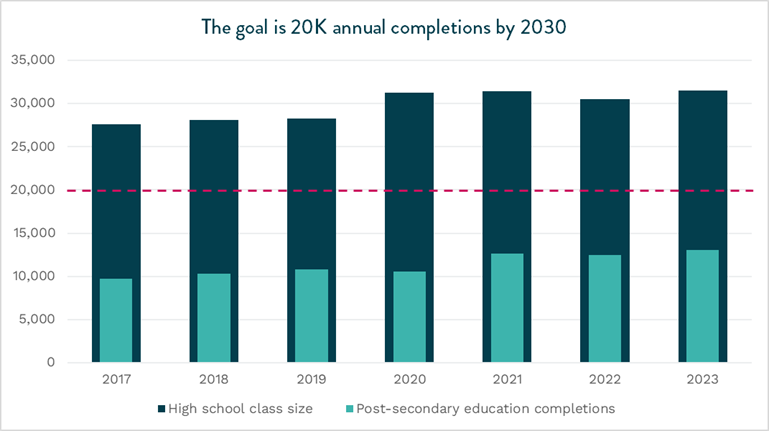
Use EDC’s Data Dashboard to explore how local education programs align with regional workforce needs and identify equity gaps in real-time. The dashboard highlights race and gender disparities, program completions, and connections to priority occupations—all designed to support more data-informed talent development efforts in San Diego County.

To learn more and get involved in EDC’s work, contact talent@sandieogbusiness.org.

Bridgette Coleman
Bridgette Coleman

Manager, Talent Initiatives

San Diego’s Good News of the Week – November 14, 2025

Every week, ‘Good News of the Week’ features a curation of positive headlines from San Diego, delivered straight to your inbox. A blend of aggregated stories from San Diego’s most trusted news sources and original EDC-created content, GNOTW provides a comprehensive recap of the region’s best stories from the past week. GNOTW is sponsored by ACE Parking.

Get Good News of the Week in your inbox every Friday. → Sign up

For the week of November 14, 2025, here’s what we’re reading:

…and here are some events and opportunities:

From our partners:

Inclusive Growth Spotlight: San Diego State University

As our region makes progress toward its 2030 Inclusive Growth goals, San Diego State University is working to support both local talent and thriving households through its upcoming Mission Valley Innovation District—which will include more than 4,600 residential units, with 10 percent designated as affordable housing.

Join the Movement


Business information and resources page

Be in the know – sign up below to receive future editions of GNOTW.

Want to submit your event or news update to our weekly newsletter? Contact us for more information.

sign up for gnotw

Enya Castañeda
Enya Castañeda

Coordinator, Investor Relations & Marketing Communications

Study: San Diego’s $4.3B cyber cluster expands amid tech contraction

EDC, CCOE study quantifies impact of region’s cybersecurity cluster

Together with the Cyber Center of Excellence (CCOE), EDC released “For San Diego, By San Diego: 2025 Cybersecurity Industry Economic Impact and Workforce Study.” The sixth update since 2014, the biennial report examines the economic impact of San Diego’s $4.3 billion cybersecurity cluster and explores the firms, technology, and talent working to help detect and contain cyber threats across San Diego and beyond.

In today’s hyperconnected, internet-first economy, cybersecurity is no longer optional. Whether in manufacturing, finance, healthcare, energy, or government, a single breach can inflict cascading operational, reputational, and financial consequences—reaching an average cost of $10.2 million in the U.S., according to IBM.

San Diego continues to be a leading cyber region, with more than 1,300 firms, the Naval Information Warfare Systems Command (NAVWAR), and the highest growth of cyber certificate obtainment among our peer metros. As organizations driving innovation and strategic national priorities face increasingly costly cyberattacks, our collaborative region is developing new technologies, defenses, and cyber warriors to combat these systemic threats,” said Lisa Easterly, President and CEO, CCOE—commissioning organization of the report.

KEY report FINDINGS

  • San Diego’s cybersecurity cluster continues to expand, adding jobs, firms, and economic impact, even as the broader technology industry contracts. There are 14,875 jobs across 1,350 establishments within the cybersecurity cluster in San Diego, up 11 percent and 33 percent over the last two years, respectively. Together, this amounts to $4.3 billion regional economic impact and 29,040 jobs impacted.
  • The cybersecurity talent pool continues to grow but has been slowing down since 2022. Despite the increased need for cybersecurity professionals, the pace the talent pool grows every year is declining. This trend parallels a similar slowdown in advertised demand, as job postings for cybersecurity workers have declined and remain 60 percent lower than pre-pandemic levels.
  • San Diego continues to expand cyber skills, particularly in certificate obtainment, which outpaces all of San Diego’s peer metros. Overall degree and certificate obtainment in San Diego continues to grow, expanding 51 percent since 2019. Certificates, which are obtained both in and outside of traditional degree programs, have grown 78 percent from 2019 to 2023.
  • Business sentiment has softened. Survey results show that perceptions of San Diego’s business environment have declined relative to 2023, including access to talent, vendors, customers, and capital. Only research and development remained at the same level compared to 2023.

Amid broader technology industry declines and a shifting policy landscape, cybersecurity remains a key, growing driver of San Diego’s economy. The region’s cybersecurity cluster supports 29,000 local jobs, most concentrated at NAVWAR, the preeminent provider of information warfare capabilities for the U.S. Navy. In all, the economic impact of San Diego’s cyber cluster is equivalent to 26 Comic-Cons.

“San Diego’s cyber cluster remains a bright spot for our region, during a period of continued economic uncertainty. However, we must not take it for granted. We can continue to support its growth by connecting cybersecurity companies to new customers, more suppliers, and diverse talent that is necessary to thrive,” said Eduardo Velasquez, Senior Director of Research and Economic Development, San Diego Regional EDC.

As cyber threats grow in frequency around the world, protecting integrated infrastructure and sensitive information across critical industries, from healthcare to defense to finance, is more important than ever,said Rob Johnson, Vice President of Cybersecurity Sales, Thales.

Finding opportunities to navigate economic uncertainty, adapting curriculum to prepare talent for the rapidly-evolving cluster, and helping equip small business vendors to sustain cybersecurity compliance are all strategies that will help San Diego maintain its leadership in cybersecurity and innovation across the region and globe.

In partnership with CCOE, the report was sponsored by Thales, Deloitte, ESET, LevitZacks, and NDIA’s San Diego chapter, and unveiled November 12 at an industry event hosted at Qualcomm.

SEE THE FULL REPORT HERE

LEARN more about cyber IN SAN DIEGO

About Cyber Center of Excellence (CCOE)
CCOE is a San Diego-based nonprofit that mobilizes industry, academia and government to grow the regional cyber economy and create a more secure digital community for all.

Inclusive Growth Spotlight: San Diego State University

EDC’s Inclusive Growth blog series highlights and celebrates San Diego companies and organizations helping drive economic growth and progress toward San Diego’s 2030 Inclusive Growth goals, launched in 2018 and informed by a partnership with the Brookings Institution.

Thriving households in San Diego

Decreasing affordability in San Diego threatens progress toward all the goals and disproportionately impacts communities of color. Household incomes have not kept pace with the cost-of-living reflected in basic household needs such as transportation, grocery expenditures, and childcare, leaving only one in 10 households able to afford the median-priced home in the region. As of 2023, San Diego has added 49,916 newly thriving households (chart below) bringing the total number of San Diego’s thriving households in the region to 610,983—51.7 percent of total households.

Read the latest Update


Meet SDSU’s Mission Valley Innovation District

San Diego State University (SDSU) is a top-tier public R1 institution that provides transformative educational experiences for more than 43,000 students in person and online, ranking among California’s leading public research universities. Building on this foundation, the SDSU Mission Valley Innovation District extends the university’s mission by fostering collaboration between academia and industry. The 1.6 million square-foot hub for office, technology, and research space creates new career pathways for students, drives regional economic growth, and advances innovative solutions to pressing societal challenges.

Promoting thriving student and faculty households

A significant challenge that SDSU faces in supporting thriving households is the rising home prices and rental costs which far outpace income growth—making it increasingly difficult for students, faculty, and staff to live near campus. For students, housing insecurity can affect academic success and well-being; for employees, it can hinder recruitment and retention, particularly among early-career professionals and those with families.

As SDSU expands through projects like SDSU Mission Valley, the university continues to explore partnerships, policy solutions, and innovative models that increase access to attainable housing while maintaining the quality and sustainability of the surrounding community. Maintaining affordability is a central focus so that students and employees can live and thrive where they learn and work—all essential to advancing SDSU’s mission of opportunity, equity, and regional impact.

Addressing affordability on multiple fronts

SDSU’s Mission Valley Innovation District is designed to advance economic opportunity and improve regional affordability through intentional planning and partnerships. Recognizing housing costs as a primary barrier to thriving households, SDSU Mission Valley will include more than 4,600 residential units, with 10 percent designated as affordable housing. The project’s transit-oriented design connects directly to the trolley, reducing transportation costs and improving access to employment and education. In addition, SDSU continues to explore partnerships that expand childcare options and support working families within the Innovation District.

Hear from SDSU:

SDSU and EDC have a shared commitment to advancing economic growth, regional talent development, and innovation. SDSU continues to invest in EDC, because EDC serves as a vital convener of regional stakeholders, bringing together leaders from government, education, and the private sector who also share common priorities and challenges. Through EDC’s programs, roundtables, and trade delegations, SDSU gains valuable connections and insights that strengthen collaboration across sectors. EDC’s data-informed approach supports evidence-based decision-making, helping partners align strategies to address regional needs in workforce development, housing, and economic growth. This collective effort directly advances SDSU’s mission of driving opportunity and innovation across the region.”

Join the movement

Progress on EDC’s 2030 Inclusive Growth goals is only achievable with and through the region’s employers scaling innovative and intentional solutions. Anchor institutions like SDG&E are helping to collectively pave the way toward a more inclusive regional economy. Join us:

To learn more and get involved in EDC’s work, contact:

Lauree Sahba
Lauree Sahba

Chief Operating Officer

A note from Mark

Our collective power in a time of need

“I am grateful for what I am and have. My thanksgiving is perpetual.”

— Henry David Thoreau

Dear EDC board-members, investors, and friends,

I hope this message finds you well as we head into the final months of the year. It is almost impossible for me to believe that 2026 is right around the corner.

Ensuring San Diego is an attractive and affordable place for talent and businesses remains more important than ever to our region’s resilience and competitiveness. As we all know and understand, the shutdown of our federal government and additional challenges coming from Washington, D.C. are creating undue stresses, strains, and hardship for families, workers, and businesses across our region—at a time when nearly half of all local households are already struggling. Just 51.7 percent of San Diego household incomes have kept pace with the region’s cost of living, meaning that many San Diegans sacrifice quality of life to pay for basic household needs such as transportation, grocery expenditures, and childcare—pressures that disproportionately impact communities of color.

I offer no political observations or critique other than to say that our charity for our neighbors and fellow citizens should never be needed because our government refuses to do its job. Yet in this season of thanksgiving, it is our charity for our neighbors and fellow citizens that is needed most.

With all that said, I could not feel more pride and gratitude for our EDC investors and partners who have been organizing efforts to help those most in need. I am grateful for:

…and many, many more that are a constant resource to families, such as Lifeline Community Services, Neighborhood House Association, YMCA of San Diego County, and local educational institutions and government partners. I see the very best of who we are as a region reflected in the actions, intentions, and service of these partners and leaders. For all of them, my thanksgiving is perpetual.

It is never lost on me that when I write these messages I am writing to our region’s most influential and important leaders. Collectively, you have the power to move mountains. As we head into a holiday season and new year that may continue to add undue stresses, strains, and hardship to the lives of so many around us, let’s not forget the power we have to make people’s days (and lives) better and brighter. Please consider donating to, aligning with, and supporting the work of the organizations listed above, or other organizations in the community whose missions and values best align with yours.

Forever grateful for what I am and have. Forever grateful for all of you.

All my best,

Mark Cafferty
Mark Cafferty

President & CEO

Read EDC’s monthly report

San Diego’s Good News of the Week – November 7, 2025

Every week, ‘Good News of the Week’ features a curation of positive headlines from San Diego, delivered straight to your inbox. A blend of aggregated stories from San Diego’s most trusted news sources and original EDC-created content, GNOTW provides a comprehensive recap of the region’s best stories from the past week. GNOTW is sponsored by ACE Parking.

Get Good News of the Week in your inbox every Friday. → Sign up

For the week of November 7, 2025, here’s what we’re reading:

…and here are some events and opportunities:

From our partners:


Join WTCSD: Binational Trade and Competitiveness Report Launch

Join World Trade Center San Diego (WTCSD), Tijuana EDC, ITJ, and other leaders at the 2025 Cali-Baja Business Summit to explore cross-border innovation and integration—and get a first look at WTCSD’s new report on our binational region’s unique economic impact and global competitiveness.

Join Us Nov. 18


Business information and resources page

Be in the know – sign up below to receive future editions of GNOTW.

Want to submit your event or news update to our weekly newsletter? Contact us for more information.

sign up for gnotw

Enya Castañeda
Enya Castañeda

Coordinator, Investor Relations & Marketing Communications