Every two/four years during the Olympic Games we not only see the world’s greatest athletes compete with one another, we also get to see a reflection of the world around them. And sometimes it isn’t pretty or easy to watch…
I am not sure that 20 years from now I will remember who won Olympic gold in 2021 in the long jump, or who started on the basketball or soccer teams—but I know I will remember Simone Biles.
So many people around us are carrying more on their shoulders than we will ever realize. The last 18 months have only added to those burdens and made life more complex for all of us.
By stepping away from the sport when she did, and by acknowledging that the pressure being put on our young Olympians in insurmountable moments, Simone Biles has no doubt modeled behavior that will help those who are approaching their own breaking points. And gold medals and floor exercises aside, it is within these actions and convictions where we find true greatness.
Every week, ‘Good News of the Week’ features a curation of positive headlines from San Diego, delivered straight to your inbox. A blend of aggregated stories from San Diego’s most trusted news sources and original EDC-created content, GNOTW provides a comprehensive recap of the region’s best stories from the past week.
Get Good News of the Week in your inbox every Friday.→ Sign up
For the week of July 30, 2021, here’s what we’re reading:
Advancing San Diego Company Spotlight: San Diego Loyal
Through Advancing San Diego, EDC provides San Diego-based small businesses with paid interns in high-demand fields. With the business cohort underway, we sat down with Ricardo Campos, VP of Operations and General Manager at San Diego Loyal, and with the soccer team’s student intern Dominique Hernandez to discuss their experience in the program.
The Advancing San Diego (ASD) Internship Program launched in Summer 2020 in a remote-capacity amid the COVID-19 pandemic and aims to provide up to 100 San Diego-based employers fully subsidized interns. This program targets small employers with 100 employees or less, which comprise 98 percent of all businesses in San Diego, employ nearly two thirds of San Diegans, and account for 70 percent of job growth. A key issue for these companies has been a lack of time and resources to recruit the skilled talent necessary to continue their growth.
As students are closing out their Spring business internship experiences, EDC is rolling out this blog series to highlight the innovative local companies that comprise the third cohort of the program, and the interns they hosted. To date, ASD has placed 93 student-interns in local businesses, with $455,000 in total wages and support services paid.
In this feature, we sat down with Michelle Consunji, intern at Meri Consulting Services. As part of the third cohort of host companies, Meri Consulting Services provides social media management services, LinkedIn coaching, and sales training for sales teams. Their team helps businesses book more meetings and generate more revenue without cold calls.
Read on for more from Michelle.
Tell us about yourself.
My name is Michelle Consunji and I am a recent college graduate from California State University San Marcos. I graduated with a Bachelor’s degree in marketing, and was grateful to have received an internship with Meri Consulting Services at the start of my senior year of college. I have always been passionate about all things creative, including social media, branding, and content creation. Some of my passions in life include fashion, traveling, and design.
How has your experience in the ASD Internship Program been, and what projects have been the most meaningful?
My transition between being an eager college student looking for professional working experience, to gaining an internship through the ASD Program has been pivotal to my current success as a recent college graduate. Not only has this internship allowed me to finally showcase my marketing skills, but also provided me with experience working with real world situations, people, and problems. My usual tasks included content creation for the company’s social media platforms, developing monthly newsletters, and tracking social media analytics. My most meaningful assignments have been the social media audits and competitive research reports I created for my boss, Meri Birhane. This assignment helped me showcase my strength in taking large chunks of information and simplifying it into something concise and easily digestible.
What advice would you give to high school students looking for a successful career?
Each experience you take on will have an impact on you. Even if it’s something you’re not sure you will connect to, you will always find out something new about yourself and your capabilities that you didn’t know before. No matter what you do or where you end up, taking that leap of faith will help you grow into who you’re meant to become.
Businesses growing in the state of California over the next five years, or considering leaving California: Apply for a significant tax credit to offset your state income tax liability.
Awards are primarily based on the following factors, including:
Number of jobs created or retained in California
Capital investments in California over the next five years
Overall economic benefit to the state and its people
Plus, reach out to EDC’s expert team for assistance, free of charge.
“Creative Electron is very pleased with the support received from CMTC and EDC. We are constantly thinking of our growth goals and how to get there. We believe our people and diversity make us great, and by providing them with the tools to expand their skill set, we are confident we will be able to exceed our ambitious goals.” –Mariem Ortiz, VP of Operations at Creative Electron, which secured a California Competes Tax Credit of $446,700.
Every week, ‘Good News of the Week’ (GNOTW) features a curation of positive headlines from across the San Diego mega-region, delivered straight to your inbox. A blend of aggregated stories from San Diego’s most trusted news sources and original EDC-created content, GNOTW provides a comprehensive recap of the region’s best stories from the past week.
With and through nearly 200 investors, EDC works to maximize San Diego’s prosperity. From helping companies secure relief funding to quantifying the impact of AI in the region’s Cybersecurity cluster, here’s what EDC accomplished in June 2021.
The Advancing San Diego (ASD) Internship Program launched in Summer 2020 in a remote-capacity amid the COVID-19 pandemic and aims to provide up to 100 San Diego-based companies with fully subsidized interns. This program targets companies with 100 employees or less, which comprise 98 percent of all businesses in San Diego, employ nearly two thirds of San Diegans, and account for 70 percent of job growth. A key issue for these companies has been a lack of time and resources to recruit the skilled talent necessary to continue their growth.
As students are closing out their Spring business internship experiences, EDC is rolling out this blog series to highlight the innovative local companies that comprise the third cohort of the program, and the interns they hosted. To date, ASD has placed 93 student-interns in local businesses, with $455,000 in total wages and support services paid.
In this feature, we sat down with Ricardo Campos, VP of Operations and General Manager at San Diego Loyal. As part of the third cohort of host companies, San Diego Loyal is a professional soccer club that was founded locally in 2019 and is currently competing in the United Soccer League (USL) Championship.
Read on for more about ASD intern host San Diego Loyal, and hear direct from their student-intern here.
Why was your company founded, and what are your current points of focus?
San Diego Loyal SC is built on four core pillars–independent, authentic, inclusive, and optimistic. San Diego Loyal plays for America’s Finest City and is led by some of the best in sport. The club was founded to bring professional soccer to San Diego and the point of focus is to make this city a better place to work, live, and play through the beautiful game.
What does growth look like over the next few years?
We are currently playing at the University of San Diego’s Torero Stadium, which can seat over 6,100 fans. Over the next few years, our focus is to identify a location within San Diego County to build a soccer-specific stadium.
How has your company pivoted as a result of COVID-19?
We played two games in front of fans in 2020 and took a pause at the onset of the pandemic; however, we returned to playing in July 2020 without fans in attendance. This had a major impact in our ticket revenue for the season but we were blessed to have our corporate partners stay with us during such challenging times.
Tell us about your experience building a small business/startup in San Diego.
Starting a professional soccer club is very challenging but resources within the United Soccer League and an experienced club management team were key factors in our success. Process creation and execution are one of the hardest parts, as you new employees implement standard operating procedures for long-term success.
In your opinion, what is special about San Diego’s business community, and the talent that drives it?
San Diego is special in many ways. The local talent is on par with any major region in the world. We are confident that the San Diego region can deliver quality talent no matter the industry.
Over the last several months, our work at EDC has had to move and change in some significant ways to respond to the economic conditions around us. And while this is always a part of our work and planning, it is safe to say that 2020—and the early stages of 2021—challenged us greatly and taught us a lot about our work and our economy, as it did all of you.
Investors and community partners often ask me what a day or a week at EDC looks like—some are just curious what the actual work feels like on a day-to-day basis; others are interested in knowing what we are seeing and experiencing through the businesses we work with to better understand if their needs and priorities may signal bigger or broader economic trends, challenges, or opportunities for the region.
As we kick off the third quarter of the year and begin developing new and improved programs, strategies, and focus areas to keep stride with our fast moving and re-opening economy, here’s a quick glance at EDC’s Q2 2021:
As always, we do all that we do with an eye on building a stronger, more inclusive economy, producing more skilled workers, creating more quality jobs within our small businesses, and establishing more thriving households and a better quality of life for businesses and residents in all corners of the San Diego region. We truly could not do any of it without you, and we thank you for your continued investment, leadership, and support.
Welcome to the third edition in EDC’s Changing Business Landscape Series, which will be published bi-monthly in the San Diego Business Journal and here on our blog. If you missed them, check out the March and May editions.
Surveying the changing business landscape in San Diego
The COVID-19 pandemic has impacted every facet of life, including how businesses operate. Companies in every industry are rapidly re-evaluating how they do business, changing the way they interact with customers, manage supply chains, and where their employees are physically located. This has massive immediate and long-term implications for San Diego’s workforce and job composition, as well as regional land use decisions and infrastructure investment.
To identify evolving trends in local business needs and operations, ensuring their ability to grow and thrive in the region, EDC is surveying more than 200 companies in the region’s key industries on a rolling basis throughout 2021 to monitor and report shifts in their priorities and strategies. In addition, EDC constructed the San Diego Business Recovery Index (BRI)—a sentiment index to measure companies’ perceptions of current conditions, as well as expectations for the future across several factors such as business development, employment and commercial real estate needs. (An index value >50 reflects expansion, and a value <50 reflects contraction. More information on the index and how it is calculated is available here.)
These insights will help inform long-term economic development priorities around talent recruitment and retention, quality job creation, and infrastructure development. Companies are surveyed on several topics, with varying emphases in each wave.
Here are three key findings from the third wave of surveying conducted in June 2021:
We are amid a great talent reshuffling. Businesses report increasing difficulty hiring and retaining talent, meanwhile the quits rate is at historic highs.
Supply chains remain knotted up. The strategic importance of our cross-border trade has never been clearer.
Space needs are in flux as companies prepare for return to office. Demand for office space may be waning, but life sciences companies are looking to add lab space.
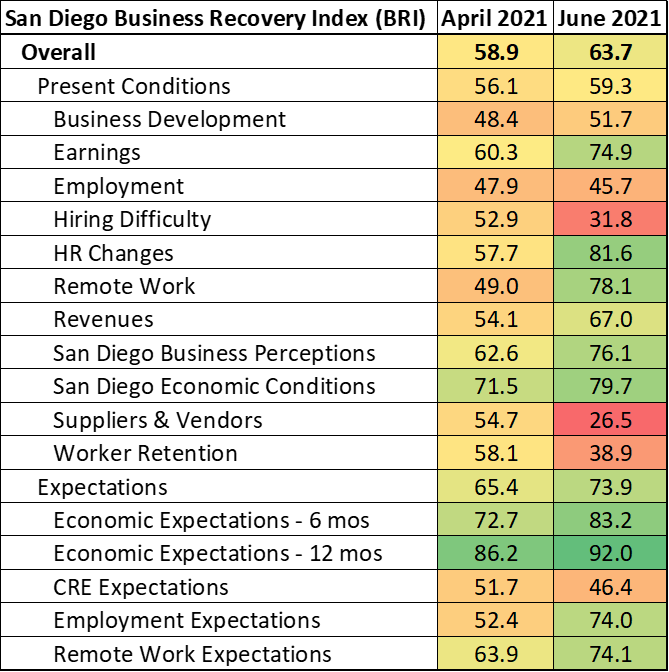
San Diego County firms built on the enthusiasm expressed in April’s survey, with the BRI advancing from 58.9 in April to 63.7 in June. The topline index was pulled higher by more upbeat views of, both, present conditions and expectations for the future. The present conditions index segment rose from 56.1 in April to 59.3 in June while the expectations segment climbed from 65.4 to 73.9 during that time. Business respondents in the region confirmed several trends that have made headlines recently. Companies stated that business conditions have improved significantly over the past two months (due in no small part to California’s reopening in June) while also noting that sourcing talent and suppliers has become significantly more difficult.
A great talent reshuffling
Companies reported that revenues and earnings have improved since April and thus optimism over the next six to 12 months has increased. Expectations are also strong in San Diego’s Innovation cluster. Businesses in this group conveyed that they plan to hire more aggressively in the coming months. This is particularly good news, since each new Innovation job supports another two jobs elsewhere in the regional economy.
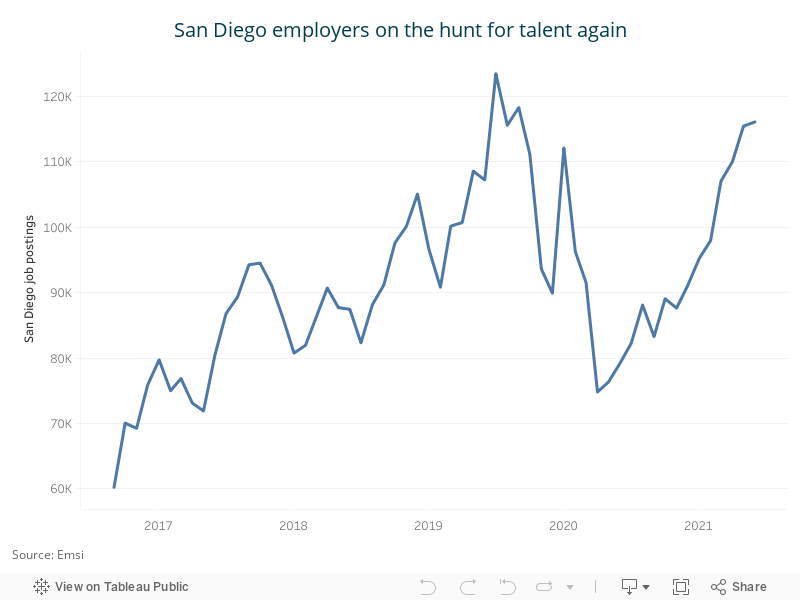
Nonetheless, companies also reported having a tougher time attracting new talent as well as increased difficulty retaining existing workers. There has been much ado about labor shortages and the impact of increased and extended unemployment benefits, but the data show that there is a much more nuanced story. First, there is a large mismatch between the talent in-demand and the talent available to work. As of May (most recently available data at time of writing), there were 104,400 people unemployed in the San Diego region and more than 115,000 job openings. However, the top hiring industries are Administrative and Support Services, Professional Services and Manufacturing industries (nearly 40 percent of unique postings), whereas the bulk of the unemployed come from Leisure and Hospitality.
Second, there are record numbers of workers quitting their jobs. The Bureau of Labor Statistics measures the proportion of workers who voluntarily leave their job relative to total employment. This “quit rate” sat at 2.5 percent in May 2021 after falling from 2.8 percent in April—the highest ever recorded. The Conference Board survey’s labor market differential, another measure of views on whether jobs are plentiful or hard to get, vaulted from 36.9 in May 2021 to 43.5 in June. That is the highest level since 2000.
All this quitting not only reflects confidence in the availability of work, but also the changing needs and desires of workers. The San Diego Association of Governments surveyed both employers and employees earlier this year and found that only 36 percent of employers expect to have one or more employees working from home at least one day per week. Meanwhile 44 percent of employees surveyed expect to work from home an average of 1.2 days per week. This difference in expectations partly reflects differences in opinion of how remote work has impacted productivity—only nine percent of employers reported increased productivity during the pandemic versus 48 percent of employees.
Flexibility will be key to keeping and attracting the best and brightest of workers. Perhaps the companies EDC surveyed understand this better than most, as they indicated both improved efficiencies from, as well as increased planned future utilization of, remote work technologies in June compared to April.
Investing in supply chains locally, binationally
Hiring challenges are also impacting supply chains globally. Companies reported a sharp decrease in the accessibility and reliability of their suppliers and vendors. Here, BRI fell from 54.7 in April to a categorical low of 26.5 in June. This corroborates the headlines regarding shortages in lumber and microchips, which has in turn stalled production of higher end goods and led to spikes in commodity prices and other item such as used cars. A lot of these supply chain disruptions are temporary in nature, directly linked to safety measures and restrictions associated with pandemic (this is why longer-term inflation expectations remain stable).
Ports and businesses across the country have experienced ongoing shortages of labor, containers, truck chassis, and more; shipping vessels have been forced to wait in harbors, in some cases for more than two weeks. This global traffic jam has impacted schedule reliability so profoundly it has forced companies to revisit the ways in which they manage risk. Many companies have moved from a just-in-time strategy to just-in-case. This means firms now keep additional inventory on hand, anything from raw materials to the final product. The lack of supply and rising costs have disproportionately impacted small and mid-market suppliers and buyers. This has resulted in direct capital investment from smaller buyers into smaller suppliers to stabilize supply chains and build necessary redundancies.
The pandemic-induced constraint on the movement of goods has only exacerbated trends from the past few years. Trade wars, changing consumer behavior, and e-commerce were already disrupting global supply chains, all of which has highlighted the strategic importance of supply chain management as well as the region’s bi-national assets. The Cali Baja Binational Mega Region is already vertically integrated in Manufacturing, and a warehousing boom in Otay Mesa is increasing capacity for goods coming via land and sea. Cali Baja is an ideal location for companies that want to move operations closer to home but maintain a binational advantage. Continued investment in trade infrastructure, such as our ports of entry and direct route service, will further cement Cali Baja as a binational innovation hub.
The return to office will be in a lab
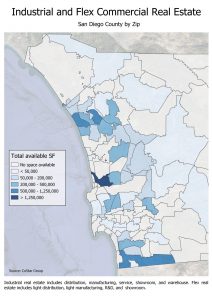
Back in April, companies indicated a modest desire to increase their physical footprint upon returning to the office. However, companies appear to be less sure as the return approaches. In June, companies expressed plans for a net reduction of space, but a deeper dive into the responses reveals that it is demand for office space that is waning. In fact, there is increasing demand for commercial space—life sciences companies in need of laboratory space. This reflects the influx of investment and rapid hiring we are seeing in these industries, as they lead the fight against the global pandemic. Fortunately, there is nearly 10 million square feet of industrial and flex space across San Diego County currently available for lease or purchase that could potentially accommodate this demand. Current hot spots include Sorrento Valley, Vista, and Otay Mesa; Downtown San Diego is also building capacity rapidly.
The headline story is a positive one for San Diego’s economy, but sentiment is far from identical across business sizes and industries. For example, small companies with fewer than 50 workers logged BRI of 53, which is modestly in expansionary territory, while companies with 250 or more employees measured an index value of 63.7. This makes sense, because San Diego’s Leisure and Hospitality businesses tend to be smaller establishments and were the hardest hit during the pandemic. While companies are enthusiastic to get back to full capacity and add workers, it will likely take a few more months for supply chains and the labor market to normalize again. The pandemic is a generational disruption with widespread ramifications, accelerating several trends already underway, including how and where people are willing to work.
Stay tuned for more on San Diego’s changing business landscape. EDC will be back every other month with more trends and insights. For more data and analysis visit: sandiegobusiness.org/research.
Every week, ‘Good News of the Week’ (GNOTW) features a curation of positive headlines from across the San Diego mega-region, delivered straight to your inbox. A blend of aggregated stories from San Diego’s most trusted news sources and original EDC-created content, GNOTW provides a comprehensive recap of the region’s best stories from the past week.
Presented by Meyers Nave, this edition of San Diego’s Data Bites covers June 2021, with data on employment, housing, and more insights about the region’s economy. Key takeaways include an unexpected unemployment rate rise amid gains in Leisure and Hospitality.
As many companies begin to plan for a safe return to traditional offices, it can seem like there are more questions than answers. Attorneys Janice Brown and Sandy McDonough from EDC investor companiesMeyers Nave and Paul Plevin address some of the most common questions about returning to in-person work.
Presented by Meyers Nave, this edition of San Diego’s Data Bites covers June 2021, with data on employment and more insights about the region’s economy at this moment in time. Check out EDC’s Research Bureau for even more data and stats about San Diego.
KEY TAKEAWAYS
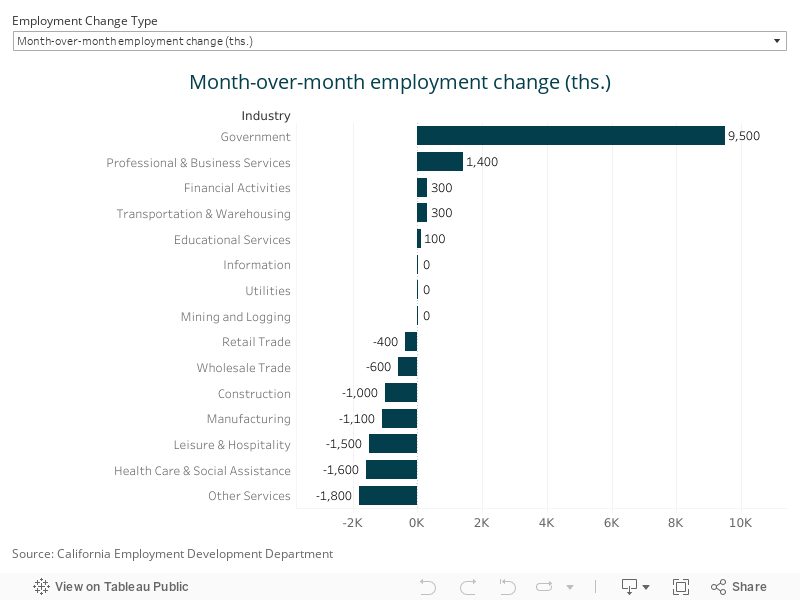
San Diego establishments added a middling 5,700 net new payroll positions in June, although revisions uncovered an additional 1,000 jobs in May. Gains in Leisure and Hospitality, Manufacturing, and Healthcare were largely offset by losses in Government, Professional and Business Services, Education, and Finance.
The unemployment rate unexpectedly jumped to seven percent from May’s 6.3 percent, according to a separate survey of household employment. However, this was driven in large part by 7,600 people either joining or rejoining the labor force last month, a positive sign for future growth.
Data suggest that enhanced unemployment benefits are not preventing workers from finding and taking jobs in San Diego.
First impression
San Diego establishments added a middling 5,700 net new positions in June, following a build of 3,000 (initially reported as +2,000) jobs in May. Leisure and Hospitality continued to lead gains with an additional 4,800 jobs last month, followed by Manufacturing (+2,000) and Healthcare and Social Assistance (+1,500). However, gains in those industries were largely offset by losses in Government (-1,600), Professional and Business Services (-800), Education (-500), and Finance (-500).
More surprisingly, the separate household survey indicated that the unemployment rate jumped from May’s 6.3 percent (initially reported as 6.4 percent) to seven percent in June. However, this was driven in large part by 7,600 people either joining or rejoining the labor force. This could prove to be a big positive for growth in the coming months, particularly since employers have been worried that there aren’t enough workers to fill open positions (more on that below).
The relatively ho-hum jobs report for last month may be a result of timing. The California Employment Development Department (EDD) surveys businesses and households during the week of the 12th of each month. However, California’s economy, including San Diego, didn’t reopen fully until the June 15, so jobs created after reopening may not show up until July’s employment report.
Are unemployment benefits preventing workers from finding jobs?
Nationally, a fiery debate has erupted regarding jobless benefits and the jobs recovery. On one side, many argue that unemployment insurance benefits, particularly enhanced federal unemployment benefits that came online as the pandemic bore down on the economy last year, are essentially “paying people to stay home” and preventing them from returning to work. Others argue that the story is more nuanced, and that other factors like access to childcare and health concerns have prevented many folks from returning.
So, what do the data tell us about San Diego’s job market?
To begin with, nearly 8,000 people entered or reentered the labor force last month, so it doesn’t appear that workers are waiting on the sidelines.
Also, job openings in the San Diego regionare on the rise and, in June, nearly matched their July 2019, pre-pandemic peak. More than 116,000 new jobs were posted last month, up 55 percent from April 2020’s nadir.
It’s important to note that, just like workers, jobs are not identical, so it’s crucial to understand which positions are being advertised and for which industries. Of the 248,000 jobs lost in the region between February and April 2020, 53 percent were in Accommodation and Food Services; Arts, Entertainment, and Recreation; and Retail. Unlike total job postings, which have essentially returned to pre-pandemic norms, postings in these three industries still rest 23 percent below their July 2019 peak. Moreover, postings in these industries only accounted for 13.6 percent of all new job openings from April 2020 to June 2021. This implies that the majority of job postings growth has been within industries that suffered far fewer job losses in the pandemic and therefore have fewer available workers to choose from, which better helps to explain why unemployment has not fallen faster in recent months.
Timing should also be considered. Leading up to the pandemic, it took a median 37 days for Accommodation, Arts, and Entertainment, and Retail companies to fill open positions. By June 2021, that number fell to 33 days (also challenging the claim that workers are engaging less with open jobs because of unemployment insurance payouts), but it still implies that it could take at least one to two months before those filled positions show up in the employment data.
Finally, of the more than 140,000 jobs recovered between April 2020 and June 2021, 85,500—or 61 percent—have come from Accommodations, Arts, and Entertainment, and Retail.
Taken together, the data suggest that workers in San Diego are eager to return to work and reestablish some sense of normalcy after more than a year of being dislocated. All told, worries over enhanced jobless benefits preventing people from taking new jobs appear to be overblown, at least locally.