‘Electrification revolution’ to drive clean energy future, job growth, innovation
Today, Carlsbad-based battery manufacturer American Lithium Energy Corporation (ALE) announces it has secured a total of $13.2 million from the California Energy Commission (CEC) as part of its Realizing Accelerated Manufacturing and Production (RAMP) and Zero-Emissions Transportation Manufacturing programs. ALE will use the funding to expand its U.S.-based manufacturing production capabilities in Carlsbad, significantly grow its team in California, and increase use of U.S. and California-based raw materials and equipment supplies, in order to further its mission of developing sustainable energy solutions that promote the widespread adoption of zero-emissions transportation.
Founded in 2006 by Dr. John Fan, ALE’s technology first serviced the U.S. Army and has been actively engaged and shipping products to the Department of Defense, Department of Energy, and several U.S. defense primes for more than 10 years. Now, with 40 patents and the most advanced lithium-ion battery in the world, the company offers battery applications for defense, aerospace, medical devices, electric vehicles, and much more.
A 2035 state mandate for electric vehicles and other ambitious goals has spurred significant investments in battery innovation. The recent $46 million CEC award to ALE and three other zero emission transportation manufacturing companies marked the single largest state award in history—designed to support the growth of lithium battery production, develop sustainable energy solutions, and promote the widespread adoption of zero-emissions transportation.
“We are thrilled to receive this significant funding from the California Energy Commission,” said Dr. John Fan, CEO, American Lithium Energy Corporation. “This funding will allow us to expand our outreach efforts, increase our production capabilities, and continue to drive innovation in the lithium battery industry. Our goal is to become a leader in sustainable energy solutions and expand our outreach efforts, increase our production capabilities, and continue to drive innovation in the lithium battery industry, and this funding will help us achieve that goal.”
As we become increasingly reliant on battery technology and governments make bold commitments to clean energy, the availability of lithium—a key component in batteries—will play a major role in nearly every aspect of our economy. California, and more specifically the Southern Border region of San Diego and Imperial Counties, is uniquely positioned to lead in the ‘electrification revolution’. Home to the largest rare earth mineral extraction site outside of China, ‘Lithium Valley’ in neighboring Imperial Valley’s Salton Sea presents significant opportunity to catalyze the U.S.’ future energy independence. In fact, the Salton Sea could provide 600,000 tons per year of lithium carbonate, currently priced at $12,000 per ton, which exceeds the total global lithium carbonate demand.
“As oil shaped the last century, lithium will help shape the next. And as leaders in technology, science, and manufacturing, our bi-national mega-region is uniquely positioned to lead in the clean energy future. To support more innovation, jobs, and companies like ALE, we will need the talent, infrastructure, and backing of our policymakers to do this right,” said Mark Cafferty, president and CEO, San Diego Regional EDC.
This funding is considered a component of ALE’s Series A fundraising. ALE is also actively engaging in discussions with investors that invest both equity and debt into energy storage solutions in order to accelerate its mission.
Other CEC program awardees include ChargePoint, Zimeno, and Wiggins Lift.
WORLD TRADE CENTER SAN DIEGO CONVENES REGIONAL LEADERS TO HELP SAN DIEGO BUSINESSES EXPAND GLOBALLY, CREATE LOCAL JOBS
In order to foster vital global economic partnerships, San Diego Mayor Todd Gloria and World Trade Center San Diego (WTCSD), an affiliate of San Diego Regional Economic Development Corporation (EDC), are leading a delegation to the Netherlands. During the September 26—29 trade mission, business and civic leaders will promote San Diego’s key industries, establish and strengthen business relationships, and explore best practices in urban mobility, climate action and sustainability, and technology and science innovation.
Against the backdrop of severe supply chain disruptions, shifting geopolitics governing the development of critical strategic technologies, and accelerating climate action and affordability mandates, San Diego leaders have made economic resilience by way of global competitiveness a top priority.
“San Diego is an undeniable force in the global marketplace, and we must seize opportunities to tell our story and maximize investment from partners around the world,” said San Diego Mayor Todd Gloria. “As we work to address our region’s biggest challenges—affordability, urban mobility, climate change, and more—I’m proud to join World Trade Center San Diego in the Netherlands to learn from like thriving, global cities.”
Home to Europe’s largest port and fourth busiest cargo airport, the Netherlands is a hub for global trade and business. With shared expertise in knowledge-intensive industries, including personalized medicine, wireless communications technology, and artificial intelligence, and a societal commitment to sustainability, climate action, and social innovation, the Netherlands is among the top 10 countries for foreign direct investment into San Diego (#6 in 2015—2020). Netherlands-based companies directly employ 5,000 San Diegans, predominately in the innovation economy at companies like ASML and Philips. By deal count, the Netherlands is the #9 country investing venture capital into San Diego, in line with Denmark and falling closely behind Japan, France and India (2015—2020). Further, Dutch firms invested nearly $318 million into San Diego’s economy in 2021 alone.
“On the heels of a pandemic that changed the world, WTCSD is grateful to be taking San Diego global once again,” said Nikia Clarke, executive director of World Trade Center San Diego and senior vice president at San Diego Regional EDC. “As the economy continues to transform around us, it is increasingly important for metro leaders to advance a compelling vision that keeps us ahead of the curve, and no one can tell the San Diego story better than Mayor Gloria and this cross-sector delegation.”
Over the three-day trade mission in cities Amsterdam, The Hague, Rotterdam, Eindhoven, and Leiden, San Diego will look to bolster public-private partnerships and business expansion through various sessions with Dutch companies and institutions.
Agenda items include:
The grand opening/ribbon cutting of Qualcomm’s AI Research Lab, which has formalized a partnership with the University of Amsterdam to support a pipeline of engineering talent. Read more →
Amid massive pressure for expansion, a meeting and tour of ASML—the global leader in semiconductor manufacturing machines (lithography)—at its Veldhoven headquarters to celebrate the 10th anniversary of its investment in its San Diego-based Cymer site. Read more →
Local, minority-owned small businesses Trabus Technologies and Nano PharmaSolutions will pitch to the Port of Rotterdam and Leiden University Medical Center respectively. Read more →
Mayor-to-Mayor meetings with Todd Gloria and the Mayors of Amsterdam and Rotterdam to strengthen relationships between our regions
Formal meetings and tours of several companies considering investment into San Diego and California as led by San Diego Mayor Todd Gloria
Delegates will participate in upwards of 15 meetings over the course of the trade mission, sharing best practices and driving business connectivity across many verticals. The two dozen San Diego delegates include representatives from Qualcomm, ASML, Mitsubishi Electric, Trabus Technologies, Alexandria Real Estate Equities, Inc., Gafcon, Arup, HomeFed Corporation, Townshend Venture Advisors and more. Also in attendance are delegates from key San Diego agencies, universities and civic organizations such as Port of San Diego, UC San Diego, San Diego State University, San Diego Association of Governments, San Diego County Regional Airport Authority and others.
The trade mission is organized by World Trade Center San Diego, an affiliate of the San Diego Regional EDC, with assistance and support provided by the U.S. Embassy in The Hague, the Consulate of the Netherlands, and sponsorship by ASML, Lufthansa and Qualcomm.
“With shared commitments to sustainability and innovation, more than 76,000 jobs in California are supported by U.S.-Netherlands trade. This trip is one example of how we can work together across borders to remain competitive in a global economy,” said Consul General Dirk Janssen, Consulate of the Netherlands in San Francisco.
Follow along with us next week during the trade mission: #SDinNL
As of May 2022, there were 75,630 unique jobs posted in San Diego County, but only 42,100 unemployed San Diegans. Couple this talent shortage with unrealistic demands around compensation, benefits, and remote work, it’s fair to say we are living the most competitive battle for talent yet.
To meet employer demand, our region needs to double the number of post-secondary degree, certificate, or program completions per year. In particular, investing in Black and Hispanic youth would turn San Diego’s talent shortage into a surplus. More on Inclusive Growth here.
As part of our ongoing talent development efforts, EDC has compiled an ongoing hub of programs and initiatives below to help you fill your high-demand San Diego roles. Sign up for the talent newsletter for ongoing opportunities to participate in the development of our talent pipeline.
HIRE TALENT
Build relationships with Advancing San Diego’s Preferred Providers of talent at Preferred Provider Meet and Greet: IT & Cybersecurity, hosted by EDC, San Diego Workforce Partnership, and CCOE. Join us Wednesday November 9, 4:00 – 6:00 pm, at UC Park and Market. → Register here.
Connect with entry-level cybersecurity or IT talent at EDC and Tech San Diego’s Tech Career Night: Industry Interactive. Join us Tuesday November 15, 4:00 – 6:00 pm, at San Diego State University. →Reach out to Andrea Crisantes at acs@sandiegobusiness.org
Promote your open mid-level roles in San Diego: Life. Changing.‘s monthly job newsletter, The Lead, sent to over 3K STEM and business talent in San Diego and other competitor metros. → Submit your role to communications@sandiegobusiness.org for consideration.
Connect with entry-level software, engineering, business, and other San Diego talent: Use Advancing San Diego’s Preferred Provider map to identify industry-recognized training programs. → Sign up for email updates to learn about upcoming opportunities to connect.
Connect with San Diego Workforce Partnership (SDWP) to learn about worker training services. As workflows shift and skill requirements change, SDWP helps employers retain their existing workforce to meet their evolving needs. → Learn about SDWP’s layoff aversion help and no-cost worker training.
Connect with San Diego’s K-12 population early to communicate the breadth of career opportunities and build a more inclusive economy. Engage students at the K-12 level via:
San Diego Regional EDC study quantifies the impact of AI in region’s Transportation cluster
Today, alongside Booz Allen Hamilton, San Diego Regional EDC released the third study in a series on the proliferation of Artificial Intelligence (AI) and Machine Learning (ML) within San Diego County’s key economic clusters. “Mobilizing the Future: AI and San Diego’s Transportation Cluster” quantifies the economic impact of the region’s Transportation cluster and explores how AI and ML technologies have helped position San Diego as a global trade hub.
While people begin to get more comfortable with the notion of autonomous-driving cars, San Diego is deploying AI and ML in Transportation even beyond consumer use. One in three Transportation and related Manufacturing companies in San Diego are either developing or adopting AI and ML technologies, thus achieving levels of precision and accuracy otherwise unattainable by humans. This is measurably higher than the average engagement rate of 25 percent across all industries.
Local startups like Airspace and Boxton are enabling the shipment of goods in the quickest, most cost effective way; large firms Lytx® and TuSimple are improving safety in transportation; established brands Cubic and SANDAG are streamlining travel and commutes for individuals; and defense contractors BAE Systems and General Dynamics NASSCO are mobilizing troops and supplies to drive mission success and safety.
Underwritten by Booz Allen Hamilton, the web-based study—transportation.sandiegoAI.org—includes video case studies on local Transportation companies, details on the $11 billion economic impact of the Transportation cluster including interactive data visuals, and demonstrates overall how the region’s rapid adoption of AI in Transportation has helped propel San Diego into the global magnet it is today.
“San Diego is home to some of the most innovative and influential Transportation technology companies in the world. The rapid development and adoption of AI in Transportation has uniquely positioned the region as a leader in solving global challenges such as climate change and supply chain disruptions brought about by the pandemic,” said Eduardo Velasquez, Research Director at San Diego Regional EDC.
KEY FINDINGS
San Diego’s Transportation cluster is big and growing. The cluster supports more than 90,000 local jobs and contributes $11 billion to the regional economy each year. Despite the pandemic, employment in the cluster has increased 10 percent during the last five years.
AI and ML in transportation is much more than just autonomous vehicles. Local developers are creating AI- and ML-based solutions to optimize shipping routes, automate and secure mass-transit fare collection systems, improve safety on roadways, and achieve extreme precision in the manufacturing of ships and aircraft.
The Transportation cluster drives global connectivity and competitiveness. These innovations bring enormous economic benefit to the region, including advanced manufacturing jobs, while propelling San Diego’s role in the global marketplace.
“It is important to remember that transportation in San Diego includes not only our personal vehicles, but also a globally connected market supported by an international border crossing, a shipping port, and an international airport,” said Joe Rohner, Director of Artificial Intelligence at Booz Allen Hamilton and leader of the firm’s West Coast AI business. “The study series continues to illustrate how the implementation of AI and ML technologies across diverse industries is perpetuating San Diego’s leadership in tackling global challenges. Booz Allen is ready to engage with our region’s leaders and industry partners to support this work.” Booz Allen employs approximately 1,400 professionals in San Diego, working on cybersecurity, analytics, engineering, and IT modernization.
Transportation is a key and rapidly growing piece of the San Diego regional economy. While employment in all other sectors contracted 2.3 percent since 2016, Transportation employment saw 10 percent growth even amid the coronavirus pandemic. This includes Transportation Manufacturing, Logistics and Freight, Passenger Transportation including Mass Transit, and Other Transportation Services. Importantly, each Transportation job creates another job in other local industries; this means 4,000 more jobs have been created elsewhere in the economy due to Transportation’s 10 percent growth over the last five years.
“At Lytx, we combine video telematics with machine vision (MV), AI, and driving data to help solve the transportation industry’s most critical problems, like distracted driving. We pioneered the use of MV + AI in fleet management solutions, and we firmly believe in this powerful technology’s ability to empower drivers, protect fleets, and create safer roadways—in San Diego and around the world,” said Rajesh Rudraradhya, Chief Technology Officer at Lytx. “The latest report in the series by EDC reinforces the importance of implementing advanced technologies such as AI and the increasing need for companies like ours to continue to innovate and improve outcomes in this space; doing so fuels regional growth while also increasing driver safety.”
With this growth, and a unique convergence of public and private entities, among other factors, San Diego’s Transportation cluster is leading in the global fight against climate change and supply chain disruption.
San Diego is home to a vibrant manufacturing cluster that spans many industries, including defense, shipbuilding, medical devices, cleantech, craft brewing, and sports and active lifestyle. And thanks to a highly-skilled workforce, robust training programs, and close proximity to Mexico, the San Diego region boasts nearly 3,150 manufacturing companies currently supporting more than 108,000 jobs. More on the industry here.
It’s easy to support San Diego manufacturing and set trends, with companies like Nixon, Pura Vida, and Knockaround designing fashion-forward accessories.
It’s hard not to spend time outdoors when you live in year-round sunshine. Luckily, San Diego companies have you covered, whether you need to capture your adventures on camera or protect your skin for a day in the sun.
With San Diego’s proximity to beautiful beaches, mountains, and parks, our companies know how important it is to care for our planet through thoughtful sustainable products.
San Diego knows how to deliver on taste, whether you’re in the mood for craft beer or something sweet. Though North County leads the way with its many breweries and Bitchin’ Sauce, there are plenty of treats to go around no matter where you are in the region.
From research to medical device manufacturing, San Diego is a thriving hub for biotech in all its forms. Device companies like BD and Illumina are leading the way when it comes to both preventative health and effective care.
Does your San Diego manufacturing company need help finding resources, or just want to know more about San Diego’s thriving manufacturing scene? Click here to learn more, and get in touch with EDC for custom help.
Welcome to the second edition in EDC’s Changing Business Landscape Series, which will be published bi-monthly in the San Diego Business Journal and here on our blog. If you missed the first edition, read it here.
Surveying the changing business landscape in San Diego
The COVID-19 pandemic has impacted every facet of life, including how businesses operate. Companies in every industry are rapidly re-evaluating how they do business, changing the way they interact with customers, manage supply chains and where their employees are physically located. This has massive immediate and long-term implications for San Diego’s workforce and job composition, as well as regional land use decisions and infrastructure investment.
To identify evolving trends in local business needs and operations, ensuring their ability to grow and thrive in the region, EDC is surveying more than 200 companies in the region’s key industries on a rolling basis throughout 2021 to monitor and report shifts in their priorities and strategies. In addition, EDC constructed the San Diego Business Recovery Index (BRI)—a sentiment index to measure companies’ perceptions of current conditions, as well as expectations for the future across several factors such as business development, employment and commercial real estate needs. Review the BRI concept and methodology here.
These insights will help inform long-term economic development priorities around talent recruitment and retention, quality job creation and infrastructure development. Companies are surveyed on several topics, with varying emphases in each wave.
Here are three key findings from the second wave of surveying conducted in April 2021:
The worst of the pandemic is behind us. Companies are very bullish about the next six to 12 months and, as a result, plan to accelerate hiring.
San Diego’s innovation cluster is (mostly) booming. Life Sciences companies lead the way while Cyber and Aerospace firms are still working through pandemic-related challenges.
Companies are seriously reevaluating their space needs. Smaller firms are looking to expand their footprint, while traditional Tech companies may be scaling down.
The worst is behind us
San Diego companies indicated that they think the worst of the pandemic has passed. With a BRI of 58.9 in April, regional firms noted that they plan to hire or rehire workers at a slightly faster pace than they have up to this point, while also expanding remote work capabilities going forward.
Last month’s index reading reflects bullish assessments of, both, present conditions (the present conditions subindex registered a value of 56.1) and expectations for the future (subindex of 65.4). Companies noted some lingering effects from a full year in lockdown, including difficulties with business development and job losses, and neutral to slightly negative feelings on remote work over the past year. Nonetheless, firms reported bright views on the current state of the regional economy and noted that San Diego businesses and key industries have adapted to the pandemic better that those in peer regions.
Regional companies were even more upbeat when it came to expectations for the future. All of the index’s expectations subindex values were north of 50, and companies overwhelmingly believe that the regional economy will have improved significantly in the next six months (subindex of 72.7) and even more so within the next 12 months (subindex of 86.2). This is important because many companies make decisions today based on their assessments of business conditions in the near future.
Most companies shared in the optimism, but to varying degrees. Small companies with fewer than 50 employees that were hardest hit during the pandemic held slightly dimmer, though still generally positive, views than their larger counterparts. In particular, smaller firms cited ongoing difficulties accessing new customers, managing suppliers and vendors, and hiring and retaining workers. Even so, assessments of current earnings trends were only slightly negative, and small firms held a sunny disposition when it comes to the current state of the San Diego economy and business climate.
Interestingly, however, companies with fewer than 50 workers had the highest level of optimism for the future across business size cohorts, which could signal an inflection point for the pace of hiring in the coming months. This bodes especially well for the jobs recovery heading into the second half of 2021, as 96 percent of San Diego’s businesses have fewer than 50 employees and small businesses have historically accounted for roughly half of all job growth.
San Diego’s innovation cluster is (mostly) booming
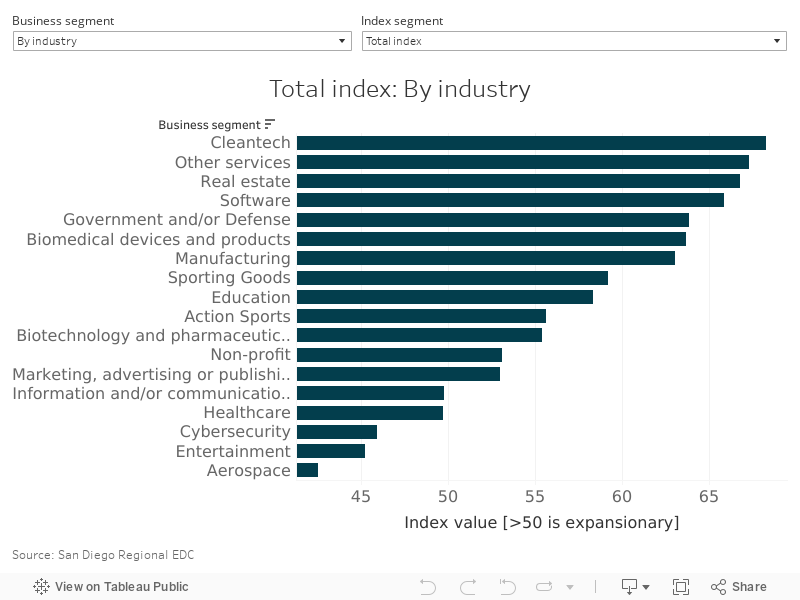
San Diego’s innovation cluster overwhelming expressed optimism entering 2021, as companies shifted toward meeting the demand for life-saving technologies, treatments and personal protective equipment leading to record venture capital investment and renewed job growth. However, a closer look reveals mixed results within the cluster. Industries like Cleantech, Software and Biomedical Device producers all held especially confident views (BRIs in the mid-60s), while Telecommunications, Cybersecurity and Aerospace each signaled ongoing challenges from the pandemic (BRIs ranging from 43 to 50).
Biotech and Biomedical Device manufactures hold strong expectations for the regional economy, with plans to increase their headcount and real estate footprint during the next year. In addition, they expect to increase their use of remote work over the same time frame. While this may seem contradictory, it reflects the modifications and enhancements that many companies are making to protect workers on the production floor, as well as those necessary to attract workers back into the office. Workers want to feel safe once back on company property and they also want to maintain the flexibility that working remotely has provided. To accommodate these needs, employers are preparing for a flexible or hybrid workplace once reopen. In addition, many companies are reconfiguring and even seeking new space to keep workers spread out, adapting space to be more comfortable in a post-pandemic environment. This includes ‘hoteling’ and ‘neighborhooding’ models to help reduce the flow of people and simultaneously allow teams to collaborate in person. Companies are preparing for a gradual return to the office to give workers adequate time to warm up to pre-pandemic routines. More on that below.
While Telecommunications and Cybersecurity firms all share this optimistic regional economic outlook with their Life Sciences peers, these industries are much more subdued about their own expansion plans for the next year. On net, they see their needs for space as unchanged, with some modest reductions in hiring compared to typical years. This reflects the challenges these industries have faced during the pandemic, namely with respect to increased difficulty with sales, hiring and, somewhat surprisingly, inefficiencies from remote work. Aerospace has not yet recovered from the initial impacts of the pandemic, still reeling from significant hits to both sales and employment, as well as disruptions in their supply chains from lockdowns and restricted international travel and transportation.
Smaller firms are looking to add space
After more than a year of implementing remote work and reduced onsite staffing, companies are beginning to plan for a return to the office. However, how much space awaits those returning to the office will vary by industry as well as firm size.
It is small- and medium-sized firms that are looking to expand their commercial real estate footprint over the next year rather than larger firms. In fact, the proportion of firms surveyed that expect to increase space by 10 percent or more of their current square footage is nearly double that of those planning to reduce their current space by 10 percent or more (16 percent to 8.4 percent, respectively). However, when you factor in the size of each company, those planning significant real estate growth represent only three percent of the jobs compared to 13 percent of jobs for those looking to reduce space significantly (companies surveyed collectively employ nearly 200,000 workers).
When we look at the innovation companies, we see some stark differences between traditional Technology and Biotechnology industries. Eight percent of respondents representing 22 percent of jobs plan to reduce their space by more than 10 percent—mostly in the Telecommunications industry. However, nearly 26 percent of respondents representing 41 percent jobs expect to add modest amounts of space less than 10 percent of their current footprint. Here many respondents are in the Biomedical Device and Biotech industries and likely in need of additional production or lab space.
Understanding these evolving and distinct trends is important because San Diego’s innovation cluster is leading the region out of this pandemic-driven economic downturn, just as it has in each past downturn. Each job added in the innovation cluster supports another two jobs elsewhere in the economy. Yet, these innovation companies do not necessarily need to be physically located in San Diego in order to operate. Making sure these companies have the infrastructure and access to talent that they need to flourish is critical to our region’s prosperity.
Stay tuned for more on San Diego’s changing business landscape. EDC will be back every other month with more trends and insights. For more data and analysis visit: sandiegobusiness.org/research.
San Diego Regional EDC is excited to kick-off our Changing Business Landscape Series, which will be published bi-monthly in the San Diego Business Journal and on our blog.
Surveying the changing business landscape in San Diego
The COVID-19 pandemic has impacted every facet of life, including how businesses operate. The San Diego region began the year with near-record high unemployment and widespread small business closures. Meanwhile, large companies across the globe have extended remote work well into 2021 and are even abandoning their corporate campuses. Companies in every industry are rapidly re-evaluating how they do business and changing the way they interact with customers, manage supply chains, and where their employees are physically located. This has massive immediate and long-term implications for San Diego’s workforce and job composition, as well as regional land use decisions and infrastructure investment.
To identify evolving trends in local business needs and operations, ensuring their ability to grow and thrive in the region, EDC began surveying more than 200 employers in the region’s key industries in January. Given the uncertainty of this moment in history, EDC will continue to survey these companies on a rolling basis throughout 2021 to monitor and report out shifts in their priorities and strategies. These insights will help inform long-term economic development priorities around talent recruitment and retention, quality job creation, and infrastructure development. Businesses are surveyed on several topics, with varying emphases in each wave.
Here are three key findings:
Everything is different, yet the future is bright. The pandemic has fundamentally altered how businesses operate across key industries. However, most companies are optimistic about their ability to pivot and emerge even stronger.
Remote working is no longer a perk or competitive advantage—it’s the standard. Most companies view remote working as here to stay. This is viewed as both a benefit and as a threat to employee retention.
Long commutes have been replaced by a blurring of work-life boundaries. Companies are struggling in maintaining employee morale and engagement. While many are seeing signs of employee burnout and isolation, few report significant concerns with retention.
San Diego’s innovation cluster rises to meet the challenge
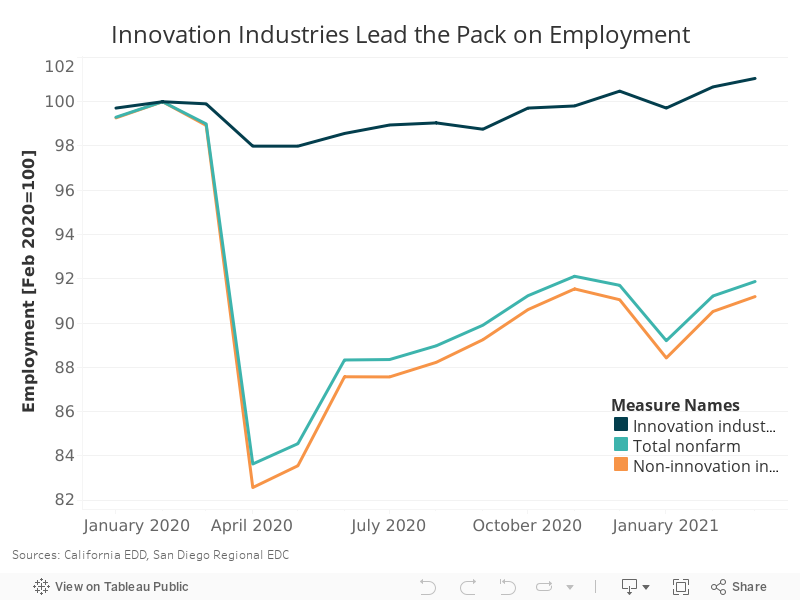
One year into a global pandemic, San Diego’s most innovative companies and industries are well on their way to economic recovery. In fact, high-wage jobs—many of which are concentrated in aerospace, life science, and technology industries—have more than recovered from the pandemic-driven recession. This is welcome news as these are key drivers of economic growth in the region. In fact, every “innovation” job supports another two jobs elsewhere in the economy.
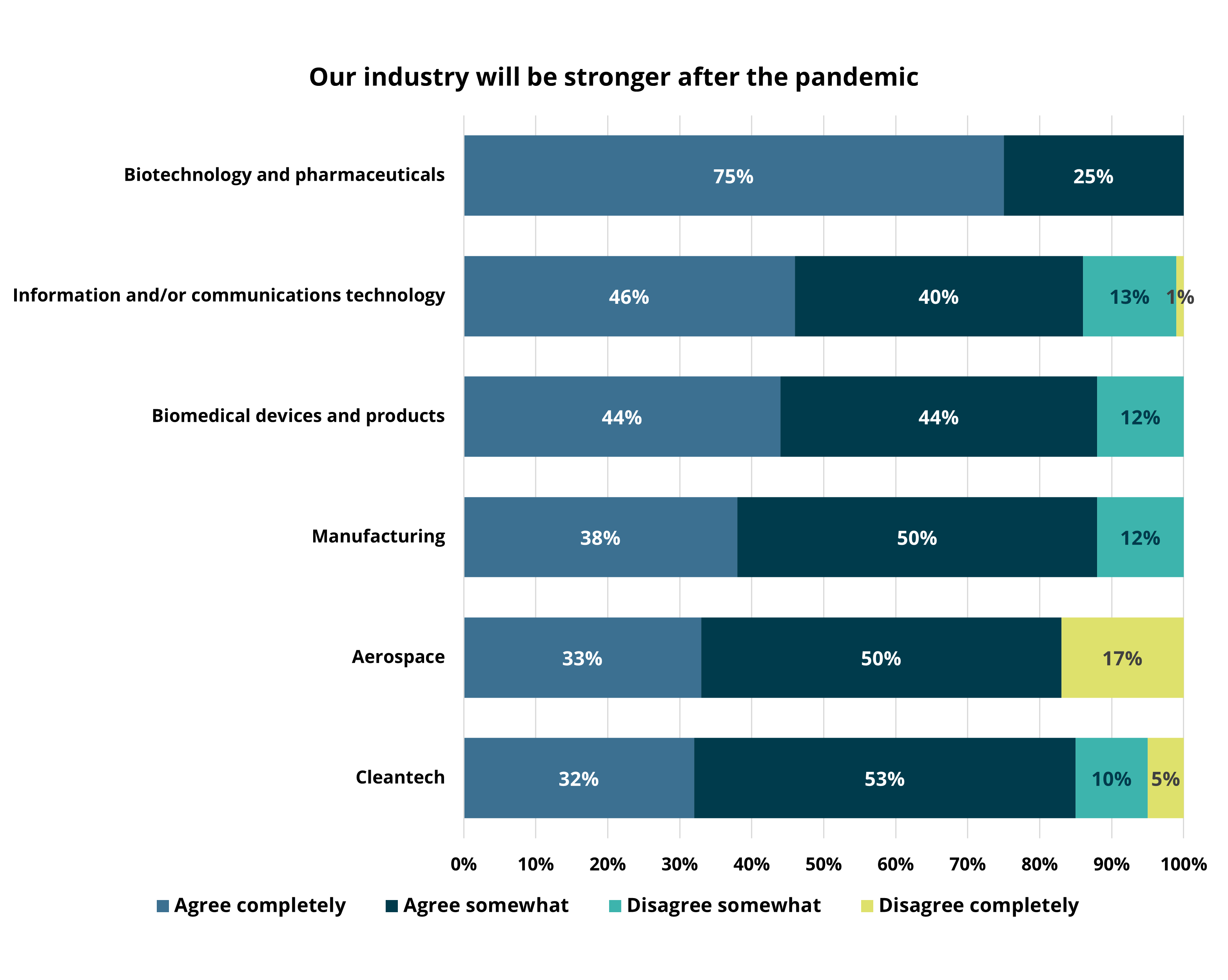
Even though growth has returned to the innovation cluster, the pandemic has disrupted the way these companies operate. The overwhelming majority (83 percent) of companies surveyed agree that the pandemic has fundamentally altered their industry. Yet, nearly as many (81 percent) feel that their industry has been able to adjust and remain healthy. Even more encouraging, 87 percent believe their industry will emerge even stronger once the pandemic has ended after adopting new ideas and implementing new strategies. However, those in the aerospace industry express somewhat lower levels of optimism, as the industry faces continued uncertainty around travel safety and demand.
Confidence is somewhat lower among smaller firms. Only 77 percent of those with fewer than 50 employees agree that their industry would emerge stronger and 10 percent strongly disagree. This likely reflects the disproportionate impact that the pandemic has had on small businesses, regardless of industry. While those in leisure and hospitality have certainly been the hardest hit, even small firms in professional and business services, including scientific and technical services, are currently experiencing lower revenues compared to before the pandemic.
Yet, the strongest signal for optimism comes from the direct response in combatting the novel coronavirus. San Diego companies have been among those leading the fight in everything from personal protective equipment and diagnostics to therapeutics and vaccine development. The life-changing and life-saving companies have pivoted and innovated yet again, drawing in record levels of venture capital investment. In the fourth quarter of 2020 alone, the region received nearly $2.7 billion in venture funding—with almost three-quarters going to life sciences and healthcare companies—which is more than three previous quarters combined, and $2 billion more than Q4 2019. The surge in investment and jobs recovery has the majority of innovation companies confident in the region’s ability to grow in prominence, or remain steadfast as a global leader in tech and life sciences.
The war for talent has no bounds
Talent has always been San Diego’s competitive advantage. People come from all over the world to get educated and build meaningful careers in everything from software engineering and autonomous vehicles to genomics sequencing and cybersecurity. San Diego’s innovation industries are among the highest-paying and fastest-growing in the region. Despite a global pandemic, many of these industries are accelerating hiring. The information sector, including telecommunications and information technology services, posted 20 percent more unique job ads in December 2020 than the year prior.
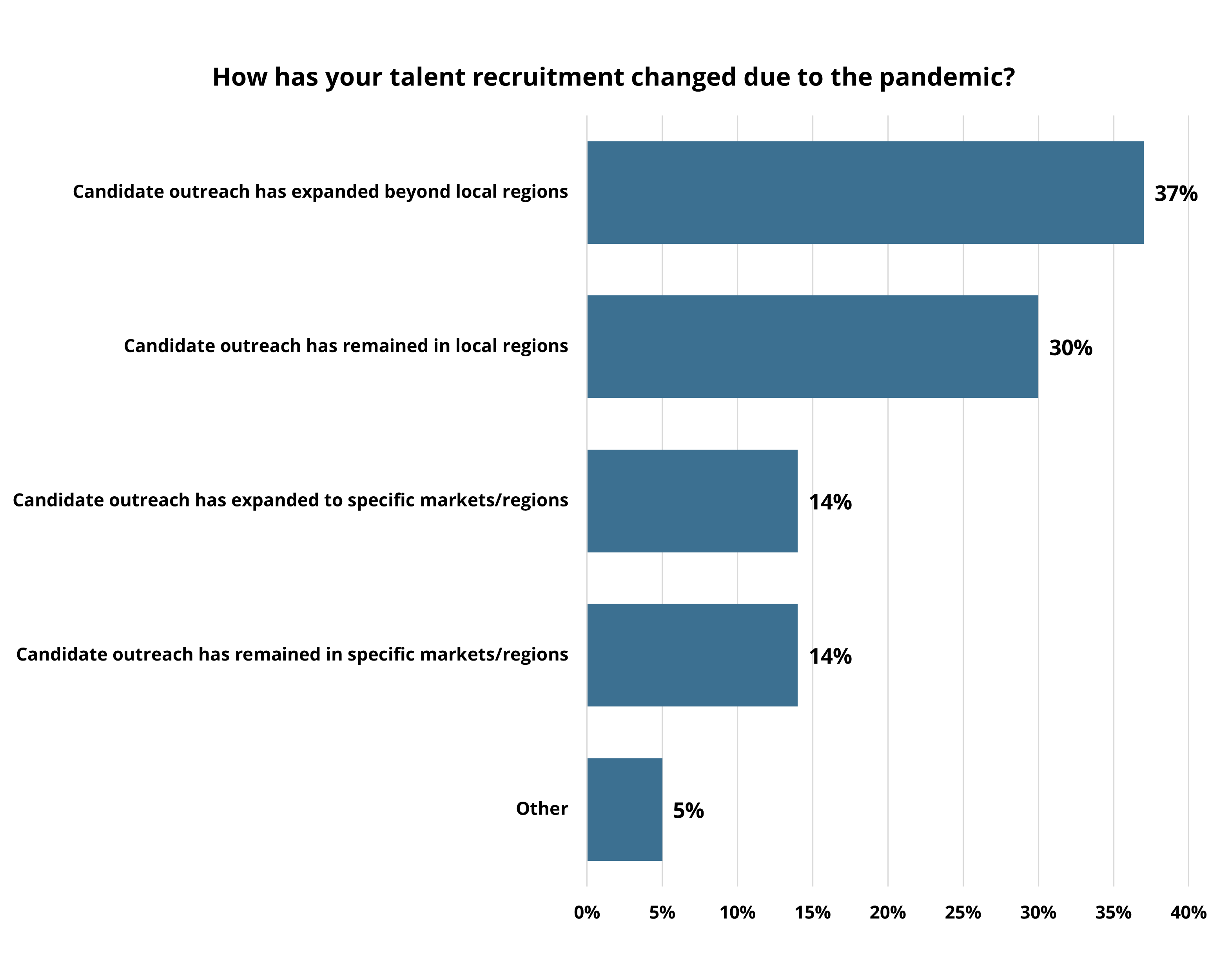
However, top talent remains hard to find. And while many of the jobs in these industries have shifted to either partially or fully remote, there are mixed feelings about whether it is a benefit or a detriment to talent recruitment and retention. Perceptions are tied to a company’s approach to attracting remote talent (see below). On one hand, a majority of respondents think that their ability to hire and retain skilled talent will not be impacted by the pandemic because of remote work capabilities. Many have expanded their recruitment beyond San Diego’s borders and are willing to accommodate working from outside the region to retain the very best talent. These San Diego-based companies that view the world as their pool for talent are embracing a global workforce that can get the job done from anywhere.
Yet, there is also a large minority of companies that view the pandemic as impacting the way they hire and retain talent. Again, the shift to remote work is cited as the top reason, with an even larger proportion (35 percent) identifying it as the cause for their pessimism. In fact, 45 percent of survey respondents rate hiring new employees during the pandemic as either “difficult” or “more difficult” than before, compared to 18 percent who view it as “easier” or “much easier.” Furthermore, nearly half of respondents cite talent recruitment as an area needing assistance and 20 percent identify it as an “urgent need.”
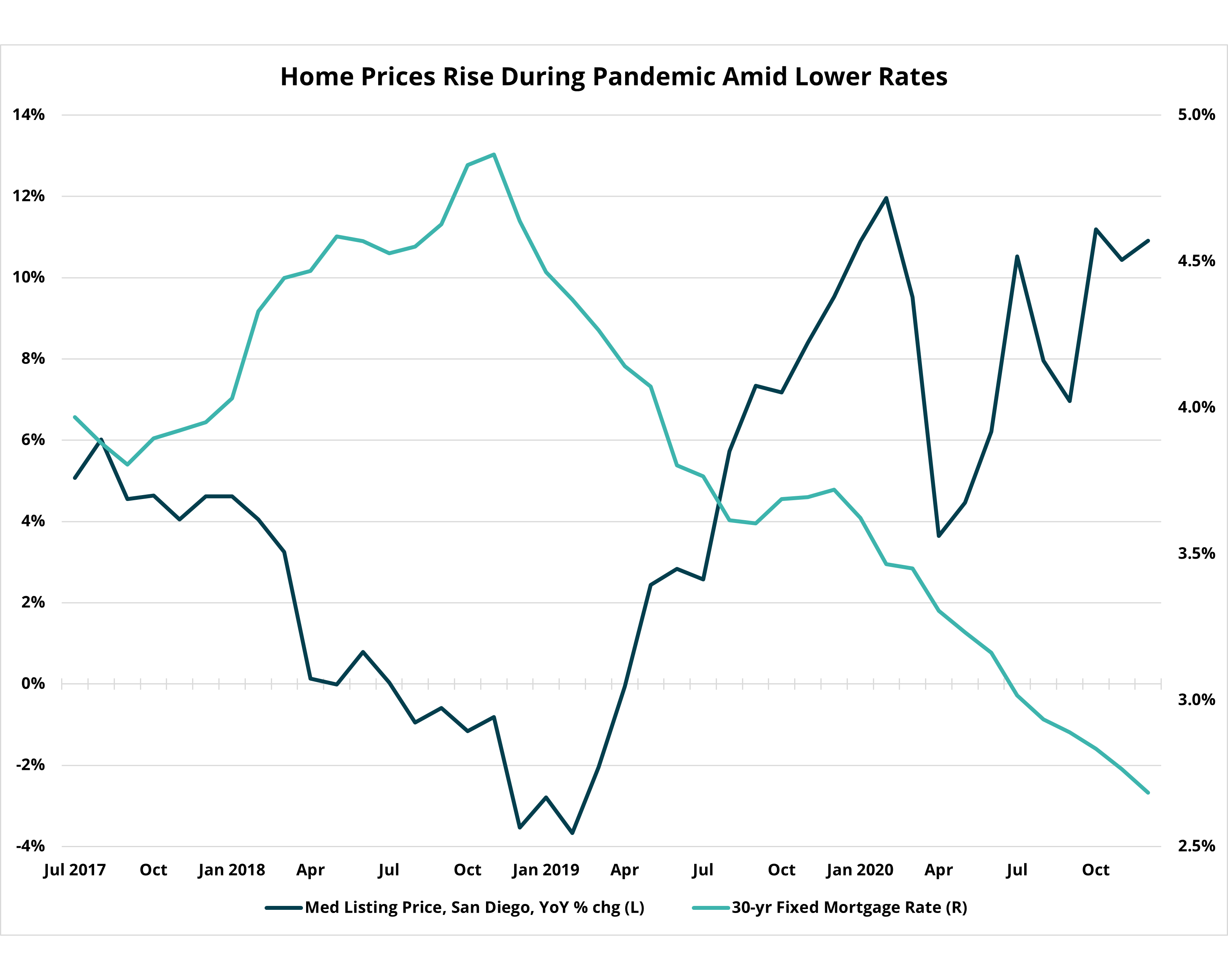
The pandemic has leveled the playing field for markets aiming to attract the best and brightest knowledge. San Diego’s competition with companies and regions across the country has increased. The region’s high cost of living is by far the biggest impediment to talent attraction, with 44 percent of respondents identifying high home prices as the most negative attribute of the San Diego market. This is due in large part to housing production not keeping pace with employment growth. As a result, San Diego has the second highest median home price among the 25 largest metros in the U.S., behind only San Francisco, and home prices jumped another 11 percent in 2020. Ensuring San Diego is an attractive and affordable place for talent and business is critical to maintaining its regional competitiveness.
Responding to workers’ needs is top of mind for companies
Transitioning to a remote work environment has been challenging. Business leaders are acutely aware of the need to balance conducting business as usual and responding to the changing needs of a newly remote workforce. Survey respondents report signs of ‘zoom fatigue,’ blurred work-life boundaries, and isolation among employees. While it has not yet significantly impacted retention, a full 60 percent of respondents rated “maintaining employee morale” as more challenging during the pandemic.
Furthermore, respondents expressed concerns about returning to an in-person work environment, recognizing that not all employees will want to return to the office immediately or full-time. This next phase of work will bring about a new set of challenges and a need for new policies, systems, and support for San Diego workers. Many questions remain around how much space will be needed and how it might need to be reconfigured to accommodate a flexible work environment that is also responsive to new health and safety requirements.
Survey respondents rated individualistic factors related to professional growth and work-life balance as the most important attributes to a competitive market for talent attraction and retention. This differs greatly from perceptions from just four years ago, when top universities and an entrepreneurial spirit were more top of mind. The desire to adapt and respond to the most pressing needs of its workforce, reinforces the notion that San Diego businesses value talent above all else.
Stay tuned for more on San Diego’s changing business landscape. EDC will be back every other month with more trends and insights. For more data and analysis visit: sandiegobusiness.org/research.
World Trade Center San Diego (WTCSD) works to connect San Diego to global resources. Before a company sets up a location in San Diego, it needs customers. That’s where WTCSD comes in.
Recognizing San Diego’s role as a cleantech’s hub and the region’s forward-thinking adoption of green policies, in January, a Japanese-maker of alternative paper and plastic products reached out to World Trade Center San Diego. Not only was the firm interested in potential customers that might need its product, but they were also looking to cultivate relationships with local manufacturers.
Through WTCSD’s MetroConnect participants and other regional partners, WTCSD was able to compile a list of potential leads and provided curated introductions to hoteliers and retailers in San Diego with a track record of progressive climate action. On the manufacturing end, EDC also was able to connect the company with contract manufacturers in the San Diego region, which lays the foundation for the Japanese-based company to make a future investment in San Diego.